
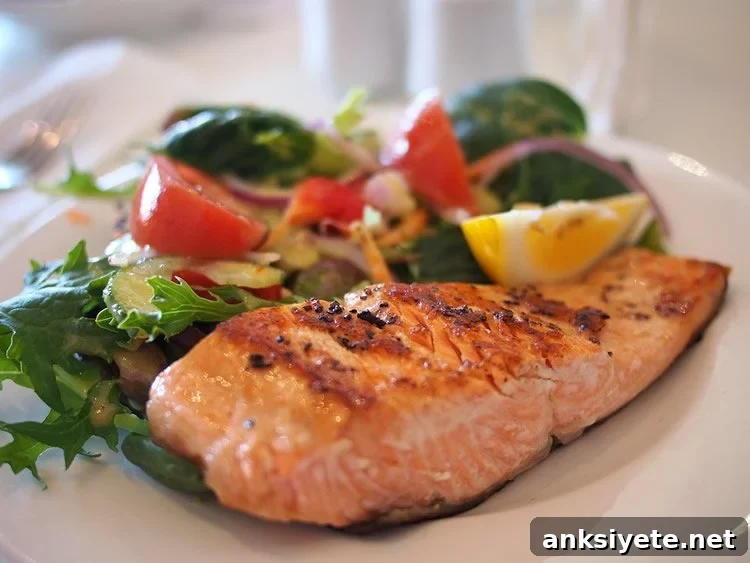
Summary: Increasing fish consumption may reduce the risk of Parkinson’s disease and other neurodegenerative disorders, according to researchers. The study identifies the fish protein parvalbumin as capable of preventing formation of harmful alpha‑synuclein amyloids.
Source: Chalmers University of Technology.
New research from Chalmers University of Technology in Sweden highlights a possible biological link between eating fish and improved long‑term brain health. The team found that parvalbumin, a protein abundant in many fish, can inhibit formation of alpha‑synuclein amyloids that are strongly associated with Parkinson’s disease.
Fish consumption has been associated with better cognitive outcomes and lower rates of certain neurodegenerative diseases, but the mechanisms behind this link have remained unclear. While omega‑3 and omega‑6 fatty acids are often credited for fish’s brain benefits, studies have produced mixed results. The Chalmers study points to a complementary explanation: the abundant fish protein parvalbumin may interact directly with human proteins involved in disease.
Parkinson’s disease is characterized in part by aggregation of the human protein alpha‑synuclein into amyloid fibrils—abnormal long fibrous assemblies sometimes called Lewy bodies in affected neurons. The Chalmers team discovered that parvalbumin itself readily forms amyloid structures and that these fish‑derived amyloids can bind alpha‑synuclein.
“Parvalbumin collects the ‘Parkinson’s protein’ and prevents it from aggregating by aggregating first,” explains Pernilla Wittung‑Stafshede, Professor and Head of the Chemical Biology division at Chalmers and lead author of the study. In other words, parvalbumin appears to act as a decoy: alpha‑synuclein binds to parvalbumin amyloid fibers rather than forming its own harmful aggregates.
Because parvalbumin is particularly abundant in species such as herring, cod, carp and certain redfish (including sockeye salmon and red snapper), increasing intake of these fish could be a straightforward way to reduce risk factors linked to Parkinson’s. Parvalbumin levels in fish can vary seasonally, often rising after the summer months when metabolic activity and sun exposure increase.
“Fish are generally more nutritious after the summer because metabolic activity increases, and parvalbumin levels are higher. That suggests there may be seasonal variation in potential benefit,” says Nathalie Scheers, Assistant Professor in the Department of Biology and Biological Engineering at Chalmers and co‑author on the study. Scheers first became interested in parvalbumin while investigating biomarkers of fish consumption, noting that parvalbumin is also the primary fish allergen and can be detected in human blood.
The implications may extend beyond Parkinson’s. Other neurodegenerative conditions—such as Alzheimer’s disease, amyotrophic lateral sclerosis (ALS) and Huntington’s disease—also involve amyloid or misfolded protein aggregates that damage neurons. The research team plans to explore whether parvalbumin can cross‑react with other amyloidogenic human proteins and thereby influence the course of other disorders.
“These diseases become more common with age, and as populations age we expect their prevalence to rise sharply. At present there are no cures, so it’s important to follow up on anything that shows promise,” Pernilla Wittung‑Stafshede adds.
A follow‑up study is planned to examine parvalbumin from herring more closely and to investigate how this protein distributes and is transported in human tissues. Nathalie Scheers and Professor Ingrid Undeland will lead those experiments to better understand whether dietary parvalbumin reaches tissues where it could interact with human proteins.
More About: Fish and Better Neurological Health
Population studies have long observed associations between diets that include more fish—such as the Mediterranean diet or traditional Japanese diets—and lower rates of Parkinson’s and Alzheimer’s disease. Tony Werner, a PhD student in the Department of Biology and Biological Engineering and lead experimentalist on the study, notes that while these epidemiological patterns are consistent, they do not establish causation on their own. The Chalmers laboratory work provides a plausible molecular mechanism that could help explain part of the observed protective effect.
More About: Amyloids and Aggregation
Proteins are chains of amino acids that fold into specific three‑dimensional structures to perform their functions. When proteins misfold, they can stick together in a process called aggregation. Aggregated proteins often form long, beta‑sheet rich fibers called amyloids. While amyloids are not always harmful, some amyloid assemblies interfere with neuronal function and survival and are implicated in neurodegenerative diseases.
More About: The Study
The research used recombinant Atlantic cod β‑parvalbumin as a model fish parvalbumin and studied its interaction with the human amyloidogenic protein alpha‑synuclein using a suite of in vitro biophysical methods. The experiments showed that β‑parvalbumin forms stable amyloid fibers and that alpha‑synuclein binds to the surface of those fibers, inhibiting alpha‑synuclein’s own amyloid formation. This binding‑to‑preformed parvalbumin amyloids represents a previously unreported mechanism for amyloid inhibition and suggests one way dietary fish components could cross‑react with human proteins.
Source: Chalmers University of Technology
Publisher: NeuroscienceNews (original reporting and summary)
Original research: The study, titled “Abundant fish protein inhibits α‑synuclein amyloid formation,” was published in Scientific Reports and lists Tony Werner, Ranjeet Kumar, Istvan Horvath, Nathalie Scheers and Pernilla Wittung‑Stafshede as authors.
Abstract
Abundant fish protein inhibits α‑synuclein amyloid formation
The most common fish allergen, the highly abundant protein β‑parvalbumin, forms amyloid structures as a strategy to resist gastrointestinal degradation and to transit into the bloodstream. Similar amyloid structures in humans are often associated with neurodegenerative disorders such as Alzheimer’s and Parkinson’s disease. This study assessed a potential connection between these amyloids by investigating recombinant Atlantic cod β‑parvalbumin and the key amyloidogenic protein in Parkinson’s disease, α‑synuclein. Using multiple in vitro biophysical approaches, the researchers found that β‑parvalbumin readily inhibits α‑synuclein amyloid formation. The mechanism involves α‑synuclein binding to the surface of β‑parvalbumin amyloid fibers. Beyond identifying a new amyloid inhibition mechanism, the results suggest that some health benefits of fish could stem from cross‑reaction between β‑parvalbumin and human amyloidogenic proteins.