
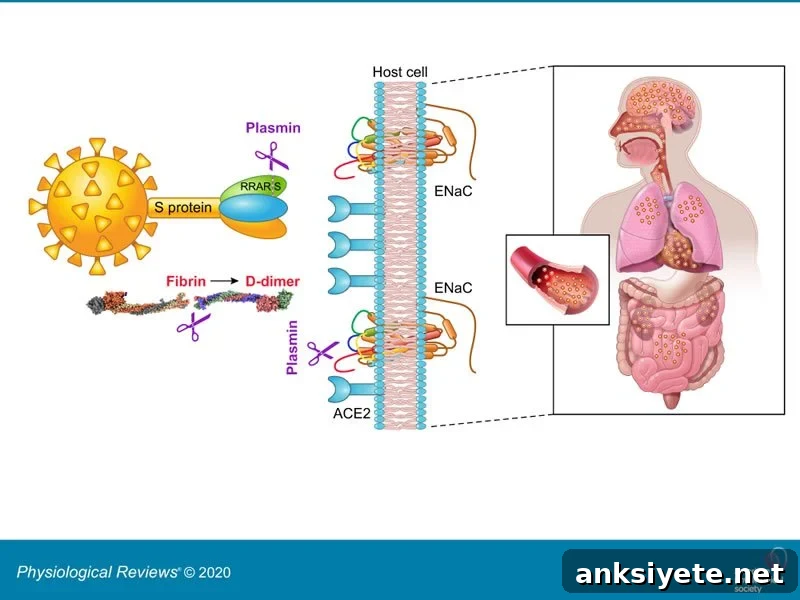
Summary: Higher levels of plasmin — an enzyme that dissolves blood clots — may increase the infectivity and severity of SARS-CoV-2 by cleaving the virus’s spike protein. Elevated plasmin and its precursor plasminogen are common in conditions such as diabetes, hypertension, and cardiovascular disease, potentially explaining why people with these comorbidities face greater risk of severe COVID-19.
Source: American Physiological Society
A new review proposes that elevated levels of a blood-clot–dissolving enzyme could be a shared risk factor for severe COVID-19 in vulnerable populations. The review appears in Physiological Reviews.
Clinical data has consistently shown that individuals with chronic conditions—such as diabetes, hypertension, coronary or cerebrovascular disease, chronic lung disease, and kidney dysfunction—are more likely to experience severe illness and complications from SARS-CoV-2 infection. One prominent and troubling feature of severe COVID-19 is dysregulation of the coagulation system, including excessive fibrinolysis (hyperfibrinolysis) and bleeding abnormalities. The review examines evidence that elevated plasmin(ogen) may link these comorbidities to worse outcomes.
Plasminogen circulates in the blood as an inactive precursor. When activated by cellular factors, plasminogen converts to plasmin, an enzyme that breaks down fibrin clots. While plasmin is essential for normal clot resolution, chronically elevated plasminogen or plasmin activity can promote excessive fibrinolysis and bleeding. The review highlights that many chronic diseases associated with poor COVID-19 outcomes also show higher-than-normal plasmin(ogen) levels and increased plasmin activity.
Multiple studies report that an overwhelming majority of hospitalized COVID-19 patients show elevated D-dimer, a fibrin degradation product produced when clots are broken down. D-dimer levels tend to correlate with viral load and disease severity and often rise further in patients who develop acute respiratory distress syndrome (ARDS). By contrast, survivors or patients with milder disease typically show falling D-dimer levels over time. As noted by the review’s authors, D-dimer may normalize over a week in mild cases but may take considerably longer in severe cases.
The review argues that higher plasmin(ogen) levels could be mechanistically important for two reasons. First, plasmin and other host proteases can cleave a furin-like insertion in the SARS-CoV-2 spike protein. This extracellular cleavage may increase the virus’s ability to infect cells and enhance its virulence. Second, an overly active plasmin(ogen) system contributes to hyperfibrinolysis, which manifests clinically as elevated D-dimer and bleeding complications reported in severe COVID-19.
Because elevated plasmin(ogen) is frequently observed in patients with the chronic conditions that predispose to severe COVID-19, the authors propose that plasmin(ogen) may be a common biological link connecting these comorbidities to COVID-19 susceptibility and poor outcomes. Measuring plasminogen levels and plasmin enzymatic activity could therefore provide useful biomarkers for disease severity and risk stratification.
The review also discusses therapeutic implications. Targeting hyperfibrinolysis or modulating the plasmin(ogen) system could represent a complementary strategy to improve clinical outcomes for patients—particularly those with preexisting conditions that raise plasmin(ogen) levels. Further clinical and translational research is needed to evaluate the efficacy and safety of interventions that reduce plasmin activity in COVID-19 patients.
About this neuroscience research article
Source:
American Physiological Society
Media contacts:
News Room – American Physiological Society
Image credit:
Hong-Long Ji, Runzhen Zhao, Sadis Matalon, and Michael A. Matthay.
Original Research: Open access
“Elevated Plasmin(ogen) as a Common Risk Factor for COVID-19 Susceptibility” by Hong-Long Ji, Runzhen Zhao, Sadis Matalon, and Michael A. Matthay. Published in Physiological Reviews. DOI: 10.1152/physrev.00013.2020.
Abstract
Elevated Plasmin(ogen) as a Common Risk Factor for COVID-19 Susceptibility
Patients with hypertension, diabetes, coronary heart disease, cerebrovascular illness, chronic obstructive pulmonary disease, and kidney dysfunction experience worse outcomes when infected with SARS-CoV-2 for reasons that are not fully understood. This review summarizes evidence that plasmin(ogen) is elevated in patients with these comorbidities and that plasmin and related proteases may cleave a furin-like site in the SARS-CoV-2 spike protein, increasing the virus’s infectivity and virulence. Plasmin-driven hyperfibrinolysis also contributes to elevated D-dimer levels seen in severe patients. The plasmin(ogen) system therefore represents a potential therapeutic target for mitigating COVID-19 severity.