
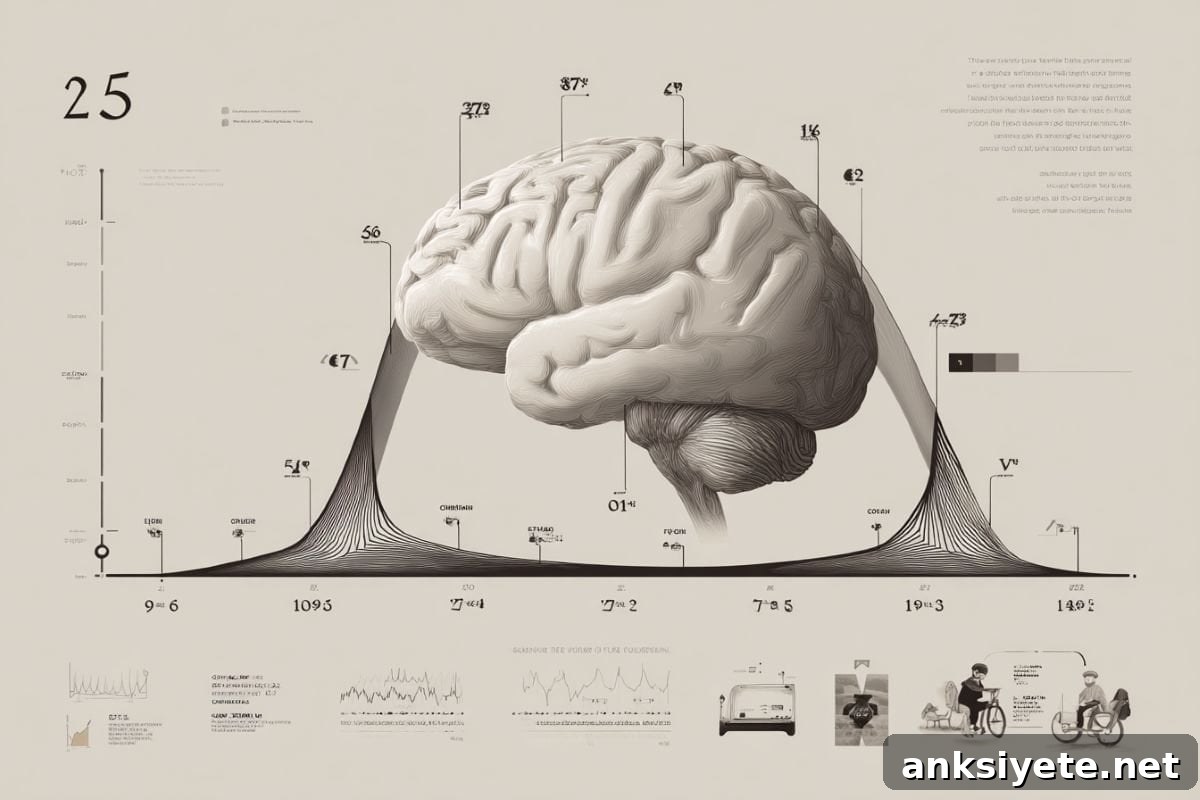
Summary: Researchers synthesized 139 neuroimaging studies covering participants aged 5 to 85 to chart how brain activity supporting cognitive control changes across the lifespan. Their meta-analysis reveals a clear inverted U-shaped trajectory: activity rises through childhood and adolescence, reaches its zenith in early to mid-adulthood (approximately 27–36 years), and then gradually declines in later life.
This pattern points to a peak period of cognitive efficiency in adulthood and underscores the importance of maintaining brain health as we age. The results refine our understanding of brain development and aging and provide an empirical basis for designing age-sensitive cognitive training and brain-health strategies.
Key Facts
- Inverted U-Shape: Functional brain activity associated with cognitive control increases through youth, peaks in early-mid adulthood, and decreases in older age.
- Peak Interval: The highest levels of task-related brain activity were observed between ages 27 and 36.
- Brain Health Implications: Findings highlight the value of targeted cognitive support and preventative strategies during midlife to slow age-related decline.
Source: Science China Press
What is cognitive control? Cognitive control refers to the brain’s capacity to direct attention, manage thoughts, and guide actions to achieve specific goals—allowing us to concentrate on a task while ignoring distractions. Everyday examples include sustaining focus while reading in a noisy environment or suppressing an impulsive response to complete a planned action. In adults, cognitive control tends to support organized, goal-directed behavior; in children and some older adults, immature or declining control systems can lead to greater difficulty regulating behavior.
Although behavioral and clinical patterns of cognitive control across development and aging are well documented, systematic knowledge about how the underlying functional brain activities change with age has been limited. Mapping these lifespan trajectories helps clarify the neural mechanisms behind cognitive development and decline and supports the design of region-specific cognitive interventions.
Summary of the study
The research compiled 139 neuroimaging studies that used conflict-based cognitive tasks (for example, indicating the direction of a central arrow while ignoring distracting flankers) and together included 3,765 participants aged between 5 and 85 years. Using a combination of seed-based effect size mapping (SDM), generalized additive models (GAM), and formal model comparison techniques, the authors reconstructed the lifespan trajectory of brain activity linked to conflict-driven cognitive control.
The principal discovery was a robust inverted U-shaped trajectory: task-related brain activity increases across childhood and adolescence, reaches peak activation in young adulthood, and then declines gradually across later adulthood. The GAM analysis estimated the peak interval to fall between 27 and 36 years of age. Model comparison showed that a square-root growth and decline function fit the regional activity data better than a simple quadratic model, and no evidence supported alternative patterns such as steady linear change or an increase-then-stable plateau.
The study also reported age-related changes in hemispheric lateralization: both adolescents and older adults exhibited stronger left-hemisphere dominance for these control-related activities than young and middle-aged adults. This observation aligns with prior behavioral findings that indicate an inverted U-shaped pattern in cognitive control performance, and it provides the neural basis for that behavioral curve.
By pinpointing the 27–36 age range as the period of maximal conflict-control activity, the results offer a neural explanation for the high cognitive performance, productivity, and creativity often observed in early to mid-adulthood. The subsequent gradual decline highlights the potential benefit of prioritizing cognitive maintenance and targeted training strategies during middle adulthood to reduce age-related loss of function.
In sum, this meta-analysis clarifies how functional brain activity supporting cognitive control fluctuates across the lifespan and supplies evidence-based guidance for tailoring cognitive-health interventions to different age groups.
Leading contributors include Dr. Zhenghan Li (Hangzhou Normal University) as first author and Dr. Guochun Yang (Guangdong Intelligent Science and Technology Research Institute) as corresponding author. Other significant contributors are Dr. Xun Liu (Institute of Psychology, Chinese Academy of Sciences), Dr. Isaac T. Petersen (University of Iowa), Dr. Lingxiao Wang (Hangzhou Normal University), and Dr. Joaquim Radua (University of Barcelona).
About this aging and cognitive control research news
Author: Bei Yan
Source: Science China Press
Contact: Bei Yan – Science China Press
Image: Image credited to Neuroscience News
Original Research: Open access. “The lifespan trajectories of brain activities related to conflict-driven cognitive control” by Guochun Yang et al., published in Science Bulletin.
Abstract
The lifespan trajectories of brain activities related to conflict-driven cognitive control
Cognitive control underpins human goal-directed behavior. Charting its functional trajectory across the lifespan is essential for optimizing cognitive capacity during stages of growth and decline. While behavioral and structural studies have previously described an inverted U-shaped pattern, age-related shifts in functional brain activity supporting control remained unclear. To address this gap, the authors performed a comprehensive meta-analysis of 139 neuroimaging studies involving conflict tasks and 3,765 participants aged 5–85. Using seed-based d mapping (SDM), generalized additive models (GAM), and model comparison methods, they characterized the age-related patterns of brain activation. Two central findings emerged: (1) a dominant inverted U-shaped lifespan trajectory, with activity rising from childhood to peak in young adulthood (roughly 27–36 years) before declining in later adulthood; and (2) both youth and older adults show weaker activation and increased left-hemisphere laterality compared with young adults. Together, these results reveal systematic age-related fluctuations in the neural mechanisms of cognitive control and inform strategies for maintaining cognitive health across life.