
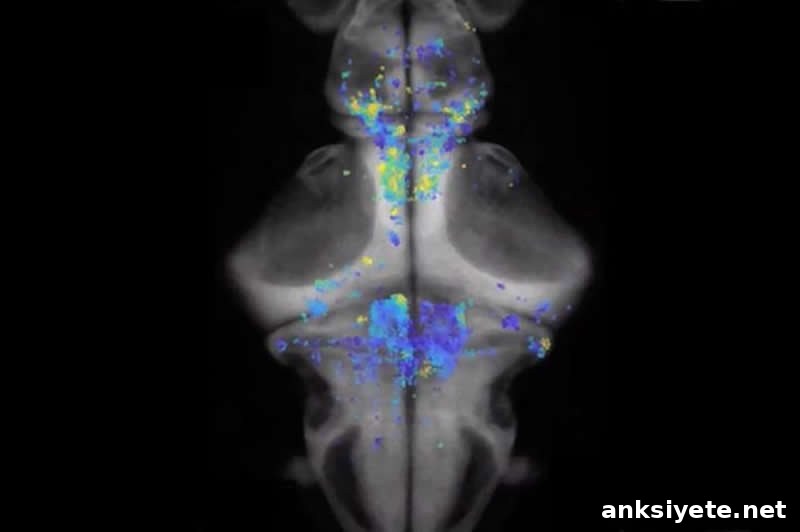
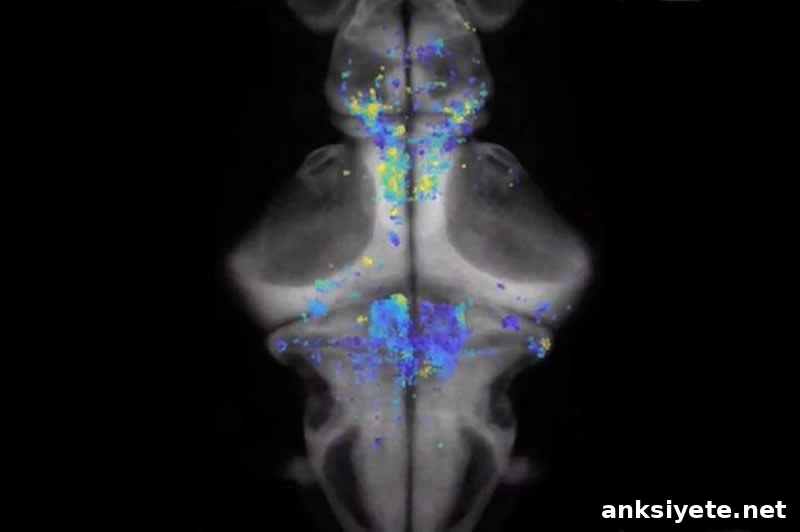
Summary: New zebrafish research reveals a major role for the cerebellum in cognition, decision making, and motor planning.
Source: Rockefeller University
Many everyday reactions—reaching for the refrigerator when hungry or switching on air conditioning when it gets warm—feel automatic. Yet even these seemingly simple behaviors are produced by millions of neurons and complex interactions across multiple brain regions. Observing that activity in real time, at single-neuron resolution, has proven difficult in most animals. Larval zebrafish, however, offer a rare view into how whole-brain dynamics give rise to decisions.
In a study published in Cell, researchers used fast, whole-brain calcium imaging and advanced statistical analysis to monitor nearly every active neuron in the zebrafish brain while the animals repeatedly made left-or-right turning decisions. That frame-by-frame view of decision formation was so detailed that the team could predict both the timing and the direction of a fish’s turn more than 10 seconds before the movement occurred.
Tracking single-trial decision dynamics
Understanding decision-making requires observing how neurons across many brain areas respond and coordinate on a trial-by-trial basis. Typical approaches either sample only a subset of neurons at high resolution or average activity across multiple trials to reduce noise—losing trial-specific details in the process. The authors wanted to capture how decisions unfold on individual trials.
To do this they combined light field microscopy, which records volumetric calcium signals across the whole brain simultaneously, with sophisticated statistical tools to analyze activity patterns without relying on trial averaging. Before imaging, the team trained larvae on a simple operant task that required goal-directed behavior rather than mere reflexes.
Fish received a mild heat stimulus from a laser and learned to relieve the heat by making a specific tail flick: turning right in one set of experiments and turning left in a control set to avoid directional bias. After roughly 15 training trials the larvae reliably responded about 20 seconds after heat onset, and in roughly 80% of trials they made the correct directional turn.
Between heat onset and the tail movement the researchers monitored roughly 5,000 of the most active neurons. They separated neural patterns that encoded sensory detection of heat or the motor execution of the turn from those that reflected decision-related activity. Strikingly, neural state differences that predicted whether a trial would end in a correct or incorrect turn appeared more than 10 seconds before movement initiation. Using these neural signatures, the team could predict for individual fish, on a single trial, both the moment the movement would begin and its direction with high accuracy.
An unexpected role for the cerebellum
Mapping the activity clusters back to anatomy revealed contributions from multiple brain regions as sensory information was transformed into a choice and then an action. One structure stood out: the cerebellum. Neuronal activity within the cerebellum not only correlated with the exact timing of the tail flick but also encoded the decision direction through hemispheric differences.
Specifically, asymmetric activity between the cerebellar hemispheres emerged soon after the heat began and progressively diverged until the fish executed a turn, predicting left-versus-right choices. Simultaneously, a bilateral ramping of cerebellar population activity predicted when the movement would occur. These findings indicate that the cerebellum’s activity carried both decision outcome (through interhemispheric differences) and decision timing (through the rate of bilateral ramping), on a single-trial basis.
Traditionally associated with coordination, balance, and motor refinement, the cerebellum here appears to play a broader cognitive role in action selection and motor planning. The authors note that recent studies have hinted at similar cognitive functions for the cerebellum, and their whole-brain, single-trial approach provides direct evidence supporting that expanded view.
Source institution: Rockefeller University
Media contact: Katherine Fenz, Rockefeller University
Image credit: Laboratory of Neurotechnology and Biophysics
Original research (citation)
Title: Cerebellar Neurodynamics Predict Decision Timing and Outcome on the Single-Trial Level
Authors (selected): Qian Lin, Jason Manley, Magdalena Helmreich, Friederike Schlumm, Jennifer M. Li, Drew N. Robson, Florian Engert, Alexander Schier, and colleagues.
Journal: Cell. DOI: 10.1016/j.cell.2019.12.018
Key highlights
- Whole-brain calcium imaging captured decision-making dynamics in larval zebrafish at single-trial resolution.
- Brain states showed pre-motor bifurcations toward alternative decisions without relying on trial averaging.
- Cerebellar activity predicted both decision outcome and timing more than 10 seconds before movement.
- Decision direction was encoded by interhemispheric differences; the rate of bilateral cerebellar ramping predicted when the action occurred.
Abstract summary
Goal-directed actions require coordinated activity across multiple brain areas, but how distributed networks drive the selection and timing of actions on a trial-by-trial basis is not fully understood. Combining whole-brain volumetric calcium imaging via light-field microscopy with an operant-conditioning task in larval zebrafish, the study identified recurring, global brain-state dynamics that diverge toward mutually exclusive decisions before movement. Trial-specific changes in functional connectivity—especially between the cerebellum and habenula—correlated with decision outcomes. Within this distributed network, the cerebellum displayed particularly strong, predictive pre-motor activity (>10 seconds before movement), predominantly in granule cells. Directional choices were encoded by the difference in activity between ipsilateral and contralateral cerebellar hemispheres, while the combined bilateral ramping rate predicted decision timing. These results highlight an important cognitive and motor-planning role for the cerebellum.