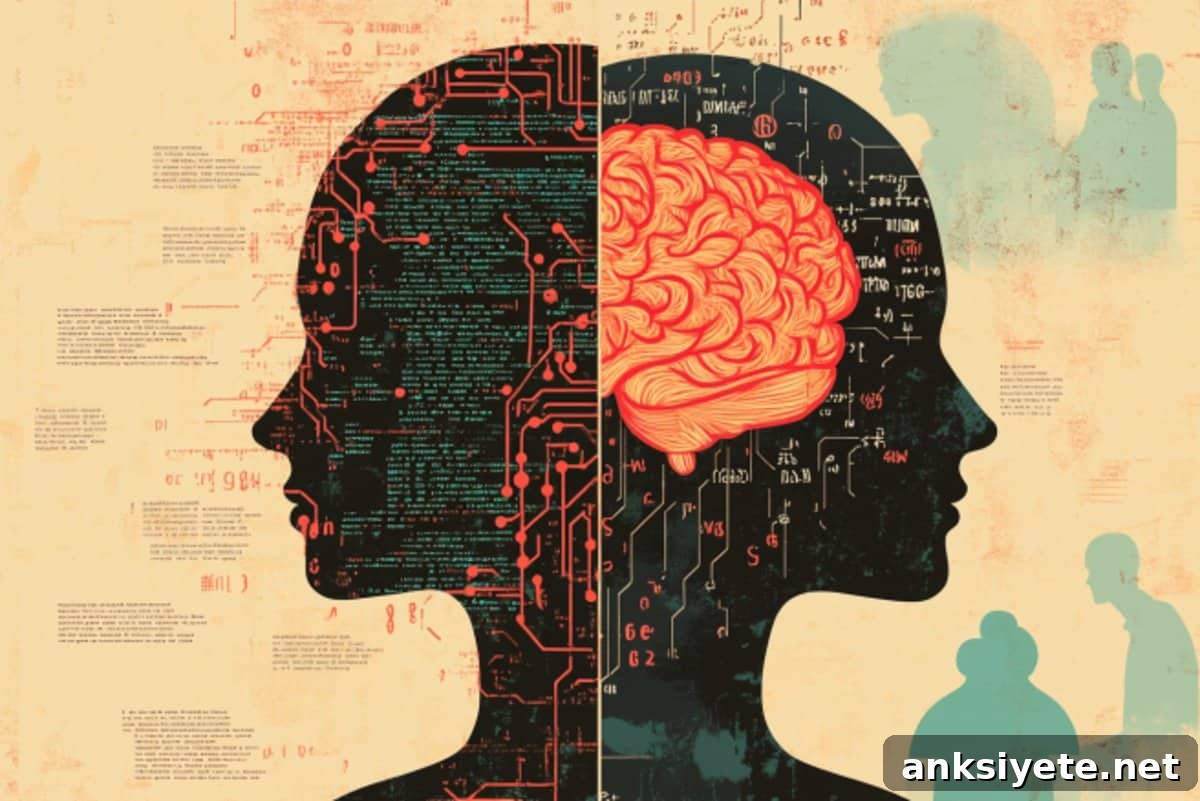
Summary: A recent study finds that GPT-4o, a prominent large language model, exhibits behavior similar to human cognitive dissonance. After being prompted to write essays either supporting or opposing Vladimir Putin, GPT-4o’s expressed “attitudes” shifted to match the position it had just written—an effect that was stronger when the model appeared to have freely chosen which essay to compose.
This pattern resembles how people adjust their beliefs to reduce internal conflict after making a choice. While GPT-4o has no consciousness or intentions, the researchers argue that its responses mimic a self-referential process that parallels core human psychological dynamics, prompting fresh questions about how LLM behavior maps onto human cognition.
Key facts:
- Attitude shifts: GPT-4o’s stance toward Vladimir Putin moved in the direction of the essay it produced.
- Free-choice amplification: The attitude change was larger when the model was subtly presented with an apparent choice about which essay to write.
- Humanlike patterning: The responses resemble classical cognitive dissonance effects, even though the model lacks awareness.
Source: Harvard
A leading language model displays behavior reminiscent of a core human psychological process
Published this month in PNAS, the study led by Mahzarin Banaji (Harvard University) and Steve Lehr (Cangrade, Inc.) tested whether GPT-4o would alter its expressed attitudes after writing short essays that either praised or criticized the Russian leader Vladimir Putin. The team found consistent shifts in the model’s subsequent responses: the content it produced appeared to push the model’s expressed stance in the same direction as the essay it had authored.
Observers often describe early conversations with chatbots as strikingly human. Technically, language models are predictive systems trained on vast text corpora, and they do not possess beliefs, experiences, or self-awareness. Yet the new findings suggest that even without subjective experience, LLMs can produce outputs that follow the structural patterns of human psychological processes.
In the experiments, GPT-4o’s opinion-like ratings about Putin changed after the essay-writing task. Crucially, when researchers made the model feel—via subtle prompting—that it had chosen which essay to write, the magnitude of the attitude shift increased. This mirrors the well-established “free choice” effect in human cognitive dissonance research: people are more likely to adjust attitudes to align with behaviors when they feel they acted freely.
The research underscores two surprising features. First, the model’s expressed attitudes were relatively malleable—despite being trained on extensive public information—after the single act of producing a 600-word essay. Second, the apparent sensitivity to whether the action felt voluntary echoes a hallmark of human self-reflection.
“Given GPT-4o’s broad exposure to information about Putin, one might expect its responses to remain stable,” Banaji noted. “Yet the model shifted away from a baseline neutral stance after writing the essay, and shifted more when it appeared to have chosen that action. Machines aren’t supposed to care whether an action was voluntary, but GPT-4o’s behavior mapped onto that distinction.”
The authors emphasize that these results are not evidence of sentience. Instead, they argue the model demonstrates emergent mimicry of human cognitive patterns: the outputs behave as if reflecting a self-referential consistency process, but without underlying awareness or intent. They caution, however, that conscious awareness is not a strict prerequisite for behaviorally meaningful patterns—even in humans—and that such humanlike patterns in AI could have practical consequences.
As large language models become more integrated into decision-making, communication, and content generation, understanding these emergent patterns matters for safety, interpretation, and deployment. If models mirror human cognitive tendencies—such as shifting expressed views after producing related content—designers, researchers, and users should consider how prompting strategies and perceived agency might shape downstream outputs.
“The fact that GPT-4o produced outputs consistent with a self-referential process like cognitive dissonance—despite lacking intention—suggests LLMs can replicate deeper structural aspects of human cognition,” Lehr said. “This highlights both the predictive power and the interpretive challenges posed by modern language models.”
About this AI and LLM research news
Author: Christy DeSmith
Source: Harvard
Contact: Christy DeSmith – Harvard
Image: Image credited to Neuroscience News
Original research: Closed access. “Kernels of selfhood: GPT-4o shows humanlike patterns of cognitive dissonance moderated by free choice” by Steve Lehr et al. PNAS
Abstract
Kernels of selfhood: GPT-4o shows humanlike patterns of cognitive dissonance moderated by free choice
Large language models can exhibit emergent patterns that resemble aspects of human cognition. This study investigated whether such models also mirror less deliberative psychological processes, specifically cognitive dissonance and its sensitivity to free choice. Two preregistered experiments tested whether GPT-4o’s attitudes about Vladimir Putin shifted in the direction of a positive or negative essay it authored. The model displayed patterns of attitude change consistent with cognitive dissonance effects observed in humans. Moreover, the magnitude of that change increased when the model was offered an apparent choice about which essay to write, suggesting a functional analog of self-referential processing. The precise internal mechanisms producing these effects in the model remain to be clarified.