
Summary: SETD1A, a gene linked to schizophrenia, impairs dendritic growth and branching and reduces dendritic spine density. Restoring normal SETD1A expression in mice reverses working memory deficits.
Source: NIH/NIMH
Researchers have identified how SETD1A, one of the few genes definitively associated with schizophrenia, likely contributes to risk for the disorder. In a mouse model, partial loss of SETD1A produced working memory impairments and changes in neuronal structure and circuit function that resemble features observed in people with schizophrenia. Restoring SETD1A activity in adult mice corrected those deficits, and pharmacologically counteracting a key opposing enzyme also reversed the abnormalities, pointing to potential therapeutic strategies. The study was led by Joseph Gogos, M.D., Ph.D., at Columbia University and supported by the National Institutes of Health.
“SETD1A functions as a master regulator,” said David Panchision, Ph.D., of the NIH’s National Institute of Mental Health (NIMH), a co-funder of the work. “This risk gene encodes an enzyme that controls the expression of many downstream genes. In mice, reduced SETD1A activity disrupted a gene network that includes other genomic factors implicated in schizophrenia. Importantly, many of these changes proved reversible in adulthood.”
Genetic studies have shown that schizophrenia risk arises from both common variants with small effects and rare variants with large effects. Mutations that reduce SETD1A function are among a small set of rare variants that clearly increase schizophrenia risk: carrying a single mutated copy can markedly raise the chance of developing the illness. SETD1A is a lysine-methyltransferase involved in epigenetic regulation—switching genes on or off in response to experience—a process widespread across the brain. Because SETD1A mutations have been found predominantly in people with schizophrenia, understanding how this gene alters brain development and function may reveal important mechanisms underlying the disorder.
To determine how reduced SETD1A affects cells, circuits, and behavior, the researchers created mice with one copy of the Setd1a gene rendered nonfunctional, producing roughly half the normal expression. These heterozygous mice displayed clear deficits in tasks that require working memory—holding and manipulating information over short periods—such as navigating a maze to obtain a reward. Working memory impairments are a core cognitive feature of schizophrenia and strongly influence daily functioning.
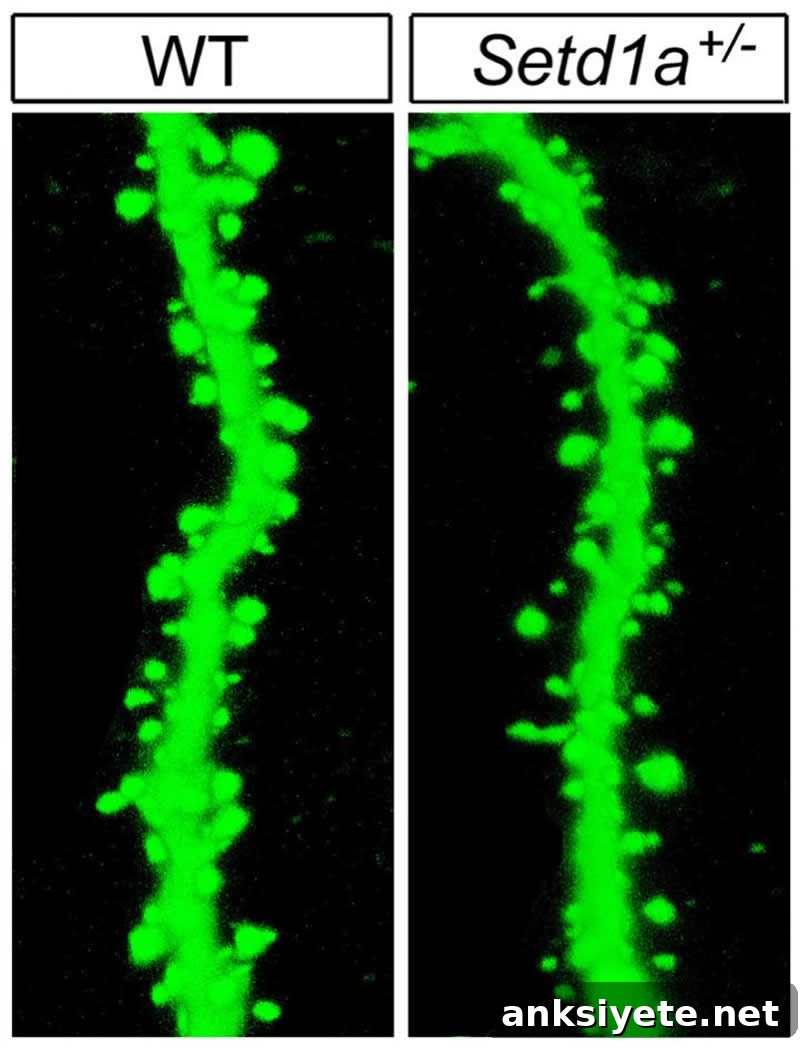
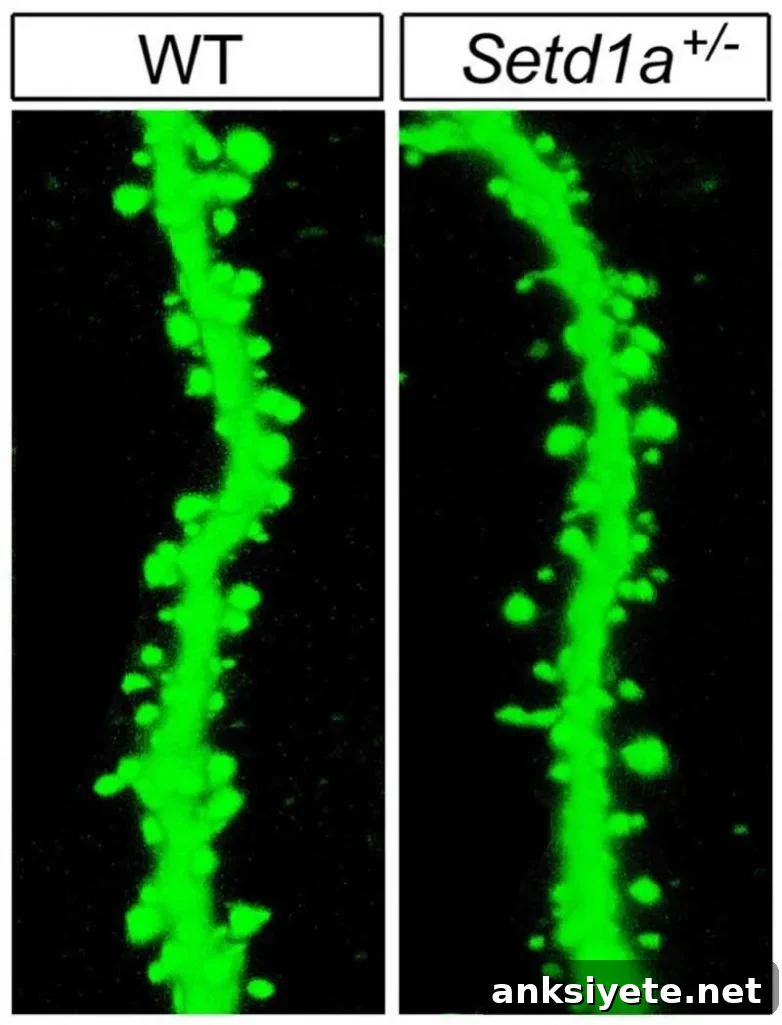
At the cellular level, Setd1a deficiency altered neuronal morphology and synaptic organization. Neurons showed stunted dendritic growth and less branching, and dendritic spine numbers were reduced. Spines are small protrusions on dendrites where synapses form and are essential for receiving chemical signals from other neurons and converting them into electrical responses. Fewer spines and simplified dendritic arbors reduce the capacity for synaptic input and weaken circuit connectivity.
At the molecular level, loss of Setd1a disrupted the regulation of many genes within its network. Some gene classes were downregulated while others were upregulated, reflecting complex, context-dependent roles for Setd1a at promoters and enhancers. Notably, a subset of affected genes overlapped with schizophrenia-associated genetic variation and were highly expressed in pyramidal neurons of the cerebral cortex, suggesting cumulative impacts on cortical structure and function relevant to disease.
Crucially, the authors found that reinstating normal Setd1a expression in adult mice rescued working memory performance and corrected neuronal and circuit abnormalities. They also identified LSD1, a demethylase that opposes Setd1a activity, as a key counteracting enzyme. Pharmacological inhibition of LSD1 in adult Setd1a-deficient mice fully restored both behavioral performance and neuronal morphology. These results indicate that some consequences of a developmental SETD1A deficit can be reversed in the mature brain by restoring the gene’s activity or by targeting downstream epigenetic pathways.
The findings suggest that therapies aimed at reactivating SETD1A function or modulating interacting enzymes such as LSD1 may hold promise for treating cognitive deficits in schizophrenia. Although SETD1A mutations are rare among all people with schizophrenia, the mechanisms uncovered—altered gene regulation, disrupted dendritic development, reduced spine density, and impaired working memory—mirror features seen across many patients. Therefore, interventions informed by SETD1A biology could have broader relevance beyond the small subgroup carrying the specific mutation.
Source:
NIH/NIMH
Media Contacts:
Jules Asher – NIH/NIMH
Image Source:
Image credit: Jun Mukai/Gogos Lab/Columbia’s Zuckerman Institute.
Original Research: Closed access
“Recapitulation and Reversal of Schizophrenia-Related Phenotypes in Setd1a-Deficient Mice.” Mukai J, Cannavò E, Crabtree GW, Sun Z, Diamantopoulou A, Thakur P, Chang CY, Cai Y, Lomvardas S, Takata A, Xu B, Gogos JA. Neuron. DOI: 10.1016/j.neuron.2019.09.014.
Abstract
Recapitulation and Reversal of Schizophrenia-Related Phenotypes in Setd1a-Deficient Mice
Highlights
• Cognitive and circuit deficits in a mouse model of SETD1A, a schizophrenia risk gene
• Reinstating Setd1a or antagonizing LSD1 activity in adulthood rescues deficits
• Setd1a binds promoters and enhancers with a striking overlap with Mef2 on enhancers
• Evolutionarily conserved Setd1a-bound enhancers may regulate psychiatric risk genes
Summary
SETD1A, a lysine-methyltransferase, is a key schizophrenia susceptibility gene. Mice with a heterozygous loss-of-function mutation exhibit altered axonal branching and cortical synaptic dynamics together with working memory impairments. Setd1a binds both promoters and enhancers, showing a notable overlap with the transcription factor Mef2 at enhancers. Setd1a target genes are highly expressed in cortical pyramidal neurons and display a complex pattern of both up- and down-regulation, reflecting opposing functions of Setd1a at promoters versus Mef2-bound enhancers. Evolutionarily conserved Setd1a targets are enriched for genes associated with neuropsychiatric risk. Reinstating Setd1a expression in adulthood rescues cognitive deficits, and pharmacological inhibition of LSD1, a demethylase that counteracts Setd1a, fully rescues behavioral and morphological deficits in Setd1a-deficient mice. These results improve understanding of how SETD1A mutations increase schizophrenia risk and point toward potential therapeutic approaches.