
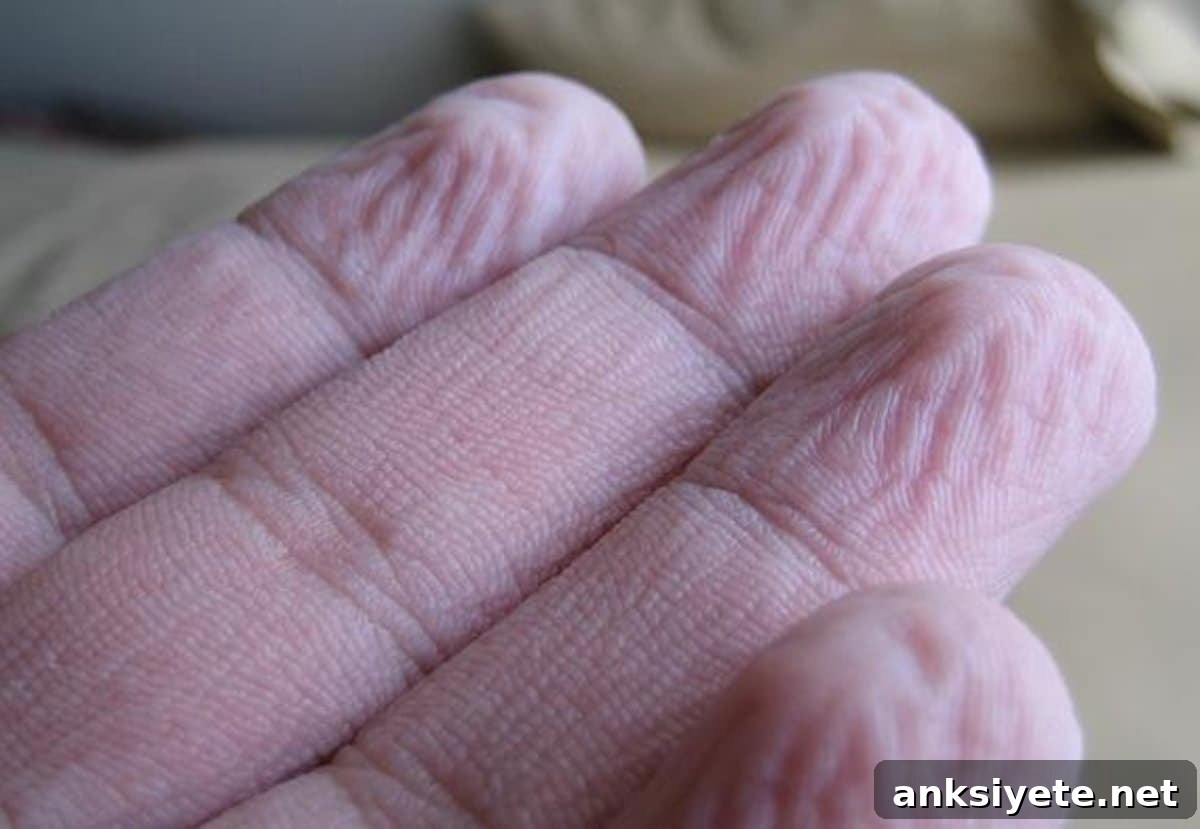
Summary: New research confirms that the characteristic wrinkles that form on fingers after prolonged water exposure follow a consistent pattern each time. That repeatability appears to arise from the fixed arrangement of blood vessels beneath the skin, which constrict during immersion and produce the familiar loops and ridges in the skin’s surface.
Scientists tested the same fingers during repeated water immersions and observed nearly identical wrinkle topography on each occasion. These findings clarify the biological mechanism behind finger pruning and suggest practical uses for forensics and biometric science, including the identification of individuals after long-term exposure to water.
Key Facts:
- Repeatable patterns: Wrinkle topography on fingers is consistent across separate water immersions.
- Vessel-driven mechanism: Wrinkle formation is driven by vasoconstriction of blood vessels beneath the skin rather than simple swelling of the outer layers.
- Forensic and biometric potential: The stability of wrinkle patterns could assist in identifying bodies recovered from water and inspire new biometric techniques.
Source: Binghamton University
Do your fingers always wrinkle the same way when you stay in the water too long?
Researchers at Binghamton University (State University of New York) set out to answer that exact question. Their study builds on earlier work by Associate Professor Guy German, who previously showed that finger pruning results from vasoconstriction—the tightening of blood vessels—rather than from the skin passively swelling with water.
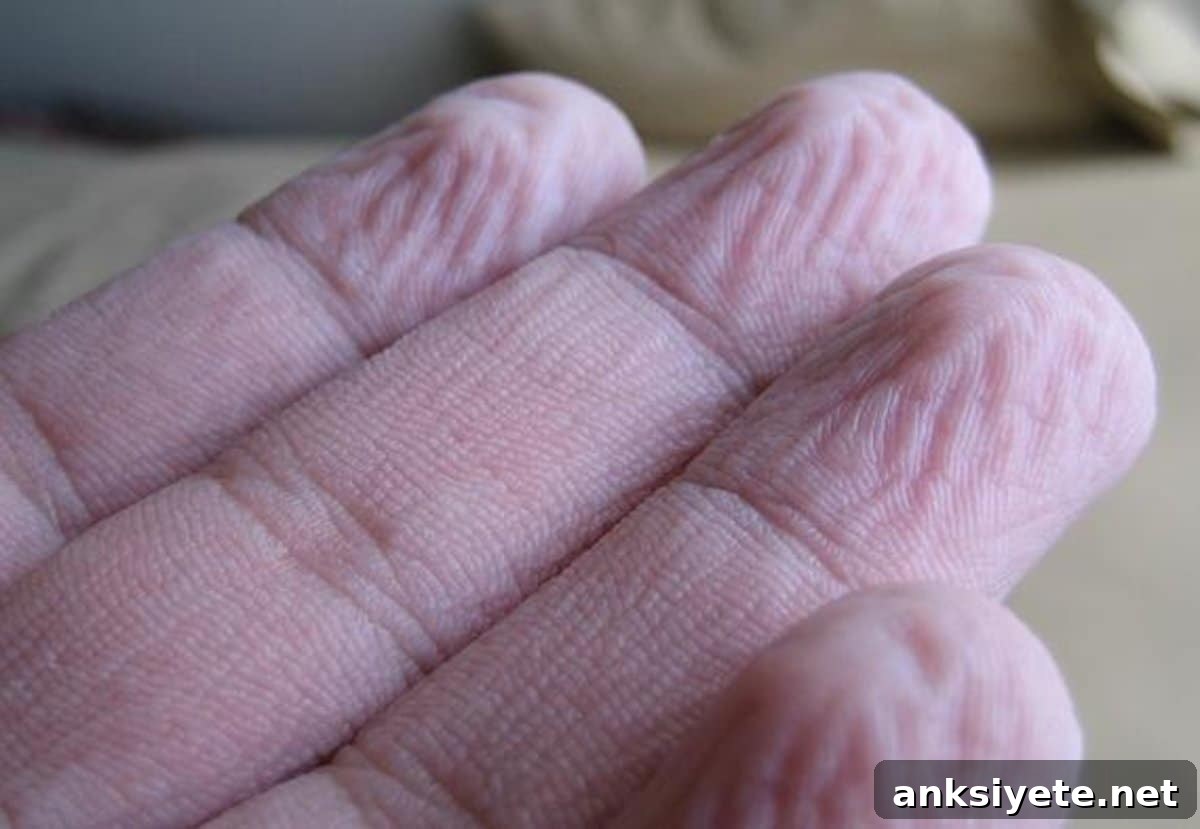
When German’s team examined the mechanism behind pruning, they realized a follow-up question had not been answered: are the wrinkle patterns reproducible for a single finger across different exposures? The answer, published recently in the Journal of the Mechanical Behavior of Biomedical Materials, is yes. German and coauthor Rachel Laytin show that the same raised loops and ridges reappear on the same finger after separate immersions.
The rationale is straightforward: blood vessels beneath the skin are relatively fixed in position. When those vessels constrict during prolonged immersion, the overlying skin deforms around them in a predictable way. Because the vascular layout does not change substantially from one immersion to the next, the resulting wrinkle topography remains consistent.
To demonstrate this, the team immersed participants’ fingers for 30 minutes, photographed the fingertip surfaces, and repeated the procedure at least 24 hours later under the same conditions. By overlaying images from the two sessions and comparing corresponding features, the researchers observed near-identical wrinkle formations on the same finger across trials.
The study also reaffirmed the clinical observation that people with median nerve damage often do not develop typical water-induced wrinkles. One participant with known median nerve injury showed no wrinkling during immersion, supporting the link between nervous system responses, vasoconstriction, and wrinkle formation.
Beyond answering a curious question, the research points to practical applications. Consistent wrinkle morphology may be useful in forensic contexts—helping to match fingerprints or assist identification when bodies have been submerged—and could inform new biometric approaches that account for water-induced skin changes. German notes that an interest in biometrics runs in his family: his father, a retired U.K. police officer, encountered water-exposed evidence during his career, which influenced German’s scientific curiosity.
German and his students are enthusiastic about pursuing further questions about skin behavior in water. Simple public curiosity—such as a child’s question—sparked this line of inquiry and produced results that both illuminate basic biology and suggest applied uses.
About this forensic neuroscience research news
Author: John Brhel
Source: Binghamton University
Contact: John Brhel – Binghamton University
Image: The image is credited to Brenderous
Original Research: Open access.
“On the repeatability of wrinkling topography patterns in the fingers of water immersed human skin” by Guy German et al. Journal of the Mechanical Behavior of Biomedical Materials
Abstract
On the repeatability of wrinkling topography patterns in the fingers of water immersed human skin
Finger wrinkling during and after water immersion—commonly called pruning—is thought to be an evolutionary adaptation that improves grip in wet conditions. Prior research has established that water-induced finger wrinkles result from vasoconstriction of blood vessels beneath the skin rather than from passive swelling of the skin surface. Until now, the specific morphology and repeatability of wrinkle topography had not been characterized in detail.
Given that the vasculature under the skin is relatively stationary, the authors hypothesized that the topographical pattern of wrinkles formed by vasoconstriction should remain consistent across separate immersion events. To test this, fingertip images taken at two different times were overlaid and visually compared to pair corresponding wrinkles. Those pairs were converted into vector representations and analyzed quantitatively using normalized dot products to evaluate orientation correlations, with randomly oriented controls used for comparison.
Results show a significant correlation in wrinkle orientation across time points, demonstrating that wrinkle morphology is consistent and repeatable. These findings clarify the underlying mechanism of water-induced finger wrinkling and highlight potential forensic and biometric applications for this predictable skin response.