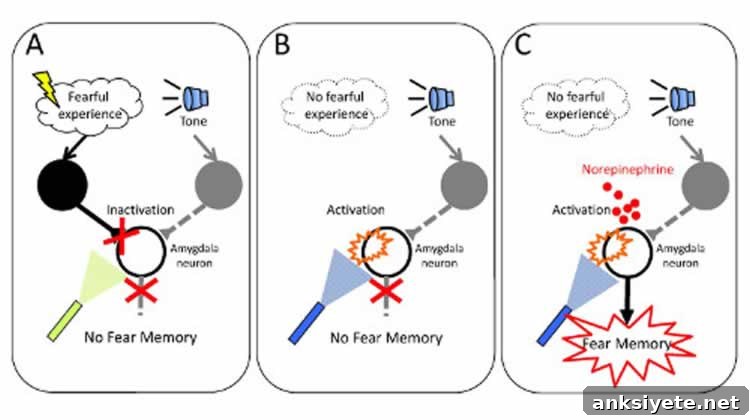
Unpleasant experiences often leave lasting traces in the brain. A new study published in the Proceedings of the National Academy of Sciences identifies a specific neural mechanism through which aversive events are converted into fear memories: coordinated changes in synaptic connections within the amygdala. The work refines a long-standing theory of memory formation, showing that Hebbian plasticity plays a critical role but requires additional neuromodulatory signals to produce lasting memories.
The research was led by Joshua Johansen at the RIKEN Brain Science Institute in Japan in collaboration with New York University scientists Lorenzo Diaz-Mataix and Joseph LeDoux. It directly tested a hypothesis first proposed by Donald Hebb in 1949: that neurons that fire together strengthen their connections, forming the basis of memory. Although Hebbian plasticity has been demonstrated in isolated brain preparations, its sufficiency and necessity for memory formation in freely behaving animals had not been conclusively tested.
To address this, the team focused on a well-established model of fear learning in which animals learn to associate a neutral auditory tone with a mild electric shock. The amygdala—a brain region essential for emotional learning—was a central focus because it stores the associative connections that underlie fear memories. Using optogenetics, a technique that enables precise control of neuronal activity with light, researchers were able to selectively silence electrical activity in amygdala neurons during the learning process.
When activity in the amygdala was suppressed during tone-shock pairing, animals failed to form the expected fear memory and the normally observed strengthening of connections between auditory pathways and amygdala neurons did not occur. These findings are consistent with Hebbian principles: coincident activity in connected cells is necessary for synaptic strengthening and memory formation.
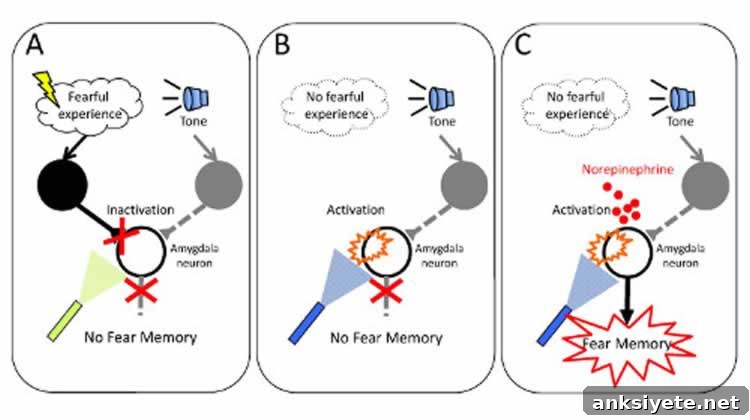
Next, the researchers asked whether direct activation of amygdala neurons could replace the aversive shock as the teaching signal. They eliminated the shock and instead used optogenetic excitation to stimulate the amygdala at the time of the tone. Contrary to what a simple Hebbian model would predict, this coincident electrical excitation alone was not sufficient to induce learning: animals did not form a fear memory under those conditions.
Unexpectedly, when the experimenters provided an additional signal—activating cell surface receptors responsive to noradrenaline at the same time as the optogenetic excitation—learning was restored. Noradrenaline, a neuromodulator closely linked to attention, arousal, and behavioral salience, acted as a necessary partner to Hebbian synaptic mechanisms. In short, coincident firing of connected neurons was required but not sufficient; a neuromodulatory signal that marks an event as behaviorally important was also needed to convert synaptic changes into a stable associative memory.
According to Johansen, this study is one of the first direct tests of Hebb’s influential hypothesis in the intact, working brain. The results support the core idea that coincident activity strengthens synapses, but they also show that the brain relies on additional biochemical context—here provided by noradrenaline—to decide which synaptic changes should be consolidated as memory. This refinement helps explain why many everyday experiences are forgotten while specific aversive or highly salient events remain vivid.
The findings have broader implications for understanding how emotional memories form and how they might be regulated. The amygdala-centric mechanism described here may represent a general strategy used across brain regions to gate memory formation: synaptic coincidence provides the potential for change, while neuromodulatory signals determine whether that change is stored. A better grasp of these interacting processes could inform new approaches for treating maladaptive fear memories in conditions such as anxiety disorders and post-traumatic stress disorder, where fear memories become intrusive or medically deleterious.
Contact: Jens Wilkinson – RIKEN
Source: RIKEN press release, December 2014
Image Source: Image adapted from the RIKEN press release
Original Research: Johansen JP, Diaz-Mataix L, Hamanaka H, Ozawa T, Ycu E, Koivumaa J, Kumar A, Hou M, Deisseroth K, Boyden E, LeDoux JE. “Hebbian and neuromodulatory mechanisms interact to trigger associative memory formation.” Proceedings of the National Academy of Sciences. Published online December 8, 2014. doi:10.1073/pnas.1421304111