
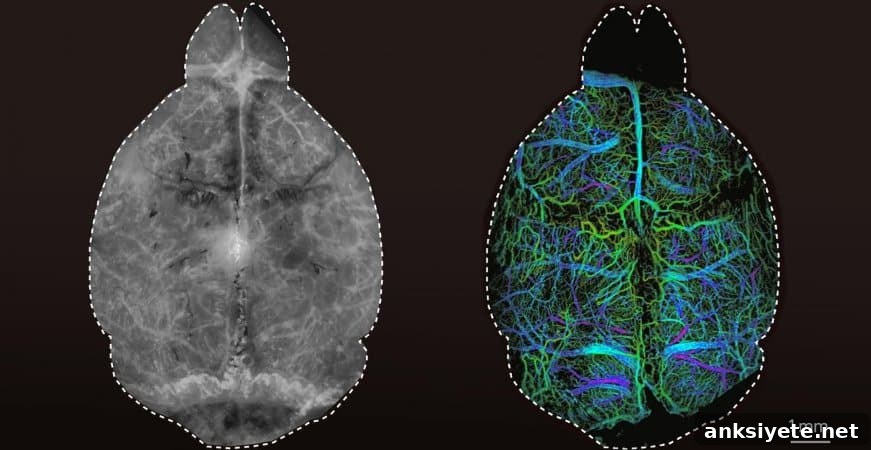
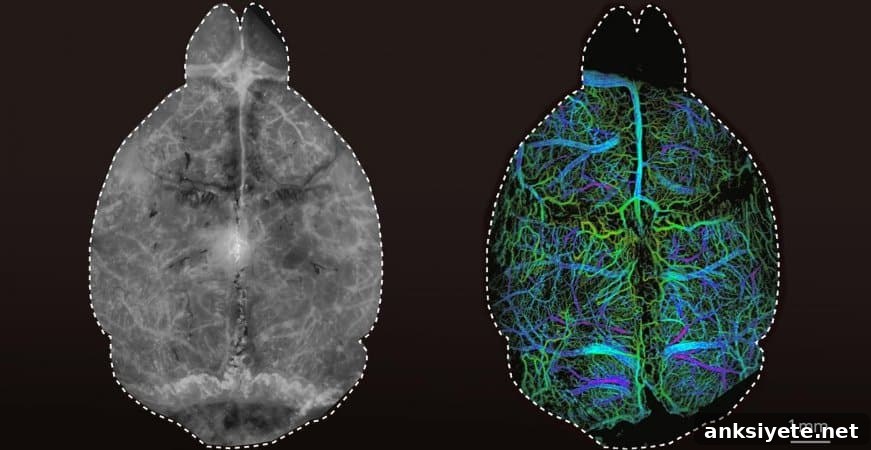
Summary: Diffuse optical localization imaging (DOLI) is a newly developed fluorescence microscopy technique that enables noninvasive, high-resolution visualization of microcirculation deep within the living brain.
Source: ETH Zurich
The inner workings of the human brain remain only partially understood. A major obstacle has been the difficulty of observing neuronal activity and microvascular function at cellular and capillary scales across intact, living brains without resorting to invasive surgery. That barrier is now being challenged.
A research team led by Daniel Razansky, Professor of Biomedical Imaging at ETH Zurich and the University of Zurich, has developed a fluorescence microscopy approach that produces high-resolution images of microcirculation through the intact scalp and skull. The technique is called diffuse optical localization imaging, or DOLI.
Razansky highlights the broader goal: “Visualizing biological processes deep inside an intact living brain is essential for understanding cognitive function and the mechanisms behind neurodegenerative diseases such as Alzheimer’s and Parkinson’s.” DOLI represents a step toward that goal by expanding the reach of fluorescence imaging in a minimally invasive way.
Improving fluorescence microscopy
Fluorescence microscopy relies on contrast agents that emit light when excited by a specific wavelength. This emission allows researchers to observe molecular and cellular processes. In practice, however, tissue scattering, absorption, and background autofluorescence limit image clarity and make it difficult to determine the precise locations of fluorescent markers deep inside tissue.
To overcome these limitations, the team introduced several technical innovations. They chose to image in the second near-infrared spectral window (NIR-II), a range that substantially reduces background scattering, tissue absorption, and intrinsic fluorescence compared with visible wavelengths. Combined with a sensitive short-wave infrared camera and a novel quantum dot contrast agent that emits strongly in the NIR-II range, these choices markedly improved image quality and penetration depth.
Microscopic imaging at depth
Initial experiments used tissue-mimicking phantoms that simulate the optical properties of brain tissue. These tests showed that DOLI can achieve microscopic imaging at roughly four times the penetration depth of conventional fluorescence microscopy approaches. In live experiments, the researchers injected mice with microdroplets containing lead sulfide (PbS)-based quantum dots and recorded sequences of epi-fluorescence images in the NIR-II window. By localizing the fluorescent microdroplets in each frame, they reconstructed high-resolution views of the cerebral microvasculature.
“For the first time, we were able to clearly visualize microvasculature and blood flow deep within the mouse brain entirely noninvasively,” Razansky reports. The team also found that the apparent size of individual microdroplets in the images varied with their depth, which allows DOLI to infer three-dimensional spatial information from planar image sequences.
Compared with other modalities, such as optoacoustic imaging, DOLI builds on the familiar and versatile foundations of fluorescence microscopy while extending its practical range. The setup is relatively simple and affordable: a sensitive infrared camera and continuous wave illumination suffice, without the need for pulsed lasers or elaborate optics. This accessibility should make it easier for laboratories to adopt and adapt the technique.
Foundations for new discoveries
Neurological disorders—including epilepsy, stroke, and dementia—affect hundreds of millions of people worldwide, and understanding the vascular and cellular changes that accompany these conditions is critical for early detection and therapy development. By enabling noninvasive imaging of deep microvasculature at high resolution, DOLI offers a promising platform for studying how blood flow and microcirculation relate to neuronal function and disease progression.
Razansky and colleagues believe the method will yield new insights into brain physiology and pathology and may, over time, support the development of novel treatments. For now, the team continues refining the approach and extending its application in animal models, advancing the tools needed to explore intact brains with greater clarity.
About this neuroimaging research news
Source: ETH Zurich
Contact: Daniel Razansky – ETH Zurich
Image: The image is credited to ETH Zurich, University of Zurich / Daniel Razansky
Original Research: Open access.
Title: Diffuse optical localization imaging for noninvasive deep brain microangiography in the NIR-II window — Daniel Razansky et al., Optica
Abstract
Diffuse optical localization imaging for noninvasive deep brain microangiography in the NIR-II window
Fluorescence microscopy is a powerful tool for biological discovery, but effective penetration depth and spatial resolution are limited by intense light scattering in living tissues.
Recent advances in short-wave infrared cameras and contrast agents emitting in the second near-infrared (NIR-II) window have pushed achievable penetration to approximately 2 mm. Nonetheless, spatial resolution still declines with depth because of photon diffusion.
We introduce diffuse optical localization imaging (DOLI), a method that attains super-resolution deep-tissue fluorescence imaging beyond the limits imposed by light diffusion.
DOLI relies on localizing flowing microdroplets that encapsulate PbS-based quantum dots in a sequence of epi-fluorescence images captured in the NIR-II spectral window. Phantom experiments demonstrate that high-resolution detection of fluorescent particles can be maintained across a 4 mm depth range, while in vivo microangiography of murine cerebral vasculature can be performed through an intact scalp and skull.
The method also enables depth estimation from planar fluorescence recordings by exploiting the localized spot size. DOLI opens a resolution-depth regime previously inaccessible to optical methods, substantially expanding the applicability of fluorescence-based imaging approaches.