
Summary: Researchers have identified three previously unrecognized proteins that work together on the surface of clock neurons to make the circadian clock responsive to light.
Source: University of Bristol.
Drosophila fruit flies are named from the Latin for “dew loving” because they are most active at dawn and dusk. Their pronounced circadian rhythm—an approximately 24-hour biological cycle—is driven by an internal clock found in the brains of animals, including humans.
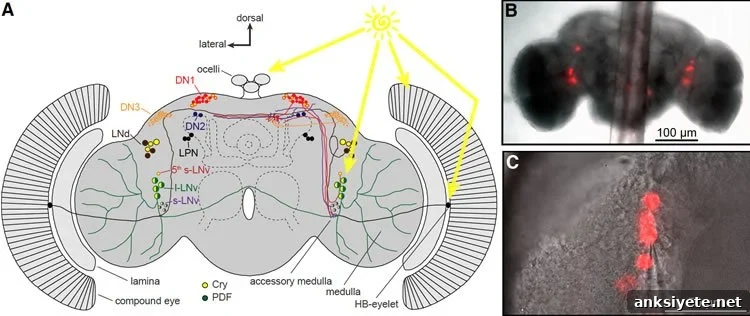
The fly’s circadian system is housed in roughly one hundred specialized clock neurons within its compact brain of about 100,000 neurons. Each clock neuron contains a molecular clock made up of clock genes that rhythmically switch each other on and off across day and night.
In a new study published in PNAS, researchers led by Dr. Edgar Buhl and Dr. James Hodge at the University of Bristol, in collaboration with Professor Ralf Stanewsky’s group at UCL, describe how they discovered three proteins that together form a membrane-based mechanism in clock neurons, enabling the circadian clock to respond to light.
“To be useful to an organism, circadian clocks must be synchronized to environmental cycles of light and temperature,” explained Dr. Hodge from Bristol’s School of Physiology, Pharmacology and Neuroscience. “Just as you reset your watch when you change time zones, animals continually adjust their internal clocks to match external day–night cycles.”
The findings have potential implications for identifying new membrane protein targets for treating sleep disorders and jet lag, and contribute to broader understanding of how body clocks influence health, aging, and neurodegenerative disease.
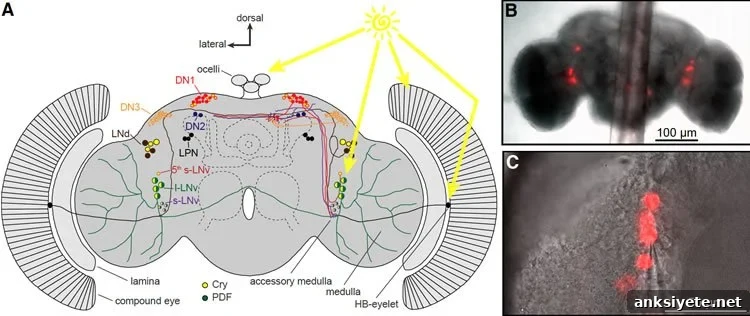
This work builds on an earlier discovery by Professor Stanewsky’s group involving the gene named Quasimodo, so-called because some mutant forms produced hunched-back flies. Using red fluorescent protein to label clock neurons and perform electrophysiological recordings, the researchers demonstrated that Quasimodo regulates how clock neurons respond to light and thereby influences circadian behavior.
Electrophysiological recordings taken at different times of day showed that clock neurons are more excitable during daytime than at night. Manipulating the level of Quasimodo in clock neurons altered this day–night excitability pattern: overexpression of Quasimodo shifted neurons toward a less active, night-like state, while reducing Quasimodo produced a more active, day-like state.
Quasimodo is localized at the cell surface, and electrical activity in neurons is generated at the membrane by ion channels. The investigators therefore examined ion channels and transporters known to be active in clock neurons and likely to interact with Quasimodo to produce a membrane-level timing mechanism that controls daily changes in electrical excitability.
They identified two additional components that, together with Quasimodo, form a membrane clock. The first is a potassium channel known as Shaw (dKv3.1), previously implicated by the same teams in circadian regulation. The second component is an ion cotransporter, NKCC, which mediates Na+, K+, and Cl− movement and has a documented role in daily activity changes in mammalian brain clocks. The study shows that Quasimodo interacts functionally with Shaw and NKCC to control daily variation in clock neuron electrical activity and to gate light responsiveness.
At the cellular level, altering Quasimodo affected daily changes in potassium currents and the reversal potential for GABA, indicating that Quasimodo modifies membrane currents and inhibitory responses in a time-of-day-dependent manner. When wild-type large ventral lateral neurons (l-LNvs) were exposed to brief blue light, they increased firing at night but showed little net response during the day. Changing the levels of Quasimodo, NKCC, or Shaw abolished these day–night differences, revealing their joint role in mediating both daily and acute light effects.
The study provides evidence that a membrane-level mechanism composed of Quasimodo, the Shaw potassium channel, and the NKCC cotransporter underlies daily variations in clock neuron excitability and allows the Drosophila circadian clock to respond appropriately to light. These discoveries refine our understanding of how molecular and membrane elements interact to produce rhythmic electrical properties in clock neurons and suggest new directions for research into circadian biology and potential therapeutic targets for sleep and circadian disorders.
Abstract (summary)
Researchers characterized a light-input pathway that regulates the excitability of Drosophila clock neurons. The molecular clock drives rhythmic electrical excitability, and the light-input factor Quasimodo (Qsm) regulates this variation likely via the NKCC cotransporter and the Shaw K+ channel (dKV3.1). Altering expression of qsm, NKCC, or Shaw reduced daily differences in neuronal activity and disrupted normal light responses. Overexpression of qsm produced a persistent night-like state, while qsm knockdown produced a persistent day-like state. The three genes appear to operate in the same pathway, with Qsm influencing both daily and acute light effects on clock neuron excitability, probably by acting on Shaw and NKCC.
Original research: “Quasimodo mediates daily and acute light effects on Drosophila clock neuron excitability” by Edgar Buhl, Adam Bradlaugh, Maite Ogueta, Ko-Fan Chen, Ralf Stanewsky, and James J. L. Hodge. Published in PNAS, November 2016.