
Summary: New research identifies a regulatory genetic mechanism that increases risk for age-related macular degeneration (AMD), improving understanding of the disease that is a leading cause of adult vision loss.
Source: PLOS
By integrating a genome-wide map of regulatory binding sites with genetic variants linked to disease, researchers have identified a functional genetic risk factor for adult-onset macular degeneration (AMD). The study, published January 17 in PLOS Biology by Ran Elkon, Ruth Ashery-Padan and colleagues at Tel Aviv University, advances our understanding of how specific transcriptional regulators in the retinal pigmented epithelium (RPE) contribute to AMD risk.
AMD results from dysfunction in the retinal pigmented epithelium, the layer of cells that supports photoreceptors, and the choriocapillaris, the vascular layer that nourishes the retina. Because the RPE plays a central role in retinal health, the investigators focused on transcription factors that guide RPE development and maintenance.
Their work began with LHX2, a tissue-specific transcription factor shown in mouse models to be critical for RPE development. Reducing LHX2 activity in human stem cell–derived RPE caused widespread down-regulation of genes, indicating that LHX2 largely functions as a transcriptional activator in this tissue by binding regulatory DNA elements and promoting gene expression.
Further analysis revealed that another key transcription factor, OTX2, cooperates with LHX2 to control a large set of RPE genes. Genome-wide binding maps showed that 68% of LHX2-bound sites are also occupied by OTX2 (864 overlapping sites), supporting the idea that these factors form a regulatory module that drives the RPE transcriptional program.
To connect these mechanistic findings to human disease, the authors compared the LHX2/OTX2 cistrome with genome-wide association study (GWAS) results for AMD. GWAS identifies single nucleotide polymorphisms (SNPs) that statistically associate with disease, but on their own they rarely explain how a variant contributes to pathology. By intersecting transcription factor binding sites with AMD-associated variants and other human RPE genomic data, the team prioritized variants likely to alter transcription factor binding and gene regulation.
One prioritized site lies within the promoter region of the TRPM1 gene, previously implicated in retinal disorders. The sequence variant at that promoter alters LHX2 binding: the C allele binds LHX2 more strongly than the T allele, and reporter assays showed higher TRPM1 expression with the C allele. These results indicate that the AMD-associated risk from this variant arises because the risk allele reduces LHX2 binding at the TRPM1 promoter, lowering TRPM1 expression in the RPE.
TRPM1 encodes a membrane ion channel with known roles in visual function, and mutations in this gene have been linked to vision deficits in prior studies. The new study connects a common regulatory variant to reduced TRPM1 expression in the RPE, providing a plausible molecular mechanism by which genetic variation increases AMD risk.
The investigators emphasize that combining tissue-specific transcription factor maps with human genetic and epigenomic datasets can reveal causal regulatory variants that underlie complex diseases. Their results define a transcriptional module—centered on LHX2 and OTX2 and including co-factors such as LDB1 and the SWI/SNF (BAF) chromatin remodeling complex—that governs RPE differentiation and function. Intersecting this module with human GWAS, expression quantitative trait loci, and ATAC-seq data from human RPE enabled identification and functional validation of a risk SNP that modulates TRPM1 expression through altered LHX2 activity.
By connecting developmental transcriptional mechanisms to genetic risk, this work provides both a refined model of RPE gene regulation and a concrete example of how noncoding regulatory variation contributes to AMD. Understanding these pathways could help guide future therapeutic strategies that aim to preserve or restore RPE function in AMD.
About this genetics and visual neuroscience research news
Author: Press Office
Source: PLOS
Contact: Press Office – PLOS
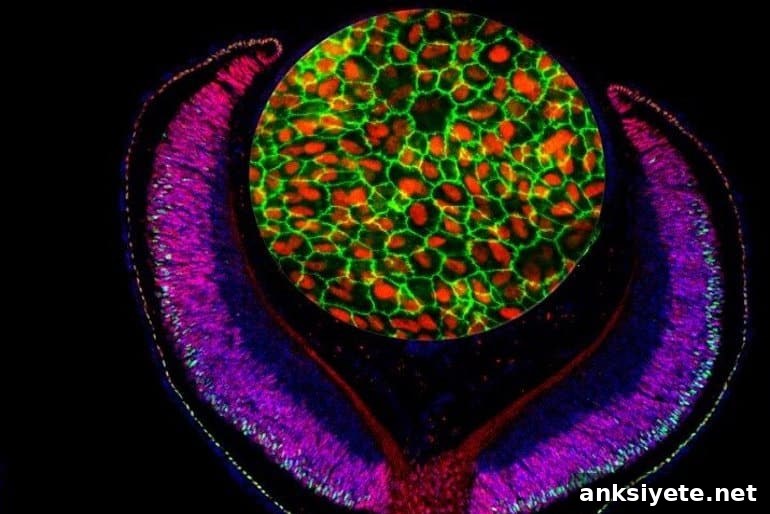
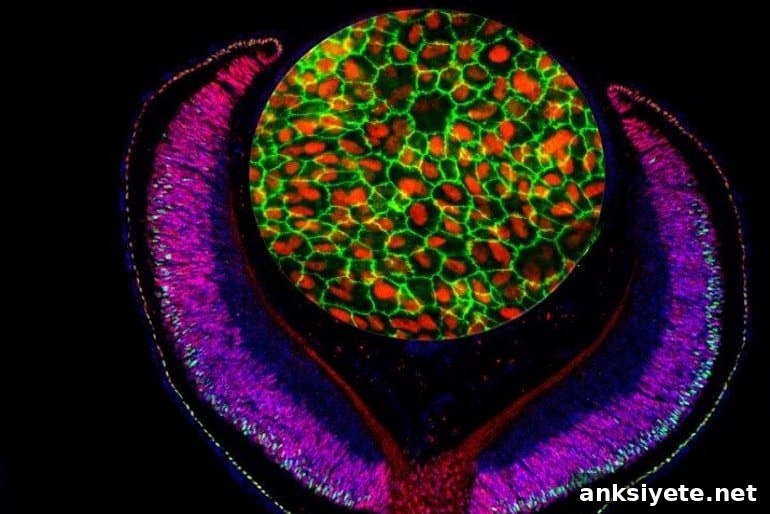
Image: The image is credited to Mazal Cohen-Gulkar, composite by Ruth Ashery-Padan
Original Research: Open access. “The LHX2-OTX2 transcriptional regulatory module controls retinal pigmented epithelium differentiation and underlies genetic risk for age-related macular degeneration” by Ruth Ashery-Padan et al., PLOS Biology.
Abstract
The LHX2-OTX2 transcriptional regulatory module controls retinal pigmented epithelium differentiation and underlies genetic risk for age-related macular degeneration
Tissue-specific transcription factors shape cell identity by binding noncoding regulatory regions (cistromes) and controlling gene expression programs. Identifying the combinations of factors that define a cell type, their specific cistromes, and how these regulatory networks relate to complex human traits is a major challenge in biology.
Focusing on the retinal pigmented epithelium—an essential lineage for retinal development and the primary tissue affected in AMD—the authors combined experiments in stem-cell-derived human RPE, functional studies in mice, and comprehensive transcriptomic and proteomic analyses. They show that developmental transcription factors LHX2 and OTX2 act together with cofactors such as LDB1 and SWI/SNF to regulate the RPE transcriptome.
Crucially, intersecting this LHX2-OTX2 cistrome with human expression quantitative trait loci, ATAC-seq data from human RPE, and AMD GWAS results, followed by functional reporter assays, identified a causal regulatory variant that alters TRPM1 expression in the RPE by modulating LHX2 activity at its promoter. The study therefore delineates an RPE transcriptional module and uncovers a regulatory risk SNP that contributes to the multifactorial genetics of AMD.