Findings reveal the first mechanistic link between sleep loss during early life and altered adult behavior in an animal model.
New research from the Perelman School of Medicine at the University of Pennsylvania shows that sleep loss in young fruit flies significantly impairs a key adult behavior: courtship and mating. Published in Science, the study led by Amita Sehgal, PhD, and colleagues establishes a clear mechanistic connection between disrupted sleep in early life and later behavioral outcomes in Drosophila.
The research team focused on very young flies, which—like infant humans and rodents—sleep substantially more than adults. “Infant humans, rats, and flies, they all sleep a lot,” Sehgal explains, emphasizing that abundant early-life sleep is conserved across species. Co-author Matthew Kayser, MD, PhD, who studies links between sleep disruption and neuropsychiatric disorders, used Drosophila because its neural circuits are genetically tractable, enabling precise manipulation of sleep-related pathways.
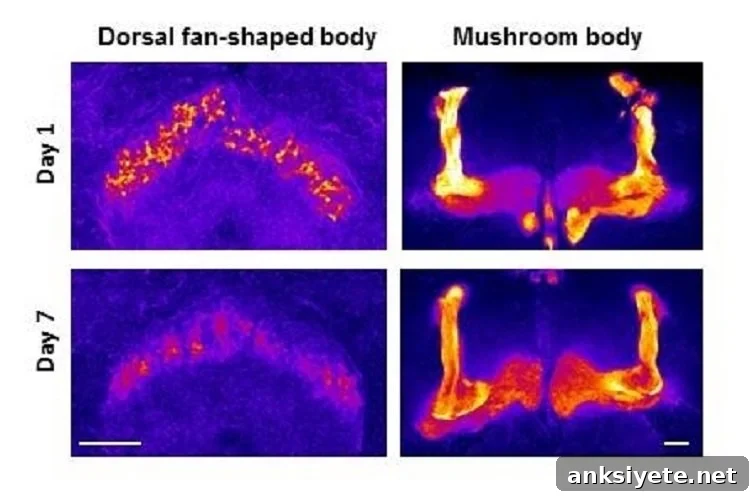
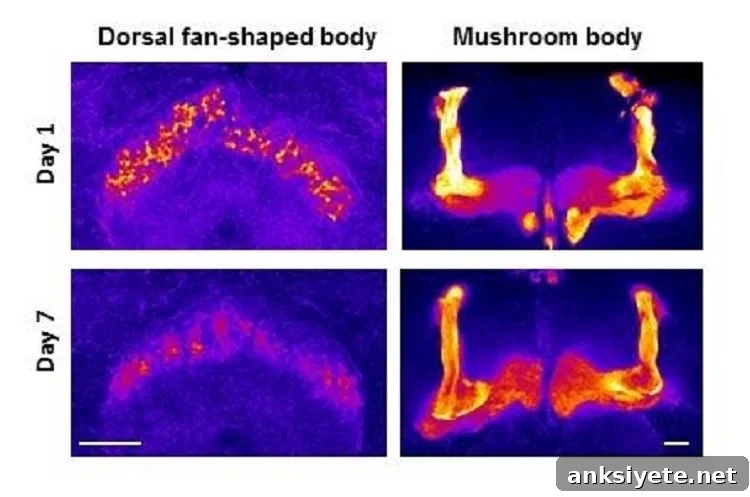
Using genetic tools, the investigators showed that young flies normally produce relatively low levels of dopamine—a neurotransmitter that promotes wakefulness—in specific neural circuits that project to the sleep-promoting dorsal fan-shaped body (dFSB). This low dopamine tone keeps the dFSB active and helps sustain the higher sleep amounts seen in young animals. When those dopamine circuits are activated prematurely, they suppress the dFSB and reduce sleep.
That observation addresses why young animals sleep so much: reduced dopamine signaling in key circuits maintains activity of the sleep-promoting dFSB, making infants harder to rouse. The study then examined the developmental consequences of interrupting those early sleep patterns. Increasing dopamine signaling during the early-life period not only reduced sleep but also produced measurable changes in adult courtship behavior.
Specifically, flies that experienced elevated dopamine and sleep loss as larvae or pupae later spent less time courting potential mates, and fewer of those interactions reached completion. To explore underlying causes, the researchers examined neurons involved in courtship circuitry. They found that a subset of neurons within a brain region called VA1v was smaller in sleep-deprived animals than in normally rested controls, suggesting that early sleep disruption can impair the maturation of circuits required for typical adult social and reproductive behaviors.
Previous work has shown that disrupting sleep alters behavior, but this study advances the field by pinpointing the neural pathway that links early sleep loss to specific adult deficits. “We identified the circuit that is less active in young flies. If you activate that circuit, you disrupt courtship by impairing the development of a different, courtship-relevant circuit,” Sehgal says. In other words, premature activation of wake-promoting inputs interferes with the developmental trajectory of distinct neural networks, producing long-lasting behavioral effects.
Although direct extrapolation from fruit flies to humans is not possible, these results provide the first mechanistic evidence that sleep during a critical developmental period shapes the formation of neural circuits that underlie adult social behaviors. This raises important questions about how sleep disturbances in human infancy and childhood might influence the maturation of brain networks relevant to social interaction, communication, and psychiatric risk.
The study’s coauthors include Zhifeng Yue from HHMI and the University of Pennsylvania. Funding was provided by the National Institutes of Health (T32HL07713; R25MH060490) and the Howard Hughes Medical Institute.
Contact: Karen Kreeger – University of Pennsylvania
Source: University of Pennsylvania press release describing the study in Science
Image credit: Amita Sehgal, PhD, and Matthew Kayser, MD, PhD, Perelman School of Medicine, University of Pennsylvania
Original research: “A Critical Period of Sleep for Development of Courtship Circuitry and Behavior in Drosophila” by Matthew S. Kayser, Zhifeng Yue, and Amita Sehgal in Science. Published online April 17, 2014.