
Summary: A small implanted array of electrodes can precisely stimulate peripheral nerves to produce controlled, fatigue-resistant limb movement, offering new hope for people with spinal cord injuries.
Source: Oregon State University
Tiny implanted electrode arrays that deliver precisely controlled electrical pulses to peripheral nerves may one day help people with spinal cord injuries regain use of paralyzed arms or legs.
Researchers explored a method for restoring communication between the brain and muscles after spinal cord injury by bypassing the damaged portion of the central nervous system. In many cases of paralysis the brain remains able to generate movement commands and peripheral motor and sensory nerves remain healthy, but those signals cannot reach muscles because the spinal cord pathway is disrupted. The team addressed this challenge by sending carefully timed electrical stimulation into peripheral nerve fibers to activate muscles directly.
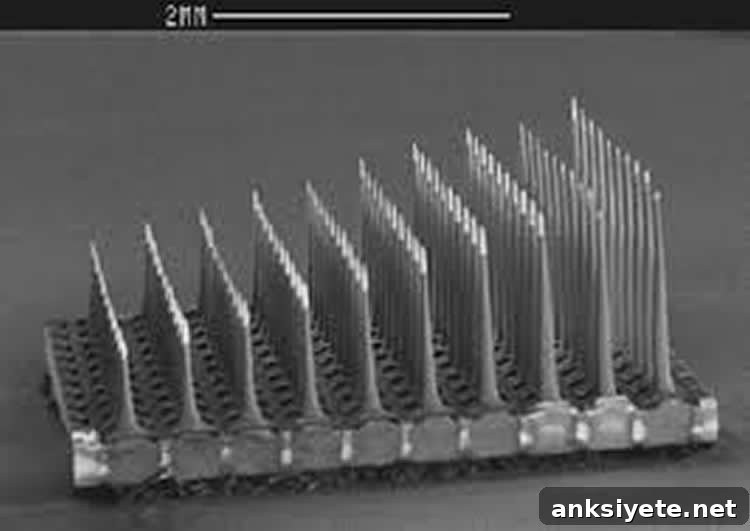
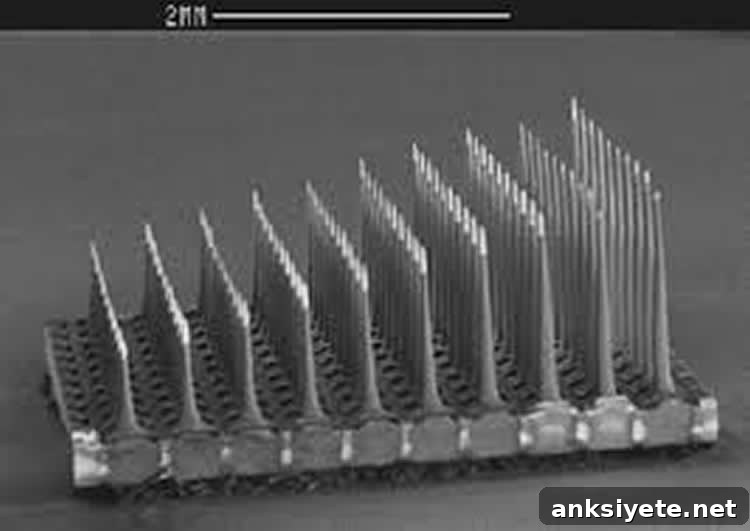
In experimental work using an anesthetized cat, scientists delivered controlled electrical pulses to nerves that activate the ankle’s plantar-flexor muscles. The pulses were generated by a proportional-integral-velocity (PIV) controller optimized for this application and were delivered through a compact 100-electrode implant, the Utah Slanted Electrode Array. That array’s small base—just 16 square millimeters—and its staggered electrode lengths allow selective activation of different nerve fibers.
Because individual electrodes could selectively recruit the appropriate motor axons at precise times, the closed-loop controller produced smooth ankle motion while resisting muscle fatigue. The stimulation approach — asynchronous intrafascicular multi-electrode stimulation (aIFMS) — targets small, distinct populations of motor axons to generate selective and more fatigue-resistant forces than conventional single-electrode stimulation.
The experiments demonstrated reliable, repeatable control of joint position despite opposing torques and external disturbances. Step responses evoked by the controller showed low overshoot and near-zero steady-state error, and the system handled varying step sizes and maintained stability over time. The controller could generate smooth eccentric movements at modest joint velocities and follow slow sinusoidal trajectories, illustrating its potential for dynamic limb control.
These results point toward future clinical systems in which a wearable control unit—small enough to fit in a smartphone-sized box—would send tailored impulses to implanted peripheral electrodes to restore functional movements. Early clinical applications could focus on enabling bed-bound patients to stand, use a walker, and take a few steps to reduce complications such as pressure sores and improve quality of life. Researchers hope that within five to ten years basic versions of this technology will be available for people with paralysis, with ongoing development aimed at expanding capabilities.
Beyond spinal cord injury, related work in neuroprosthetics aims to restore function for amputees by decoding a person’s intent from brain or peripheral signals so that prosthetic limbs move in accordance with the wearer’s intentions. Intent signals can be obtained from brain implants, cranial recordings, or from peripheral sources such as electromyography (EMG), which measures electrical activity in muscles and can provide control information for prosthetic devices.
Lead investigator V John Mathews, a professor of electrical engineering and computer science at Oregon State University, collaborated with Mitch Frankel (then a Ph.D. student at the University of Utah) and other faculty at Utah on the study. Their findings were published in Frontiers in Neuroscience and provide key insights into the design of closed-loop controllers for multielectrode peripheral stimulation.
Funding: Supported by the U.S. Army Medical Research and Materiel Command.
Source: V John Mathews, Oregon State University
Image credit: Oregon State University
Original research: Mitchell A. Frankel, V John Mathews, Gregory A. Clark, Richard A. Normann and Sanford G. Meek. “Control of Dynamic Limb Motion Using Fatigue-Resistant Asynchronous Intrafascicular Multi-Electrode Stimulation.” Frontiers in Neuroscience. Published online September 13, 2016. doi:10.3389/fnins.2016.00414
Oregon State University. “Precise Nerve Stimulation Via Electrode Implants Offers New Hope for Paralysis Patients.” NeuroscienceNews. 22 November 2016.
Abstract
Control of Dynamic Limb Motion Using Fatigue-Resistant Asynchronous Intrafascicular Multi-Electrode Stimulation
Asynchronous intrafascicular multi-electrode stimulation (aIFMS) of small independent populations of peripheral nerve motor axons can evoke selective, fatigue-resistant muscle forces. Previously developed closed-loop methods for isometric force were extended to the more demanding task of dynamically controlling joint position in the presence of opposing torque. A proportional-integral-velocity controller with integrator anti-windup measures was validated experimentally to evoke motion about the hind-limb ankle joint of an anesthetized feline via aIFMS of fast-twitch plantar-flexor muscles. The controller achieved steps in joint position with low overshoot, acceptable rise and settling times, and near-zero steady-state error. Controlled step responses were consistent across step sizes, robust against external disturbances, and reliable over time. The controller produced smooth eccentric motion at joint velocities up to approximately 8 degrees per second and tracked sinusoidal trajectories at frequencies up to 0.1 Hz with time delays under 1.5 seconds. These findings contribute to the development of a robust closed-loop aIFMS controller capable of producing precise, fatigue-resistant motion in individuals with paralysis.