
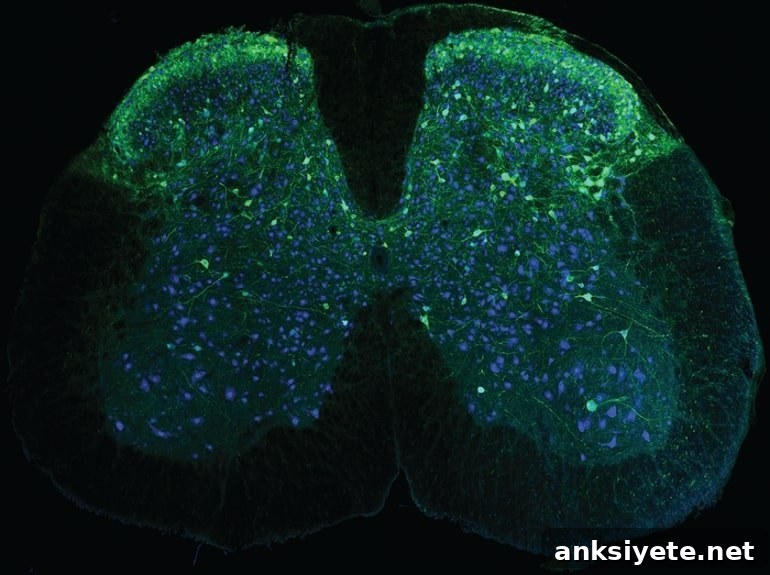
Summary: Researchers have developed a lightweight, wearable microscope that captures high-resolution, real-time images of neuronal and glial activity in previously inaccessible regions of the mouse spinal cord.
Source: Salk Institute
The spinal cord is the main conduit for signals between the brain and the rest of the body, controlling breathing, movement, and the relay of sensory information including pain. Despite its importance, observing cellular activity within many spinal regions in awake, behaving animals has been technically difficult, limiting our understanding of how pain and other sensations are processed at the cellular level.
Scientists at the Salk Institute have addressed this limitation by designing wearable microscopes that enable detailed imaging of neural and non-neural cells in the spinal cord of freely moving mice.
Described in two papers published in Nature Communications (March 21, 2023) and Nature Biotechnology (March 6, 2023), this imaging advancement opens new paths for studying the neural basis of sensation and movement in both healthy and disease states, including chronic pain, itch, amyotrophic lateral sclerosis (ALS), and multiple sclerosis (MS).
“These wearable microscopes allow us to observe neuronal and glial activity in regions and at speeds that were previously inaccessible to high-resolution tools,” says Axel Nimmerjahn, associate professor and director of the Waitt Advanced Biophotonics Center. “They fundamentally change what is possible when studying the central nervous system in behaving animals.”
The devices are compact—roughly 7 to 14 millimeters wide, comparable to a small finger or the diameter of the human spinal cord—and deliver high-resolution, high-contrast, multicolor imaging in real time. When paired with a chronically implanted microprism, a small reflective glass element positioned near target tissue, the system lets researchers visualize cells located at depths and across regions that were previously out of reach.
“The microprism extends the effective imaging depth, permitting direct observation of cells that could not be seen before,” explains Erin Carey, co-first author and researcher in Nimmerjahn’s lab. “It also enables simultaneous imaging of cells across different depths while minimizing tissue disturbance.”
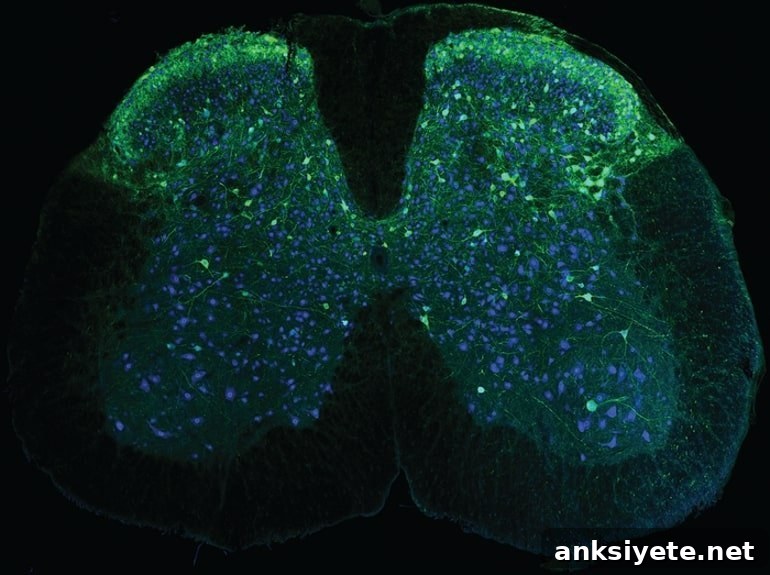
Pavel Shekhtmeyster, a former postdoctoral fellow and co-first author on both studies, adds, “We overcame previous limitations in field-of-view and imaging depth for spinal cord research. The microscopes are light enough for mice to carry, making measurements that were once thought impossible.”
Using this platform, the team focused first on astrocytes—star-shaped glial cells known to support neurons—because their earlier work suggested astrocytes might play unexpected roles in pain processing. The wearable microscopes revealed that mechanical tail squeeze in mice triggers coordinated astrocyte calcium activity that spreads across spinal segments, demonstrating sensorimotor-evoked, trans-segmental signaling patterns in awake animals.
Previously, such distributed cellular responses could not be observed directly in freely moving animals. “Seeing when and where pain-related signals occur, and which cells participate, allows us to design and test targeted therapeutic strategies,” says Daniela Duarte, co-first author and researcher in Nimmerjahn’s lab. “These microscopes could transform how pain is studied at the cellular level.”
The research team has already begun applying the technology to investigate how neuronal and non-neuronal activity in the spinal cord changes in different pain conditions and how interventions modulate abnormal cellular signaling.
Other contributors to the work include Alexander Ngo, Grace Gao, Nicholas A. Nelson, Jack A. Olmstead, and Charles L. Clark of the Salk Institute.
Funding: This research was supported by multiple grants from the National Institutes of Health (R01NS108034, U19NS112959, U19NS123719, U01NS103522, and F31NS120619), an NIH Training Grant (T32/CMG), the Sol Goldman Charitable Trust, C. and L. Greenfield, a Rose Hills Foundation Graduate Fellowship, a Burt and Ethel Aginsky Research Scholar Award, a Kavli-Helinski Endowment Graduate Fellowship, and a Salk Innovation Grant.
About this neurotech research news
Author: Press Office
Source: Salk Institute
Contact: Press Office – Salk Institute
Image: Image credit: Salk Institute
Original Research: Open access.
“Multiplex translaminar imaging in the spinal cord of behaving mice” by Axel Nimmerjahn et al. Nature Communications
Open access.
“Trans-segmental imaging in the spinal cord of behaving mice” by Axel Nimmerjahn et al. Nature Biotechnology
Abstract
Multiplex translaminar imaging in the spinal cord of behaving mice
Although the spinal cord plays central roles in sensorimotor processing and pain signaling, mapping activity in genetically defined cell types across spinal laminae has been difficult. Conventional calcium imaging provides cellular-level activity measurements but has been limited to superficial areas. To overcome this, the researchers used chronically implanted microprisms to visualize sensory- and motor-evoked activity in regions and at speeds beyond the reach of other high-resolution imaging approaches. They also developed wearable microscopes with custom compound microlenses for translaminar imaging in freely behaving animals. This system resolves prior limitations in working distance, resolution, contrast, and achromatic range. Using the platform, the team demonstrated that dorsal horn astrocytes in behaving mice exhibit sensorimotor program–dependent, lamina-specific calcium excitation, and that tachykinin precursor 1 (Tac1)-expressing neurons show translaminar responses to acute mechanical pain but not to locomotion.
Abstract
Trans-segmental imaging in the spinal cord of behaving mice
Spinal cord circuits are essential for transmitting pain, yet activity patterns within and across spinal segments in behaving animals have been largely elusive. The team developed a wearable widefield macroscope offering a 7.9-mm2 field of view, approximately 3–4 µm lateral resolution, a 2.7-mm working distance, and a total weight under 10 grams. Using this device, they observed that highly localized painful mechanical stimuli provoke widespread, coordinated astrocyte excitation across multiple spinal segments, revealing large-scale, pain-evoked network dynamics that can now be studied in awake, moving mice.