
Summary: Not only the cerebral cortex but the entire auditory pathway encodes sounds according to prior expectations.
Source: TU Dresden
Our senses are the primary window to the world, yet they do not simply relay objective reality. Over the past two decades, neuroscience has shown that perception is shaped by the brain’s predictions: cortical circuits continuously generate expectations and sensory neurons often respond primarily to the difference between expectation and incoming input. New research from TU Dresden now shows that this predictive process extends beyond the cortex into early, subcortical stages of the auditory pathway.
A research team led by Prof. Dr. Katharina von Kriegstein used ultra-high-field functional magnetic resonance imaging (fMRI) to measure brain activity while participants listened to sequences of tones. Nineteen healthy volunteers were instructed to detect the one tone in a sequence that deviated from the rest. The experiment manipulated where in the sequence the deviant tone was most likely to occur, creating clear expectations about when an unusual sound should appear.
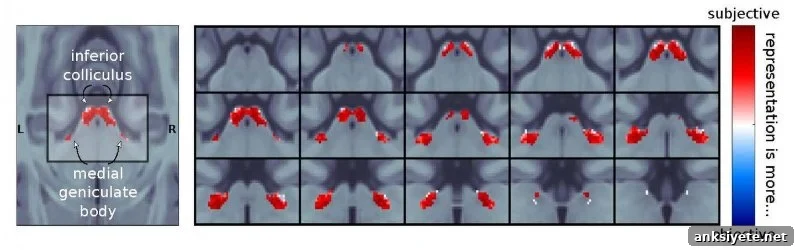
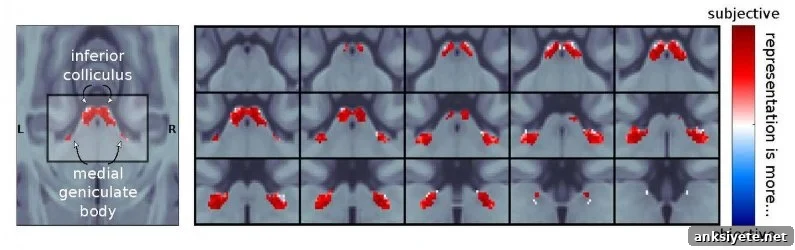
The investigators focused on two key subcortical nuclei within the auditory pathway: the inferior colliculus and the medial geniculate body. These structures are evolutionarily conserved and form essential relays between the ear and the cortex. Although listeners detected expected deviants more quickly, the fMRI signal in these subcortical nuclei increased selectively when a deviant occurred in an unexpected position. In other words, these early auditory centers showed stronger responses to surprising events than to predictable ones.
This pattern supports the predictive coding framework, which conceptualizes perception as a continuous process of hypothesis testing. Under this view, the brain continuously predicts future sensory input and devotes resources to encoding the mismatch—the prediction error—between expectation and reality. The TU Dresden findings demonstrate that abstract expectations can alter response amplitude already at early, subcortical stages of auditory processing, not only at the cortical level.
Dr. Alejandro Tabas, the study’s first author, summarizes the significance: “Our subjective beliefs about the physical world play a decisive role in perception. Previous work established that the cerebral cortex tests predictions against sensory input. We now show that this predictive process also shapes activity in more primitive, evolutionarily conserved auditory structures. This means that much of what we perceive is filtered through our prior expectations even at the first stages of neural processing.”
These results shift the focus of sensory neuroscience by highlighting subcortical contributions to expectation-driven perception. Historically, research emphasized the cortex as the primary locus of subjective interpretation because it differs most between humans and other mammals. As a result, the possibility that subcortical structures also carry expectation-driven signals received less attention. The new data call for broader investigation of how top-down predictions reach and modulate early sensory relays.
The findings also have potential clinical relevance. Predictive processing plays a central role in everyday behavior, and disrupted transmission of expectations to subcortical pathways could impair cognition and perception. For example, developmental dyslexia—the most common learning disorder—has been associated with atypical responses in subcortical auditory structures and with difficulties in using regularities in sound to support perception. The current study offers a mechanistic framework that could help explain why individuals with dyslexia struggle with speech perception and auditory patterning, and it suggests new directions for clinical research into sensory-processing disorders.
About this auditory neuroscience research news
Source: TU Dresden
Contact: Alejandro Tabas – TU Dresden
Image: The image is credited to TU Dresden
Original Research: Open access. “Abstract rules drive adaptation in the subcortical sensory pathway” by Alejandro Tabas, Glad Mihai, Stefan Kiebel, Robert Trampel, Katharina von Kriegstein. eLife. DOI: 10.7554/eLife.64501
Abstract
Abstract rules drive adaptation in the subcortical sensory pathway
Subcortical sensory pathways are fundamental for mapping the external world to neural representations. Neural responses adapt to the statistics of sensory input, traditionally explained as reduced activity for highly regular stimuli. An alternative account posits that neural coding is driven directly by expectations about sensory input. Using abstract rules to manipulate expectations independently of local stimulus statistics, ultra-high-field fMRI data show that abstract expectations modulate tone-evoked responses in the human auditory pathway. These results provide clear evidence for abstract processing in a subcortical sensory pathway and indicate that our prior beliefs alter neural representations from the earliest stages of the processing hierarchy.