
Summary: A new study finds that believing a cigarette contains nicotine can relieve a smoker’s cravings even when the cigarette does not actually contain nicotine.
Source: Virginia Tech
Virginia Tech and University of Texas at Dallas researchers reveal how belief and drug effects interact in the brain
New research from the Virginia Tech Carilion Research Institute and the Center for BrainHealth at The University of Texas at Dallas suggests that craving relief for cigarette smokers depends heavily on what they believe they are inhaling. The study, published in Frontiers in Psychiatry, shows that a smoker’s belief about nicotine content—rather than nicotine alone—shapes both subjective craving and activity in the insular cortex, a brain region linked to bodily awareness and addiction.
Researchers used functional magnetic resonance imaging (fMRI) to measure neural responses while study participants performed a decision-making task after smoking. “We expected nicotine itself to reduce craving and change neural responses regardless of belief, but that was not what we observed,” said P. Read Montague, co-author of the study and director of the Human Neuroimaging Laboratory and the Computational Psychiatry Unit at the Virginia Tech Carilion Research Institute. Montague is also the inaugural Virginia Tech Carilion Vernon Mountcastle Research Professor.
“We specifically examined how beliefs about nicotine influenced craving and neural activity before and after smoking,” said Xiaosi Gu, assistant professor at the University of Texas at Dallas and head of the Computational Psychiatry Unit at the Center for BrainHealth. “We focused on the insula because it is a key region associated with craving, interoception, and addiction.”
The study enrolled 24 chronic smokers aged 30 to 50. Each participant attended four laboratory sessions after abstaining from nicotine since midnight. In each visit they smoked a cigarette and then completed an fMRI task that assessed reward learning and decision making. The design crossed what participants were told about the cigarette (told “nicotine” vs. told “no nicotine”) with the cigarette’s actual content (nicotine vs. placebo), creating four conditions: told nicotine/received nicotine, told nicotine/received placebo, told no nicotine/received nicotine, and told no nicotine/received placebo. Craving ratings were collected before smoking and after the scanning session.
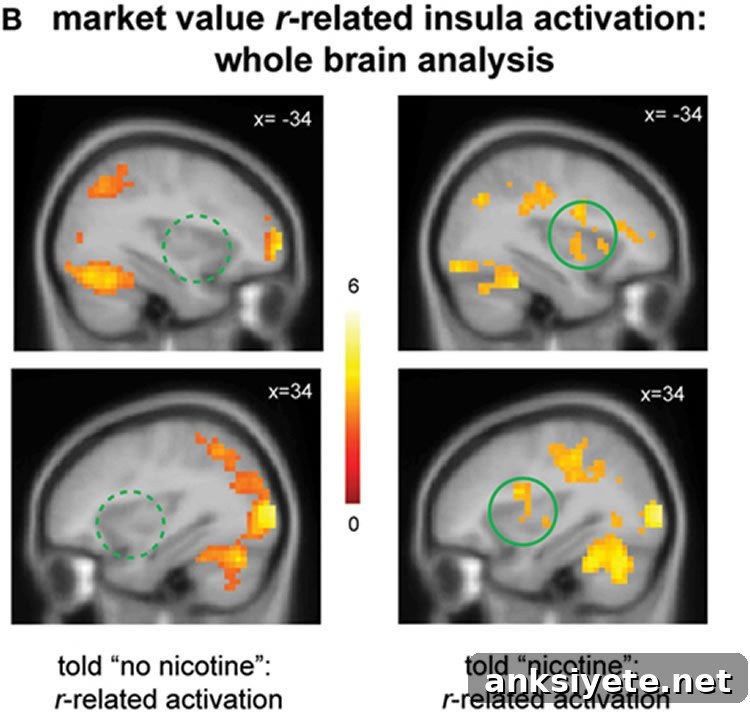
When smokers both received nicotine and were told the cigarette contained nicotine, scans revealed significant insula activation that correlated with reduced craving and with computational learning signals. By contrast, when smokers received nicotine but were told the cigarette contained no nicotine, those neural signatures and craving reductions were absent. Similarly, belief alone influenced insula responses tied to learning signals even when the cigarette contained no nicotine.
“These findings indicate that, for a drug effect to be fully realized in a person, their belief about the drug’s presence matters,” Gu said. The results build on earlier work showing that beliefs about nicotine can alter decision making and related neural signals.
Key findings:
- Smokers reported reduced craving only when they both received nicotine and believed they had smoked a nicotine cigarette.
- Insula activity associated with craving and learning was significant when participants were told the cigarette contained nicotine, regardless of nicotine’s actual presence in some analyses.
- Belief about nicotine can modulate brain signals linked to addiction and decision making, suggesting cognitive states are an important component of drug effects.
Methods summary: Twenty-four deprived smokers participated in a balanced placebo design study. Participants smoked under four belief/actual-content conditions and then completed an fMRI reward-learning task. Craving ratings were collected before smoking and after the task. Neural analyses focused on insula activation related to subjective craving and computational learning signals.
Funding: The study was supported by the National Institutes of Health, the Kane Family Foundation, the Wellcome Trust, and the Dallas Foundation.
Source: Ashley WennersHerron, Virginia Tech
Original research: “Belief about Nicotine Modulates Subjective Craving and Insula Activity in Deprived Smokers” by Xiaosi Gu, Terry Lohrenz, Ramiro Salas, Philip R. Baldwin, Alireza Soltani, Ulrich Kirk, Paul M. Cinciripini, and P. Read Montague. Frontiers in Psychiatry. Published online July 13, 2016. DOI: 10.3389/fpsyt.2016.00126
This study examines how cognitive beliefs influence craving and neural activity in nicotine-addicted individuals. Using a two-by-two balanced placebo design and fMRI, researchers found that belief about nicotine strongly affected subjective craving and insula responses related to both craving and learning. When smokers believed they had inhaled nicotine, craving decreased and insula activity increased in association with learning signals, but these effects were absent when smokers believed they had not smoked nicotine. The findings illuminate how beliefs and pharmacology interact in addiction and suggest cognitive states could be leveraged in treatment strategies.