
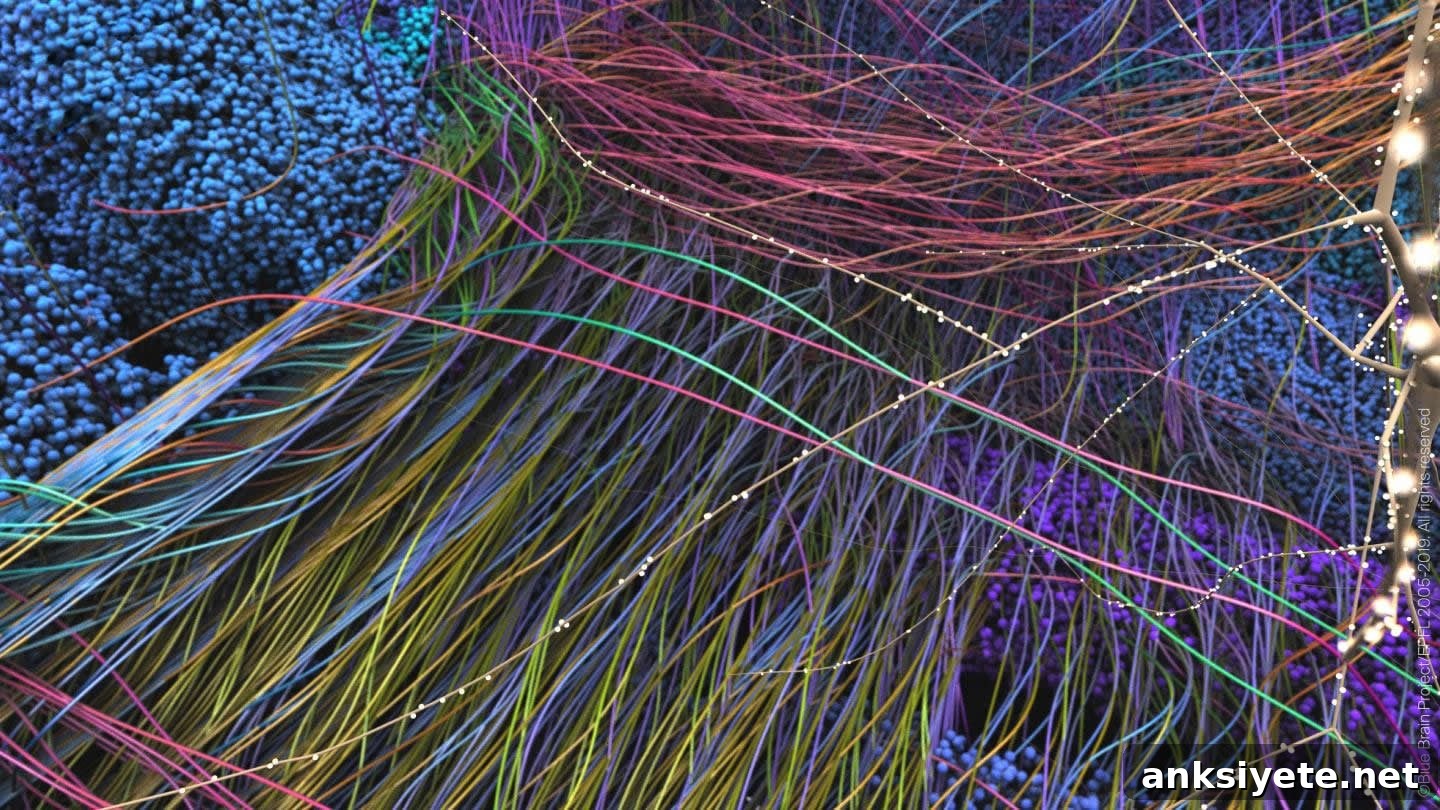
Summary: Researchers created statistical instances of a mouse micro-connectome that include more than 10 million neurons. The model covers five orders of magnitude in scale and represents roughly 88 billion synaptic connections.
Source: EPFL
The pattern of synaptic connections between neurons determines their activity and function. Until now, comprehensive maps of these connections—known as connectomes—have been measured only in extremely small tissue volumes, far smaller than a pinhead. For larger brain regions, long-range connectivity is carried by thin, lengthy axon bundles and has only been reconstructed for a limited number of individual neurons, leaving an incomplete picture. At the other extreme, macro-scale studies produce averaged, low-resolution maps that lack single-cell detail.
In a paper published in Nature Communications, researchers from the Blue Brain Project show that combining meso-scale and micro-scale datasets resolves this gap. By integrating two complementary resources—the Allen Mouse Brain Connectivity Atlas and Janelia MouseLight—the team inferred key principles that determine which individual neurons can form long-range connections across the neocortex. The two datasets complemented each other: one offers whole-neocortex coverage across regions, while the other provides cellular-level reconstructions of individual axons.
Complex, self-similar structure emerges at single-cell resolution
Using those inferred principles, the researchers extended previous local-circuit models and parameterized rules of neocortical connectivity to generate statistical instances of a whole-neocortex micro-connectome. Analysis of these instances revealed an unexpected result: network structures previously observed only between adjacent neurons also organize neurons across distant regions and even across opposite ends of the neocortex. This finding echoes a pattern of scale-invariant organization that had been seen in human MRI studies, and suggests that such self-similarity can persist down to the level of individual neurons.
“This forced me to rethink how we visualize long-range projections,” says lead author Michael Reimann. “Historically these axonal bundles were depicted as blunt cables that broadly link or synchronize entire regions. Our results indicate much more selective targeting—individual neurons can be specifically connected over long distances. And we identified that specificity from relatively coarse-grained rules. As tracing and imaging improve, I expect further refinements and additional targeting principles to emerge.”
An openly available null model to benchmark experiments and drive simulations
The team produced a first-draft, whole-neocortex micro-connectome by improving their circuit-building pipeline to place neurons inside anatomically accurate 3D atlas-defined volumes rather than simpler geometric approximations. The pipeline uses cellular composition data from the Blue Brain Cell Atlas and integrates multiple publicly available datasets to constrain projection strengths, topographical mapping, laminar (layer) profiles, and the detailed targeting behavior of individual axons—a set of constraints the authors call the “projection recipe.” Where unknown constraints likely further limit connectivity, the researchers left room for iterative refinement.
To accelerate validation and follow-up studies, the model, the parameterized projection rules, and stochastic instantiations of whole-neocortex micro-connectomes have been released to the public. These openly accessible connectome instances and sparse connection matrices can serve as powerful null models: researchers can compare their experimental data against these predictions, and modelers can use them as substrates for large-scale, biologically detailed brain simulations.
Advancing simulation as a research tool
The in-silico approach used by the team enables reconstruction and analysis of neural wiring across spatial scales that are currently inaccessible to experimental techniques. Simulations reach sub-cellular resolution of innervation, making it possible to predict how individual neurons are targeted and how those connections scale up to influence regional and whole-neocortex activity. The authors note that this approach builds on earlier Blue Brain work demonstrating morphological constraints on connectivity and on foundational reconstructions of neocortical microcircuitry.
As Blue Brain founder Prof. Henry Markram explains, these results accelerate the capacity to simulate larger and more accurate brain regions at higher resolution. With improved data and computational power, the team anticipates building increasingly realistic models that will further test the feasibility and value of detailed brain simulation.
Source:
EPFL
Media Contacts:
Kate Mullins – EPFL
Image Source:
Image credit: Blue Brain Project / EPFL.
Original Research: Open access
“A null model of the mouse whole-neocortex micro-connectome.” Michael W. Reimann, Michael Gevaert, Ying Shi, Huanxiang Lu, Henry Markram & Eilif Muller. Nature Communications.
Abstract
A null model of the mouse whole-neocortex micro-connectome
Connectomics has progressed on distinct but complementary scales: macro- and meso-scale mapping captures connections between neuronal populations, while micro-scale mapping resolves individual neuron-to-neuron connectivity. By combining these perspectives—region-to-region connectivity data with whole-brain single-axon reconstructions—the authors build a first-draft statistical model of the mouse neocortex micro-connectome. This hybrid approach uncovers a targeting principle that predicts how individual axons innervate distant regions from meso-scale inputs. The generated connectome reproduces biological trends across scales and proposes that scale-invariant topological organization extends to single neurons. The model provides a robust null hypothesis for experimental comparisons and a foundation for whole-brain, high-resolution simulations.