
Summary: New imaging of striosomal neurons reveals their role in predicting rewards and aversive outcomes during reinforcement learning.
Source: OIST
A surprising reward or a sudden penalty can become a lasting memory. If you touch a hot oven, you quickly learn to avoid it.
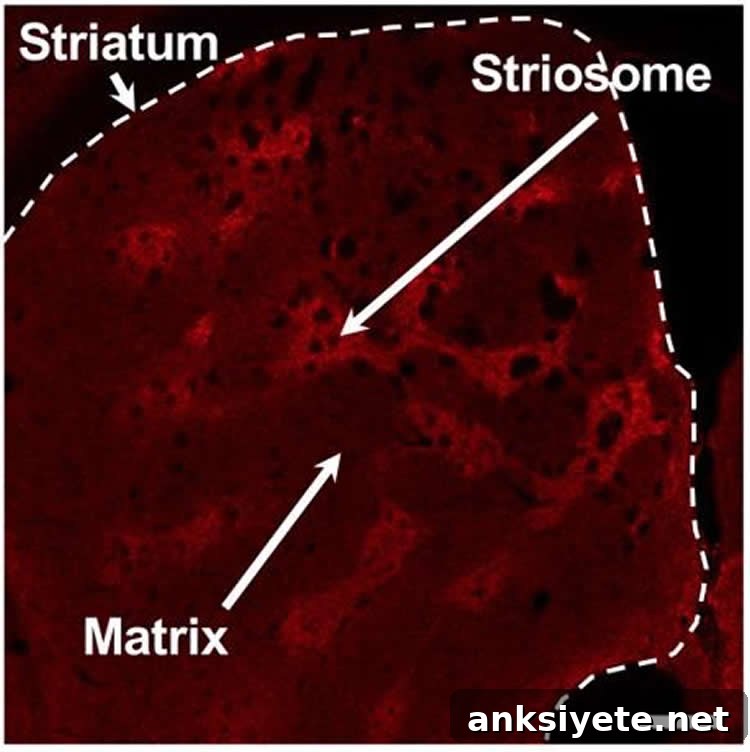
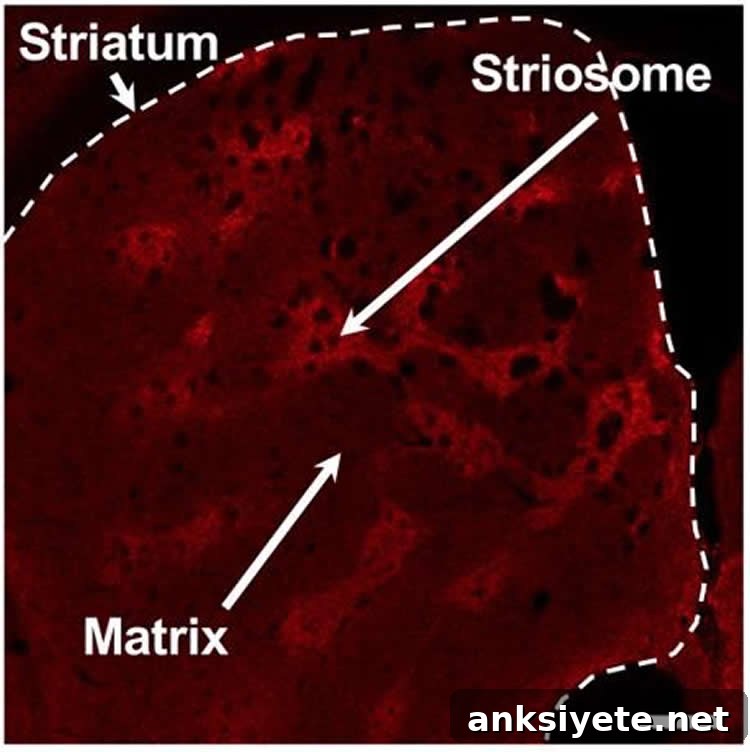
Learning through trial and error—called reinforcement learning—helps animals and humans adapt by associating sensory cues or actions with positive or negative outcomes. The basal ganglia, a group of forebrain structures, are central to this process. Within the basal ganglia, the striatum is arranged as a mosaic of two compartments: striosomes and the surrounding matrix. Although these compartments were discovered decades ago, their distinct contributions to learning have been difficult to determine.
Researchers in the Neural Computation Unit at the Okinawa Institute of Science and Technology Graduate University (OIST) applied advanced optical imaging and genetic targeting to isolate and record activity from striosomal neurons during learning. Their findings, published in eNeuro, clarify how striosomal neurons participate in reinforcement learning and how their activity changes across different stages of learning.
Scientists have speculated that striosomal neurons help predict whether a stimulus will lead to a positive outcome, a process called reward prediction. This hypothesis stems from the fact that striosomal neurons connect to midbrain neurons that release dopamine, a neuromodulator critical for motivation and reward-driven behavior.
“Reward prediction matters in everyday decisions,” explains Professor Kenji Doya, leader of the Neural Computation Unit. “For example, spotting your favorite dish on a menu can create excitement before you even taste it, and that expectation can guide your choice.”
Confirming the role of striosomes has been challenging because striosomal neurons are sparse—about 15% of the striatum—and are distributed in a mosaic pattern that makes them hard to identify in usual recordings, says Tomohiko Yoshizawa, an OIST technician and the paper’s first author.
To overcome these obstacles, the team used a transgenic mouse line that expresses calcium indicators specifically in striosomal neurons. These indicators fluoresce when neurons are active, allowing researchers to observe neural activity optically. Instead of removing large portions of overlying tissue to access the deep striatum, the team used a thin, rod-shaped lens on an endoscopic microscope to record activity with minimal damage. This combination of genetic targeting and endoscopic in vivo calcium imaging allowed prolonged recordings of identified striosomal cells while mice performed behavioral tasks.
In the experiment, mice were trained in an odor-conditioning task that paired four distinct scents—banana, lemon, cinnamon and mint—with four different outcomes: a large water reward, a small water reward, an aversive air puff to the face, or no outcome. As learning progressed, the mice began licking the water spout in anticipation when odors predicted water, even before any liquid was delivered.
Striosomal neurons in the dorsomedial striatum developed cue-driven activity that reflected the expected outcome. Neurons fired more strongly in response to odors that predicted water, and the magnitude of their responses scaled with reward size: cues signaling a larger reward elicited larger neural responses. Some striosomal neurons also responded when the actual outcomes—water or air puffs—were delivered, indicating these cells encode both expected and received outcomes.
By tracking the same identified striosomal neurons over several weeks, the researchers found that predictive, cue-related activity is specific to particular learning stages. Striosomal neurons showed strong predictive activity early in learning (around one week) and again during later stages (around two weeks), but these signals diminished after continued training. This pattern suggests that striosomal ensembles engage dynamically during critical periods of learning rather than maintaining constant predictive signals throughout extended practice.
The observation that striosomal cells both predict and respond to actual rewards and aversive events supports a model in which the striosomes influence dopaminergic systems by providing information about expected and experienced outcomes. Because the mosaic arrangement of striosomes and matrix compartments is conserved across rodents and primates, these findings in mice may offer insights relevant to human brain function.
Understanding how striosomal neurons contribute to reinforcement learning could inform research into neurological disorders linked to dysfunction in these circuits. Conditions such as Huntington’s disease and other basal ganglia disorders involve disrupted signaling within striatal compartments, and revealing the role of striosomes may help guide future diagnostic and therapeutic strategies.
Funding: Ministry of Education, Culture, Sports, Science and Technology; Okinawa Institute of Science and Technology Graduate University provided funding for this study.
Source and publisher: Kaoru Natori, OIST. Article organized by NeuroscienceNews.com.
Original research: “Reward-Predictive Neural Activities in Striatal Striosome Compartments” by Tomohiko Yoshizawa, Makoto Ito and Kenji Doya. Published in eNeuro. doi: 10.1523/ENEURO.0367-17.2018
Abstract
The striatum plays a key role in reward prediction and contains two anatomically distinct compartments, striosomes and matrix, with striosomes comprising roughly 15% of the volume and arranged in a mosaic. Identifying striosomal neurons electrophysiologically has been difficult, leaving open whether these neurons—known to project to midbrain dopaminergic cells—participate in reward prediction. Using a Sepw1-NP67 mouse line that selectively expresses a Cre recombinase in striosomal neurons together with endoscopic in vivo calcium imaging, we recorded identified striosomal neuron activity during an odor-conditioning task. Striosomal neurons in the dorsomedial striatum exhibited cue-predictive activity for odors associated with water rewards or aversive air puffs, and the strength of these signals scaled with expected outcome intensity. Longitudinal recordings showed that predictive activity was specific to certain learning stages and diminished after extended training. Additionally, some striosomal neurons responded to the actual delivery of rewards or air puffs. These results indicate that striosomes contribute to reward prediction through learning-stage-specific ensembles and convey both reward and aversive signals to dopaminergic neurons.