
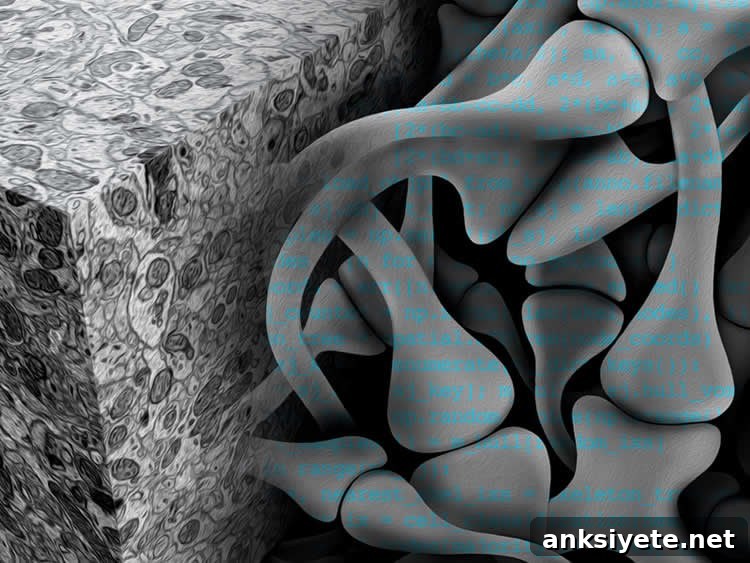
Summary: Researchers have trained deep neural networks to accelerate the reconstruction of neural circuits and to infer synaptic connectivity from large-scale electron microscopy data.
Neurobiologists Program a Neural Network to Map the Brain’s Wiring
Understanding how consciousness and complex behaviors emerge from neural activity depends critically on knowing how neurons connect to one another. These connections—synapses and the long, thin projections that link neurons—form the brain’s wiring, or connectome. Mapping the connectome at high resolution is one of modern neuroscience’s biggest challenges because brain tissue imaged by electron microscopy produces terabytes to petabytes of data. Until recently, the computational tools for reliably tracing neural circuits and identifying synapses were too slow or inaccurate, forcing researchers to spend enormous amounts of manual labor on data annotation.
Scientists at the Max Planck Institute of Neurobiology in Martinsried are changing that by combining advances in high-throughput electron microscopy with deep learning. Over the past several years the Electrons – Photons – Neurons Department has developed staining and imaging methods that convert brain tissue into three-dimensional, nanoscale electron microscope volumes. Their prototype microscope scans sample surfaces with 91 electron beams in parallel and then exposes the next sample level. Compared with previous instruments, this parallel-beam approach increases data acquisition rates by more than 50-fold. With this throughput, an entire mouse brain could be imaged in a few years rather than decades.
Although imaging at this scale is now feasible, analyzing the resulting teravoxel datasets remained a bottleneck. Conventional algorithms often fail to follow ultra-thin neurites across many image sections or to detect synaptic contacts reliably, which forces researchers to manually verify and correct segmentation and synapse annotations. To overcome this barrier, the Max Planck team led by Jörgen Kornfeld turned to deep convolutional neural networks (CNNs) and related machine-learning techniques to automate the inference of synaptic connectivity from volume electron microscopy.
Training Deep Networks to Recognize Neuronal Structures
The research team trained multiple convolutional neural networks to recognize key anatomical features in electron microscopy volumes: axons, dendrites, spines, synapses, mitochondria, myelin, somata, and cell-type–specific markers. Training required curated examples and careful validation so the models could distinguish true synaptic contacts from nearby cellular structures and reliably trace thin neuronal projections across sections. After iterative training and evaluation, the researchers assembled a processing pipeline called SyConn that combines deep CNNs with additional classifiers to produce richly annotated synaptic connectivity matrices from manual or automated neurite reconstructions.
Applied to datasets from multiple species, including zebrafish, mouse, and zebra finch, SyConn dramatically reduced the need for human proofreading. In analyses of songbird basal ganglia, the pipeline produced a synaptic wiring map with such low error rates that minimal human checking was required. That level of automation relieves neurobiologists of thousands of hours of repetitive annotation work, shortening the time needed to decode neural circuits and accelerating research into learning, memory, and disorders of the nervous system.
The team’s results also enabled biologically meaningful discoveries. For example, the study found relationships between cell activity and cellular structure: basal ganglia cell types with higher in vivo firing rates tended to have greater densities of mitochondria and synaptic vesicles. Synapse sizes and counts were also found to scale systematically depending on the postsynaptic cell type, revealing structure–function links that are accessible once large volumes can be annotated automatically.
Source: Stefanie Merker – Max Planck Institute
Image Source: NeuroscienceNews.com image is credited to Julia Kuhl.
Original Research: “Automated synaptic connectivity inference for volume electron microscopy” by Sven Dorkenwald, Philipp Schubert, Marius F. Killinger, Gregor Urban, Shawn Mikula, Fabian Svara, and Jörgen Kornfeld, published in Nature Methods (online February 27, 2017). DOI: 10.1038/nmeth.4206
Abstract (Summary of the Research)
Teravoxel volume electron microscopy datasets from neural tissue can now be acquired in weeks, but manual analysis still takes years. The SyConn framework uses deep convolutional neural networks and random forest classifiers to infer a richly annotated synaptic connectivity matrix from neurite skeleton reconstructions by automatically identifying mitochondria, synapses and their types, axons, dendrites, spines, myelin, somata and cell types. The approach was tested on serial block-face electron microscopy data from zebrafish, mouse and zebra finch, and used to compute the synaptic wiring of songbird basal ganglia. The analysis revealed that basal-ganglia cell types with high firing rates in vivo had higher densities of mitochondria and vesicles, and that synapse sizes and counts scaled systematically depending on the innervated postsynaptic cell types.