
Summary: A new study finds differences in hemispheric brain connectivity in people with autism spectrum disorder (ASD) compared with typically developing peers.
Brain hemispheres and specialization
Dividing cognitive labor between the left and right hemispheres is a hallmark of typical brain development. The left hemisphere tends to process details and language-related tasks, while the right hemisphere more often integrates diverse streams of information to produce a broader, more holistic interpretation of a situation. New research from San Diego State University (SDSU) shows that this hemispheric specialization appears to be reduced in young people with autism spectrum disorder.
The SDSU study: participants and methods
The research, conducted by the Brain Development Imaging Lab at SDSU and led by Ralph-Axel Müller, Ruth Carper and Jeffrey Treiber, used diffusion tensor imaging (DTI), a magnetic resonance imaging (MRI) technique that maps the microstructure of white matter pathways. The team analyzed scans from 41 children and adolescents diagnosed with ASD and 44 matched typically developing (TD) peers. Their objective was to compare the density and microstructural asymmetry of white matter connections across the two groups.
Key findings
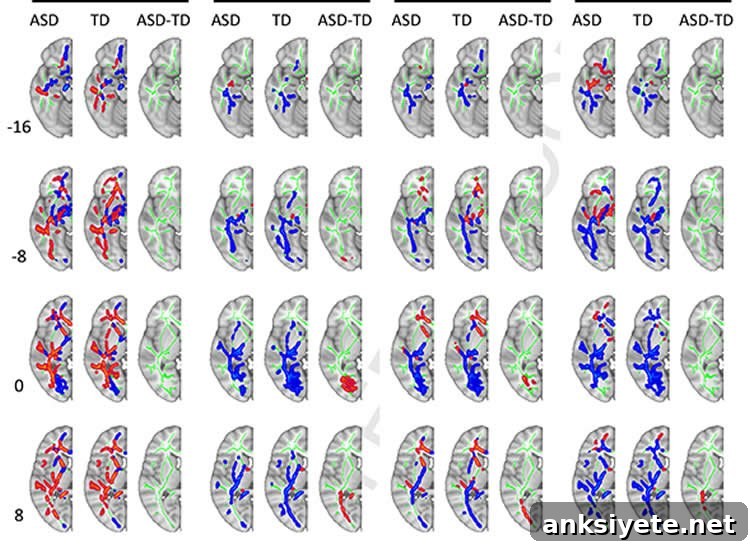
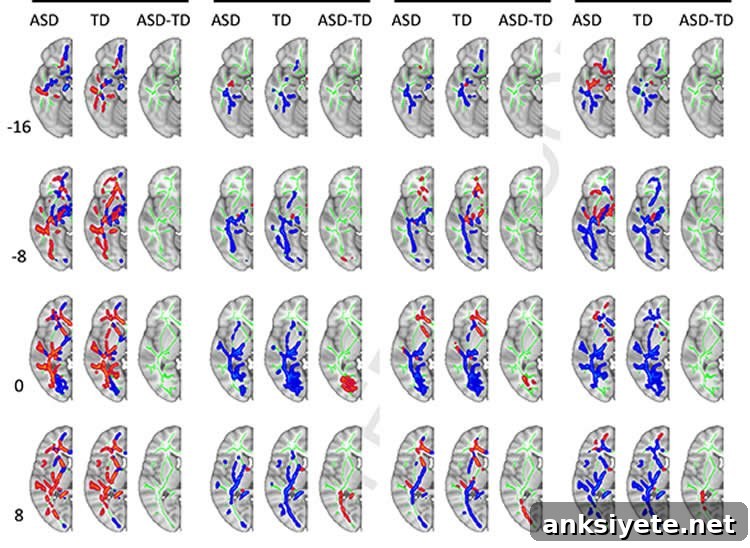
In typically developing participants, the researchers observed pronounced rightward asymmetry in fractional anisotropy (FA), indicating denser or more organized connections in the right hemisphere. Mean diffusivity (MD) showed leftward asymmetry in TD participants, with complementary patterns in axial and radial diffusivity. These patterns are consistent with a division of labor in which the right hemisphere supports integrative processing and the left hemisphere supports more specialized, focal processing.
In contrast, individuals with ASD exhibited a more symmetrical distribution of white matter microstructure across the hemispheres. The ASD group showed reduced hemispheric asymmetry for FA across the whole brain and reduced asymmetry for MD, axial diffusivity, and radial diffusivity in a region of occipital white matter where several major association and projection tracts converge. The overall pattern indicates a weakening of the typical left-right specialization seen in TD youth.
Implications for cognition and autism characteristics
The reduced hemispheric asymmetry observed in ASD may relate to cognitive traits commonly reported in the condition. One proposed link is to “weak central coherence,” a tendency to focus on local details at the expense of global integration — in other words, “seeing the trees but not the forest.” If the right hemisphere normally helps combine multiple information streams into coherent, integrative representations, then a reduction in rightward specialization could make global integration more difficult for some people with ASD.
The study does not establish causation: it remains unclear whether altered white matter asymmetry drives differences in information integration, or whether atypical patterns of perception and cognition influence white matter development. Longitudinal research will be needed to clarify timing and causal relationships between brain connectivity and behavioral traits.
Next steps and infrastructure
Future studies will benefit from improved local imaging capacity. SDSU planned to open an imaging facility within its Engineering and Interdisciplinary Sciences Complex to support ongoing research; installation of the facility’s MRI system was scheduled for the year following the study’s publication. Expanded imaging resources will allow larger and, ideally, longitudinal studies to trace how white matter asymmetry evolves with age and experience in ASD and typically developing populations.
Abstract summary
This study presents a comprehensive analysis of white matter microstructure asymmetries in children and adolescents with and without ASD. Using tract-based spatial statistics on diffusion tensor imaging data, the research identified typical rightward FA and leftward MD asymmetries in TD participants. Those asymmetries were significantly reduced in youth with ASD, both in whole-brain FA and within occipital regions where multiple tracts run closely together. No relationships were found between global white matter asymmetry and age or measures of social-communicative ability in this sample. The authors interpret the TD asymmetries as reflecting different processing modes across hemispheres—more integrative in the right, more specialized in the left—and conclude that this hemispheric “division of labor” appears diminished in ASD.
Source: San Diego State University (SDSU).
Authors / Investigators: Ralph-Axel Müller, Ruth Carper, Jeffrey Treiber and colleagues from the SDSU Brain Development Imaging Lab.
Publication: Journal of the American Academy of Child & Adolescent Psychiatry. Article: “Reduced Hemispheric Asymmetry of White Matter Microstructure in Autism Spectrum Disorder” by Ruth A. Carper, PhD; Jeffrey M. Treiber, BA; Shannon Yandall DeJesus; and Ralph-Axel Müller, PhD. Published online September 28, 2016. DOI: 10.1016/j.jaac.2016.09.491.
Image credit: Ralph-Axel Müller.
This summary synthesizes the study’s methods and findings while emphasizing the potential cognitive implications of altered hemispheric specialization in ASD. Additional research, including longitudinal and larger-sample studies, is necessary to determine developmental trajectories and causal relationships between white matter asymmetry and autism-related behaviors.