Approaching black people may cause time expansion effects.
White Americans who experience anxiety around people of a different race may perceive approaching Black individuals as moving more slowly or lasting longer in view, a series of experiments suggests. The findings, published in the Journal of Experimental Psychology: General, highlight how intergroup anxiety can alter basic perceptual processes such as motion and time perception, with potential consequences for eyewitness memory and social interactions.
Researchers presented white adult participants with images of faces that appeared to move toward or away from the viewer on a computer screen. Participants rated either the apparent speed or the perceived duration that each face occupied the screen. They also completed a questionnaire designed to measure racial anxiety—how uncomfortable or uneasy they felt when around people of another race.
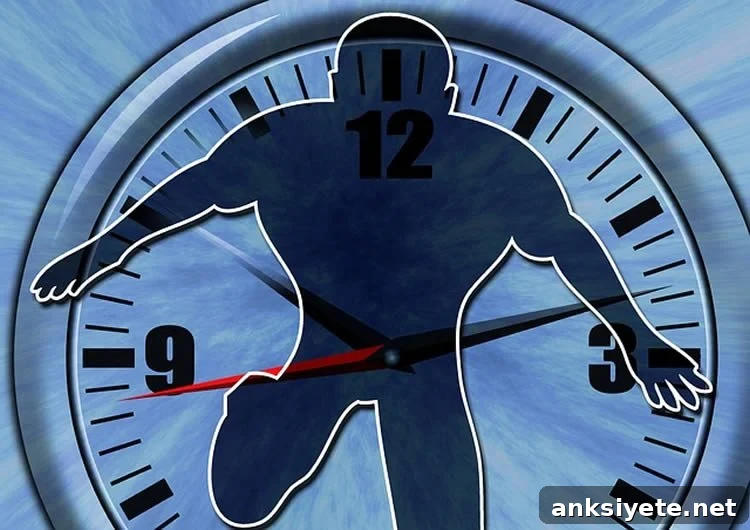
The pattern was consistent across multiple laboratory and online experiments: white participants who reported higher levels of racial anxiety showed a bias in their perception of approaching Black faces. In four image-based experiments, anxious white observers judged approaching Black faces as moving more slowly and as being present for a longer period than equivalent white faces. These effects emerged only for faces that seemed to be coming closer, not for faces appearing to move away, suggesting the effect is linked to perceived threat in approach situations.
One additional online experiment produced a somewhat different finding: when asked to imagine a person moving toward them, participants with greater racial anxiety imagined the Black person was moving more quickly. The authors suggest this discrepancy may reflect differences between imagined scenarios and immediate perceptual experience. Overall, the strongest and most consistent evidence across the studies supports a time-expansion effect for approaching Black faces among anxious white observers.
The pooled sample across all experiments exceeded 500 white adults, recruited online, at a university, and at a shopping mall in New Jersey. Participants were roughly balanced by gender and varied in age. Because the studies included only white participants, the research does not address whether Black observers with high intergroup anxiety would show comparable perceptual biases when viewing approaching white targets.
The authors caution that these perceptual distortions do not necessarily indicate overt racial hostility or explicit prejudice. Racial anxiety can stem from unfamiliarity, concern about saying the wrong thing, or worry about being perceived as prejudiced. In other words, the measured effect may reflect discomfort and heightened arousal rather than deliberate bias.
Lead researcher Andreana Kenrick, PhD, noted that the findings mirror reports from people who survive threatening incidents, who often describe a subjective slowing of time. Heightened attention and arousal in anxious moments can stretch experienced duration, making events seem to take longer and actions appear slower. In social encounters, that same perceptual slowing may influence memory confidence and the interpretation of ambiguous behavior.
These perceptual shifts have important practical implications. If anxious observers perceive time as extended, they may later feel overly confident in identifying an individual or in interpreting their movements as threatening. This could contribute to misinterpretations of innocuous actions and errors in eyewitness testimony. The authors emphasize the need for additional research before drawing strong conclusions about the downstream social or legal impacts.
Source: Kim I. Mills – APA
Original Research: “Moving While Black: Intergroup Attitudes Influence Judgments of Speed” by Andreana C. Kenrick, Stacey Sinclair, Jennifer Richeson, Sara C. Verosky, and Janetta Lun in Journal of Experimental Psychology: General. Published online November 2, 2015. doi:10.1037/xge0000115
Abstract
Moving While Black: Intergroup Attitudes Influence Judgments of Speed
Four experiments investigated whether intergroup attitudes shape judgments about how fast Black people are moving. When white participants rated the speed of Black and White faces that appeared to advance toward them, greater intergroup anxiety correlated with judging Black targets as moving more slowly relative to White targets (Experiments 1a and 1b). Experiment 2 showed the effect occurs specifically for approaching targets. Experiment 3 indicated the bias arises at least in part from perceived duration—the time each image appeared to move—consistent with time expansion and perceptual slowing reported in threatening situations.