
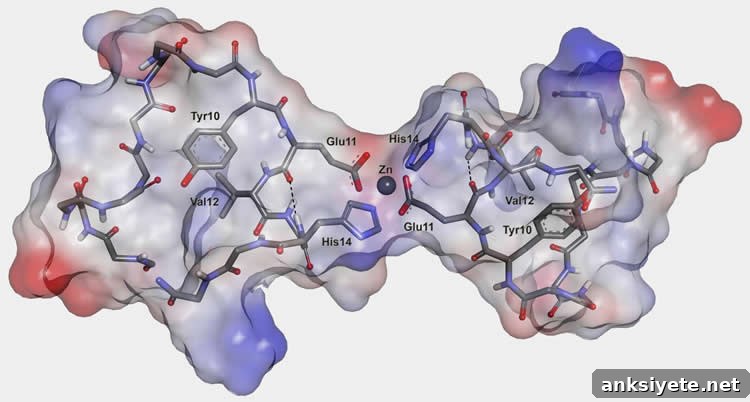
A team of scientists from Lomonosov Moscow State University, together with researchers from the Institute of Molecular Biology at the Russian Academy of Sciences and King’s College London, has clarified key steps in the development of Alzheimer’s disease and identified a likely trigger. Their study was published in Scientific Reports.
“Alzheimer’s disease is a common degenerative disorder of the central nervous system that causes progressive loss of cognitive abilities,” explains Vladimir Polshakov, lead researcher at MSU’s Faculty of Fundamental Medicine. “Until now the condition was widely regarded as incurable. By working out the mechanism that drives disease progression, we may now be able to design chemical compounds that prevent or reverse the destructive process.”
Several competing ideas aim to explain how Alzheimer’s develops. One of the most prominent is the amyloid hypothesis, which centers on beta-amyloid peptides. In healthy conditions these protein fragments help protect brain cells and are rapidly removed by proteases — enzymes that break down and clear used proteins. According to the amyloid hypothesis, however, this balance is disturbed and protective peptides become toxic. They begin to aggregate, forming assemblies that evade protease activity and eventually build up into the amyloid plaques found in affected brains. While the later stages of plaque accumulation are well described, the very early steps by which native beta-amyloid transforms into harmful assemblies remain poorly understood.
“Previous work indicated that transition metal ions, particularly zinc, play an important role in triggering these pathological changes,” Polshakov says. “Zinc has many normal and beneficial functions in the brain, but it has long been suspected of initiating a cascade of events that lead to Alzheimer’s. What remained unclear was the precise chemistry: how zinc ions interact with peptide molecules, which amino acids bind zinc, and how those interactions promote peptide aggregation. Our goal was to clarify some of those questions.”
The team focused on several pathogenic Aβ (beta-amyloid) peptide variants and their metal-binding domains — short peptide segments that coordinate metal ions. They used a combination of experimental techniques, including nuclear magnetic resonance (NMR) spectroscopy, to determine the structures of zinc-induced complexes. Some spectra requiring greater sensitivity were acquired at facilities in London. One of the studied variants carries the so-called “English mutation,” differing from the common Aβ sequence by a single amino acid substitution; another was an isomerized form of the peptide, in which the aspartic acid residue adopts an altered atomic configuration. This kind of spontaneous isomerization accumulates with age and is therefore relevant to Alzheimer’s disease.
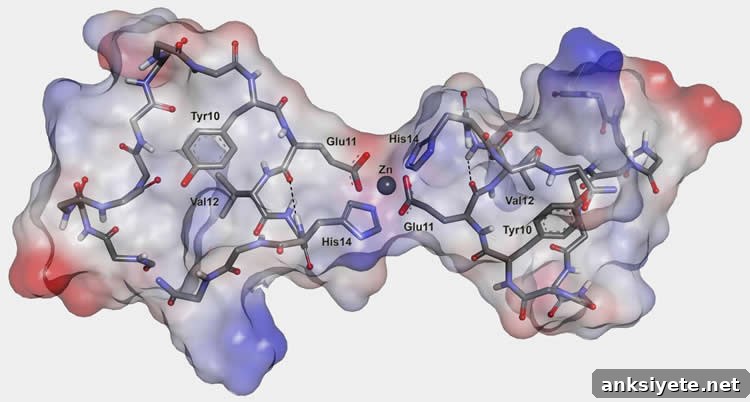
Biologists at the Moscow Institute of Molecular Biology previously showed that introducing an isomerized peptide into transgenic mice accelerates plaque formation. In vitro, the metal-binding domain of the isomerized peptide aggregated so rapidly in the presence of zinc that the intermediates were difficult to isolate. Despite differences in aggregation kinetics between the English mutant and the isomerized peptide, the researchers found a common initiating event: formation of zinc-bridged dimers. In each case the earliest detectable pathogenic species was a dimer consisting of two peptide molecules linked by a single zinc ion. Similar dimers were also found with normal human Aβ peptides. The distinctions among peptide forms can be largely explained by differences in how quickly such dimers form and how prone they are to further aggregation.
From these observations the authors proposed a detailed mechanism for zinc-controlled conversion of a protective peptide into a toxic aggregate-forming species. According to their model, specific histidine residues in the N-terminal Aβ1–16 metal-binding region govern a zinc-mediated oligomerization pathway. One minimal zinc-binding motif, residues 6HDSGYEVHH14, and in particular histidine-6 and the 11EVHH14 segment, form two zinc-dependent interaction interfaces that stabilize dimers and promote subsequent oligomer growth. The mechanism accounts for multiple experimental results from this group and other laboratories working on Alzheimer’s disease.
The researchers suggest that these structural determinants — the histidine residues and the two zinc-mediated interfaces in the Aβ metal-binding domain — represent promising targets for rational drug design. Compounds that specifically block zinc binding or disrupt the early zinc-bridged dimer formation could prevent the pathological aggregation that leads to Alzheimer’s disease.
Source: Vladimir Koryagin – Lomonosov Moscow State University
Image source: Lomonosov Moscow State University.
Original research: Full open-access research: “Interplay of histidine residues of the Alzheimer’s disease Aβ peptide governs its Zn-induced oligomerization” by Andrey N. Istrate, Sergey A. Kozin, Sergey S. Zhokhov, Alexey B. Mantsyzov, Olga I. Kechko, Annalisa Pastore, Alexander A. Makarov and Vladimir I. Polshakov in Scientific Reports. Published online February 22, 2016. doi:10.1038/srep21734
Abstract
Interplay of histidine residues of the Alzheimer’s disease Aβ peptide governs its Zn-induced oligomerization
Conformational changes of the Aβ peptide convert it from a native monomeric state into toxic soluble dimers, oligomers and insoluble aggregates that are characteristic of Alzheimer’s disease (AD). Zinc interactions with the N-terminal Aβ1–16 domain appear to play a key role in AD progression and can trigger plaque formation. The authors determined structures and functional properties of metal-binding domains from several Aβ variants and found that Zn-induced oligomerization is governed by conformational changes within the minimal zinc-binding site 6HDSGYEVHH14. Residue H6 and the 11EVHH14 segment are critical for forming two zinc-mediated interaction interfaces in Aβ. These structural features are promising targets for designing therapeutics aimed at blocking pathological Aβ aggregation.