
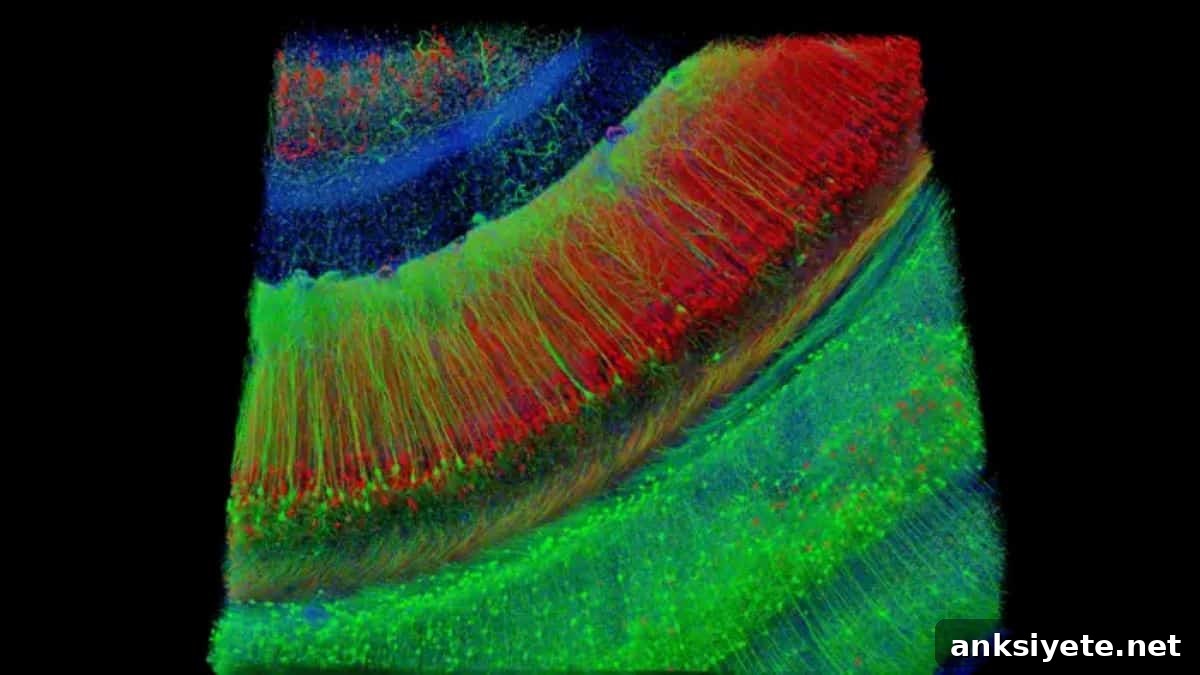
Summary: Why does Alzheimer’s disease (AD) destroy some neurons while leaving neighboring cells intact? With a significant five-year grant from the National Institutes of Health, researchers at the USC Stevens Neuroimaging and Informatics Institute are building a detailed, multiscale digital model of the hippocampus to address this question. The project aims to trace how changes at the molecular level cascade through circuits and memory networks, revealing the points where resilience gives way to dysfunction.
The team is constructing a virtual testbed that links gene expression, cellular physiology, three-dimensional circuit structure, and large-scale brain network dynamics. This integrated model will let scientists simulate stages of disease progression that cannot be observed directly in living patients, helping to identify when and where memory networks cross critical thresholds and begin to fail.
Key Facts
- Multiscale modeling: The project connects three biological scales—molecular signatures of individual cell types, local 3D circuit reconstructions, and whole-brain networks at the resolution used in functional MRI—so changes at one level can be simulated and evaluated for their effects at other levels.
- Targeting neuronal vulnerability: Alzheimer’s pathology is selective: some hippocampal neurons deteriorate while adjacent cells remain functional. The study focuses on early gene expression and structural changes that mark neurons destined to fail, in order to understand why vulnerability varies across cell types.
- A virtual testbed for interventions: By modeling disease trajectories, researchers can test whether protecting or restoring specific neuron types stabilizes memory circuits and delays or prevents network collapse—information that is impractical or unsafe to obtain in human subjects.
- Precision neuroscience framework: The project builds on the Hippocampus Gene Expression Atlas (HGEA), which maps distinct hippocampal neuron populations by their gene activity and connectivity, enabling cell type–specific simulations and predictions.
- Open science commitment: All computational models, data products, and methodological tools developed during the program will be shared openly, maximizing the benefit of the NIH investment and accelerating progress in Alzheimer’s research worldwide.
Source: USC
By linking cellular detail to whole-brain network function, the research team hopes to uncover the critical changes in Alzheimer’s progression that point to earlier and more effective interventions.
A multidisciplinary team led by Michael S. Bienkowski, PhD, assistant professor of physiology and neuroscience and of biomedical engineering at the Keck School of Medicine of USC, has been awarded a five-year NIH R01 grant to develop a high-resolution, cell type-specific multiscale model of the hippocampus. The hippocampus is essential for memory formation and is among the first regions affected in Alzheimer’s disease.
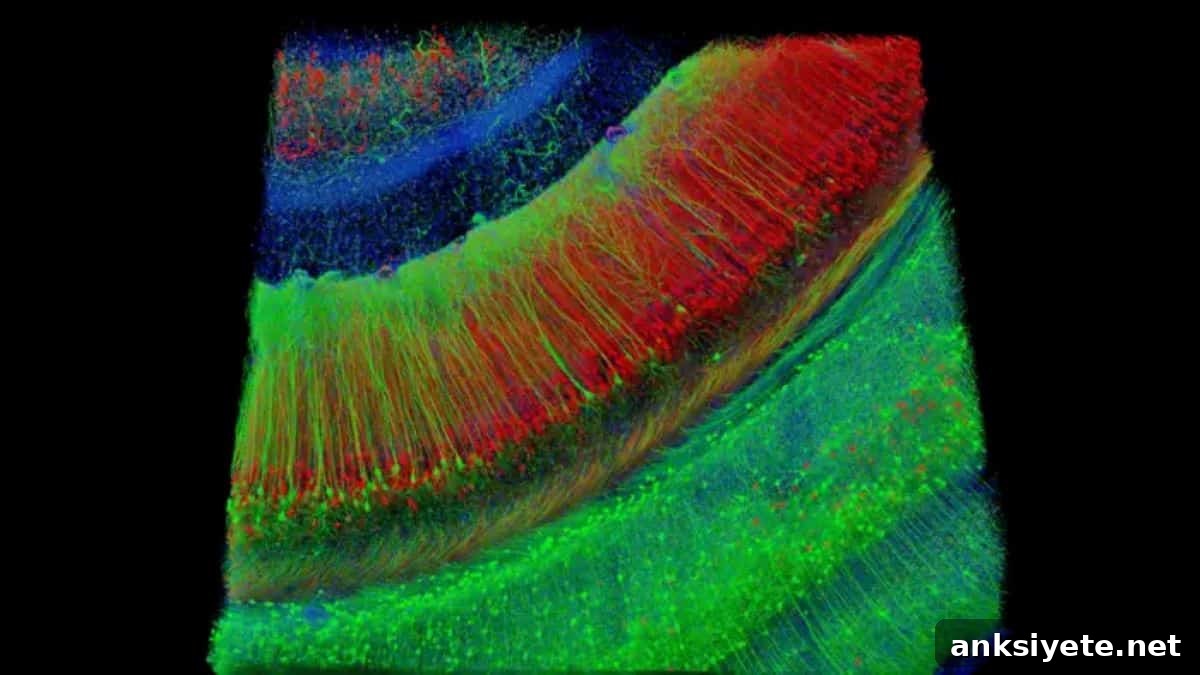
A multiscale approach integrates observations across levels of organization: molecular data that define cell types and their changing gene expression; high-resolution anatomical reconstructions of local circuits; and systems-level models that capture how hippocampal activity interacts with broader memory networks. Linking these levels creates a coherent framework for testing how specific cellular changes lead to progressive network dysfunction and cognitive decline.
Alzheimer’s affects more than 6 million Americans and is expected to rise substantially in coming decades. While amyloid and tau proteins are hallmarks of the disease, their presence does not explain why some neurons die and others do not. The model seeks to identify vulnerable cell types, trace the sequence of molecular and structural alterations they experience, and determine how those changes compromise circuit-level operations important for memory.
“Alzheimer’s doesn’t damage the brain uniformly,” said Bienkowski. “Even within the same hippocampal region, some neuron populations deteriorate rapidly while neighboring populations remain relatively intact. Our goal is to model how those cellular and molecular changes progressively undermine hippocampal network function and lead to measurable memory deficits.”
The research extends Bienkowski’s prior work on the Hippocampus Gene Expression Atlas (HGEA), which delineates hippocampal neuron populations by gene expression profiles and connectivity patterns. Integrating HGEA with new molecular imaging datasets, three-dimensional circuit models, and advanced computational simulations will enable the team to simulate disease progression with cell type resolution.
Key collaborators include computational neuroscientists Gianluca Lazzi, PhD, and Jean-Marie Bouteiller, PhD, whose expertise in biophysical and systems modeling of hippocampal circuits is essential to translating molecular and structural data into dynamic simulations. The project will analyze both genetically engineered mouse models of AD and donated human brain tissue to identify early signs of cellular stress, changes in gene expression, or synaptic disconnection that precede cell death.
“By integrating changes observed at multiple time points and scales, this model serves as a virtual laboratory,” said Bienkowski. “It allows us to evaluate how protecting specific neurons or circuit elements might stabilize memory-related networks, and to prioritize therapeutic strategies that target those critical tipping points before damage becomes irreversible.”
Arthur W. Toga, PhD, director of the Stevens INI, emphasized the broader shift toward precision neuroscience. “This work shows how combining large-scale data, cutting-edge imaging, and computational modeling can deepen our understanding of neurodegeneration,” he said. “By pinpointing which neurons and circuits are most crucial and when they become vulnerable, we can better align clinical studies with the underlying biology and move toward more targeted treatments.”
All algorithms, models, and supporting data from the project will be released openly to the research community, enabling other investigators to validate findings, build on the tools, and accelerate discovery across the field.
Key Questions Answered:
A: The hippocampus is the brain’s primary hub for forming and consolidating memories and is often one of the first regions affected by Alzheimer’s. Modeling this region in detail—from genes to circuits to network interactions—offers critical insight into how memory breakdown begins and provides a tractable, high-impact target for interventions that could be applied more broadly across the brain.
A: Virtual models do not replace human studies but complement them. They enable controlled, repeatable experiments—such as selectively damaging or protecting specific cell types—and let researchers observe downstream effects across scales in ways that are impossible or unsafe in living humans. The model functions like a simulator to generate hypotheses and prioritize experiments for eventual clinical translation.
A: Tipping points are thresholds where accumulated cellular and synaptic damage overwhelms a network’s capacity to compensate, triggering rapid functional decline and clinical symptoms. Identifying these moments could enable interventions timed to preserve network integrity and slow or prevent the onset of dementia.
Editorial Notes:
- This article was edited by a Neuroscience News editor.
- Journal paper reviewed in full.
- Additional context provided by staff.
About this Alzheimer’s disease research news
Author: Laura LeBlanc
Source: USC
Contact: Laura LeBlanc – USC
Image: The image is credited to Stevens INI