
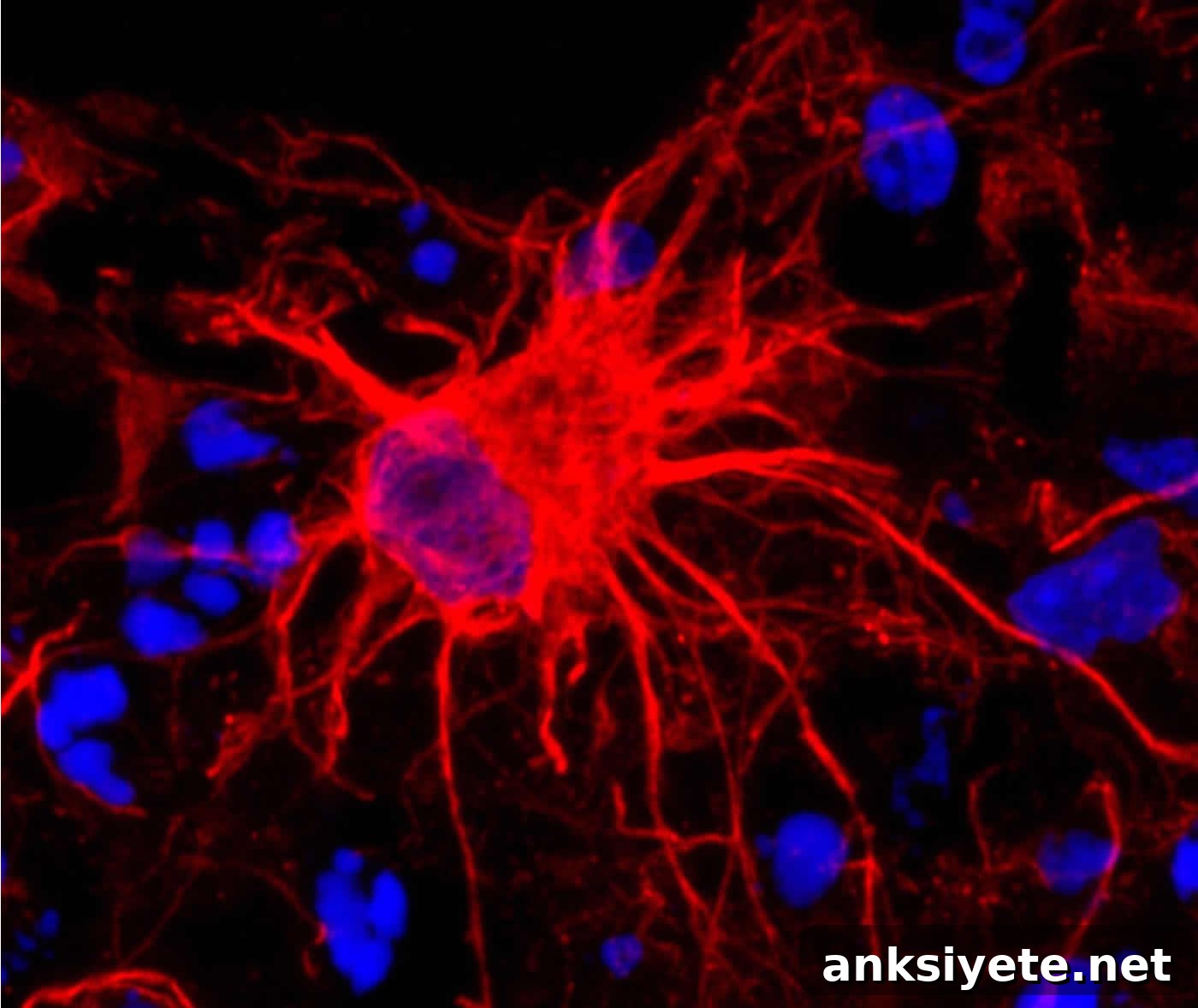
Summary: Researchers tracked the maturation of astrocytes produced from human cortical spheroids (hCSs) and found that the lab-grown cells develop on a timeline comparable to astrocytes in the human brain.
Source: NIH/NINDS.
NIH-funded study establishes a model to study astrocyte development and its link to brain disorders
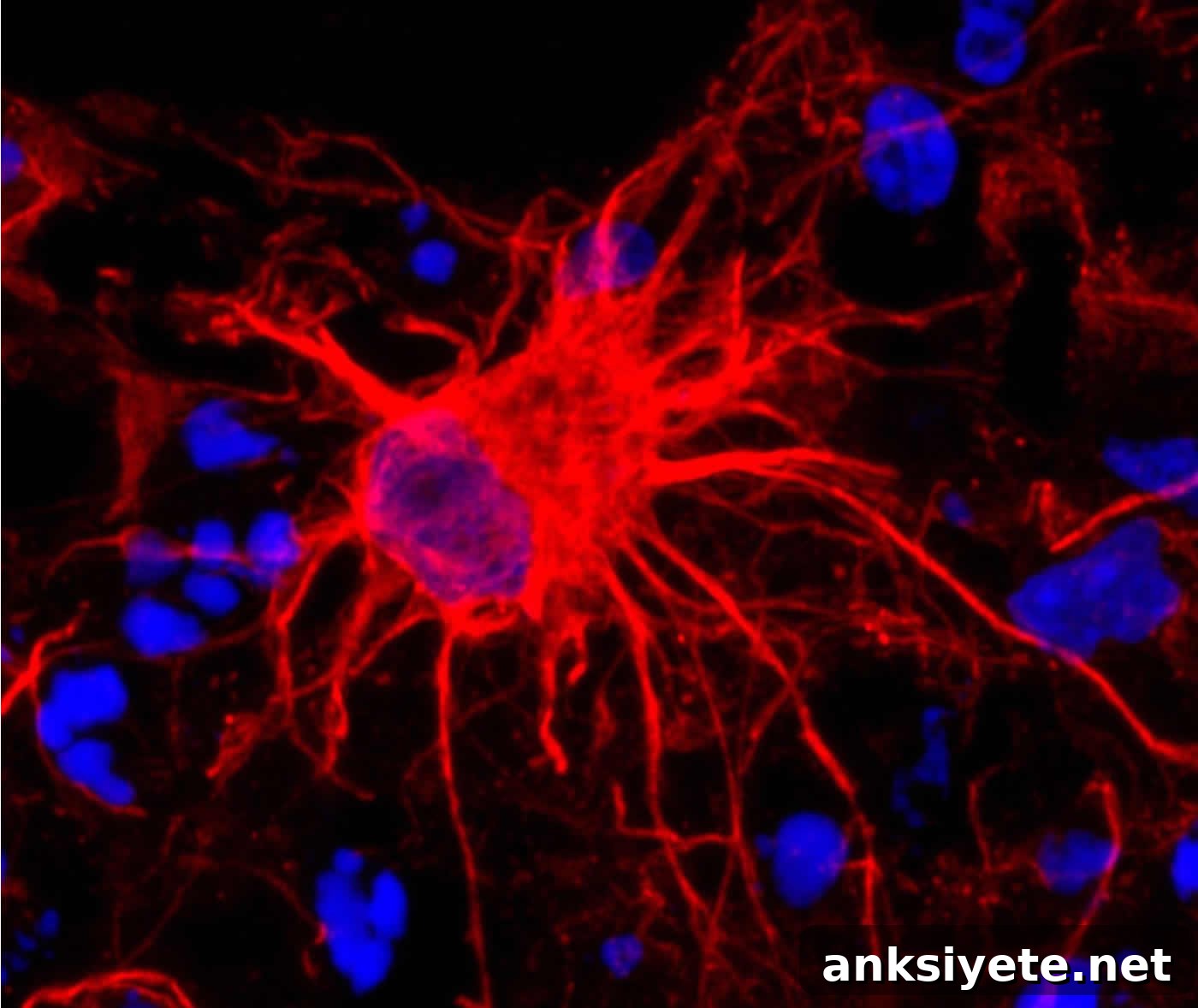
Astrocytes, the star-shaped support cells of the brain, have received renewed scientific attention because of their active roles in neural development and disease. A team of researchers examined how astrocytes mature within three-dimensional human cortical spheroids (hCSs), lab-grown cell clusters that mimic aspects of human cortical tissue. Their results, published in Neuron and supported in part by the NIH’s National Institute of Neurological Disorders and Stroke (NINDS), show that astrocytes formed in hCSs progress through developmental stages at rates comparable to those observed in human brain tissue.
“This work fills an important gap in human brain research by providing a robust method to study astrocyte development in both normal and diseased states,” said NINDS program director Jill Morris, Ph.D.
Building on a 2015 protocol developed by Sergiu Pasca, M.D., and Ben Barres, M.D., Ph.D., the researchers used adult skin cells reprogrammed into induced pluripotent stem cells (iPSCs) and then guided them to form three-dimensional cortical spheroids. These hCSs recapitulate many cellular features of the human cortex and can be maintained for many months, allowing investigators to follow the emergence and maturation of neurons, astrocytes, and other brain cell types over extended time periods.
“One of the major challenges in studying the human brain is accessing and characterizing cells across developmental stages,” Dr. Pasca said. “Human cortical spheroids provide a system that can replay aspects of brain development step by step.”
In the current study, led experimentally by Steven Sloan, an M.D./Ph.D. student at Stanford, the team compared astrocytes from hCSs to astrocytes isolated from developing and adult human brain tissue. The spheroids were cultured for up to 20 months, making this one of the longest longitudinal analyses of lab-grown human brain cells to date.
Across multiple measures—gene expression profiles, cellular morphology, and functional behaviors—the astrocytes derived from hCSs exhibited age-related changes that paralleled those seen in human brain samples. For example, astrocytes from spheroids younger than six months were highly proliferative and strongly engaged in pruning excess neuronal connections, a hallmark of very early brain development. By contrast, astrocytes from spheroids older than nine months showed greatly reduced proliferative capacity and removed fewer synaptic connections, resembling astrocytes from infants aged six to twelve months. Yet both early-stage and later-stage hCS astrocytes retained the ability to promote new synapse formation, mirroring observations made in developing and mature human tissue.
“These findings show that astrocytes are active participants in neural circuit formation and refinement, not merely passive support cells,” Dr. Pasca explained.
David Panchision, Ph.D., program director at the National Institute of Mental Health (NIMH), which also contributed funding, emphasized the potential human-specific significance: “Astrocytes compose a larger fraction of the human brain than in many other species, suggesting they play particularly important roles in human neural function and that their dysfunction could have substantial consequences for brain health.”
The investigators caution that hCSs remain a model system and lack many features present in an intact brain, including full vascularization, certain cell types, and long-range connectivity. Some genes characteristic of fully mature astrocytes did not become active in the hCS-derived cells within the time frame studied, raising the possibility that additional maturation would occur with longer culture or with altered conditions. To address this, the team aims to discover methods to accelerate maturation and to use hCSs to dissect the molecular triggers that drive astrocyte development. Such approaches could also support screening efforts for compounds that correct astrocyte dysfunction linked to neurological and psychiatric disorders.
“We now have a way to replay human astrocyte development starting from any patient’s cells,” Dr. Barres said. “That capability opens new opportunities to study disease mechanisms and to test potential therapies in a human cellular context.”
Funding: This research was supported by the National Institute of Neurological Disorders and Stroke (NINDS) (NS081703), the National Institute of Mental Health (NIMH) (MH099555, MH107800, MH106261), the National Institute of General Medical Sciences (GM007365), the National Center for Advancing Translational Sciences (TR001085), the California Institute of Regenerative Medicine, the MQ Fellow Award, and Stanford University.
Source: Brandon Levy — NIH/NINDS
Image credit: Sergiu Pasca, M.D., Stanford University.
Publication: The study appears in the journal Neuron.
NIH/NINDS. “Astrocytes Given Star Treatment.” Neuroscience News, 16 August 2017.