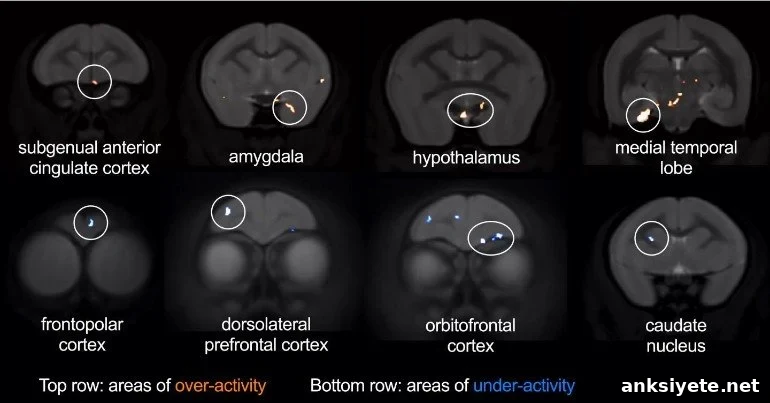
Summary: Overactivity in the subgenual anterior cingulate cortex (sgACC) appears to drive key symptoms of depression, anxiety and cardiovascular dysregulation.
Source: University of Cambridge
New research identifies over-activity in a single brain region, the subgenual anterior cingulate cortex (sgACC), as a driver of multiple symptoms seen in mood and anxiety disorders. The study also shows that different symptom clusters produced by the same neural change respond differently to treatment.
Published in the journal Nature Communications, the study from the University of Cambridge maps how increased sgACC activity affects emotion, physiology and behavior, and how those effects relate to treatment response. The findings suggest that targeting treatment according to a patient’s dominant symptoms could improve outcomes for depression and anxiety.
Depression and anxiety are heterogeneous: some people primarily experience heightened negative emotions such as guilt and worry, others lose the ability to feel pleasure (anhedonia), and many have a mixture of symptoms. Understanding which brain circuits produce which symptoms is essential for developing targeted therapies.
Using marmosets, a non-human primate model with brain anatomy and function that parallels human systems, researchers selectively increased activity in sgACC by infusing very small amounts of an excitatory compound. This causal approach allowed the team to observe the downstream physiological, behavioral and neural consequences of sgACC over-activation.
They found that raising sgACC activity shifted the animals’ physiology toward a stress profile: higher heart rate, reduced vagal tone, altered cortisol dynamics and greater cardiovascular reactivity. Behaviorally, the marmosets showed amplified responses to threat and impaired regulation of fear, consistent with core features of anxiety and stress-related depression.
“Over-activation of sgACC promoted a ‘fight-or-flight’ state rather than a ‘rest-and-digest’ state, by engaging the cardiovascular system and increasing threat responsiveness,” said Dr Laith Alexander, one of the study’s first authors in the Department of Physiology, Development and Neuroscience at the University of Cambridge.
In addition to increased reactivity, the team had previously shown that sgACC over-activity reduces anticipation and motivation for reward, modeling anhedonia seen in depression. The current work extends that picture by demonstrating concurrent increases in anxiety-like behaviors and physiological stress markers.
To assess fear learning and emotion regulation, researchers trained the marmosets to associate a tone with a rubber snake, an innately threatening stimulus. After the association was learned, the tone was repeatedly presented without the snake to measure extinction—how quickly the animals could downregulate their fear response. When sgACC was over-activated, marmosets remained fearful for longer, both in behavior and blood pressure measures, indicating disrupted emotion regulation.
When exposed to the uncertain threat of an unfamiliar human, the animals were also more anxious following sgACC over-activation, keeping their distance and showing heightened vigilance.
“The marmosets were far more wary of an unfamiliar person after sgACC over-activation—maintaining distance and increased vigilance—consistent with amplified anxiety,” said Dr Christian Wood, a lead author and senior postdoctoral scientist at Cambridge’s Department of Physiology, Development and Neuroscience.
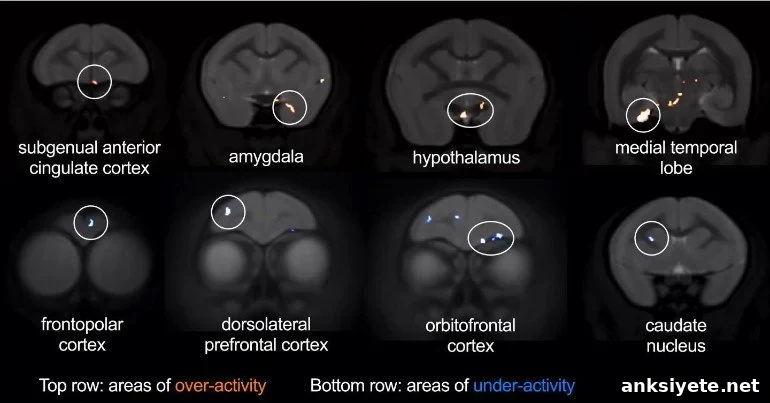
Positron emission tomography (18F-FDG PET) revealed that sgACC over-activation engages a wider stress network: activity rose in the amygdala and hypothalamus, while activity diminished in lateral prefrontal regions responsible for cognitive control and emotional regulation. The pattern differs from the network changes previously linked to impaired reward processing, suggesting distinct circuits mediate threat-related and reward-related symptoms.
“This distinction is important because it may explain why certain symptoms respond to some treatments but not others,” said Professor Angela Roberts, who led the study.
The team tested ketamine, an agent known for fast-acting antidepressant effects, to see whether it could reverse the sgACC-induced changes. Consistent with earlier findings, ketamine restored reward-related behavior affected by sgACC over-activation, alleviating anhedonia-like symptoms. However, ketamine did not reduce the heightened anxiety-like responses to the distal threat of an unfamiliar human.
“We have clear evidence that symptom clusters differ in treatment sensitivity: ketamine reversed the anhedonia-like behavior but failed to normalize anxiety-like behaviors provoked by sgACC over-activation,” Professor Roberts explained. “This supports the view that the same neural abnormality can drive multiple symptoms that require different treatment strategies.”
Implications
These findings highlight the sgACC as a central node linking emotional distress, diminished reward processing and cardiovascular dysregulation in stress-related illnesses. They also emphasize the need for symptom-guided treatment selection: interventions that relieve anhedonia may not address anxiety and heightened physiological arousal, and vice versa. Personalized therapies targeting the specific neural networks underlying a patient’s symptom profile could improve outcomes in depression and anxiety.
About this mental health research news
Source: University of Cambridge
Contact: Jacqueline Garget – University of Cambridge
Image: The image is credited to Laith Alexander
Original Research: Open access. “Over-activation of primate subgenual cingulate cortex enhances the cardiovascular, behavioral and neural responses to threat” by Laith Alexander, Christian M. Wood, Philip L. R. Gaskin, Stephen J. Sawiak, Tim D. Fryer, Young T. Hong, Lauren McIver, Hannah F. Clarke & Angela C. Roberts. Nature Communications
Abstract
Over-activation of primate subgenual cingulate cortex enhances the cardiovascular, behavioral and neural responses to threat
Stress-related disorders such as depression and anxiety are characterized by heightened negative emotion and physiological dysregulation. Elevated activity in area 25 of the subgenual anterior cingulate cortex (sgACC/25) has been implicated in these conditions, but causal evidence has been limited. By combining targeted intracerebral microinfusions with cardiovascular and behavioral monitoring in marmosets, this study shows that sgACC/25 over-activation reduces vagal tone and heart-rate variability, alters cortisol responses during stress, and heightens reactivity to both proximal and distal threats. 18F-FDG PET imaging demonstrates accompanying changes in a network that includes the amygdala, hypothalamus and dorsolateral prefrontal cortex. Ketamine, which has rapid antidepressant effects, fails to reverse the elevated arousal to distal threat, in contrast to its previously demonstrated benefit on reward blunting induced by sgACC over-activation, illustrating symptom-specific treatment effects.