
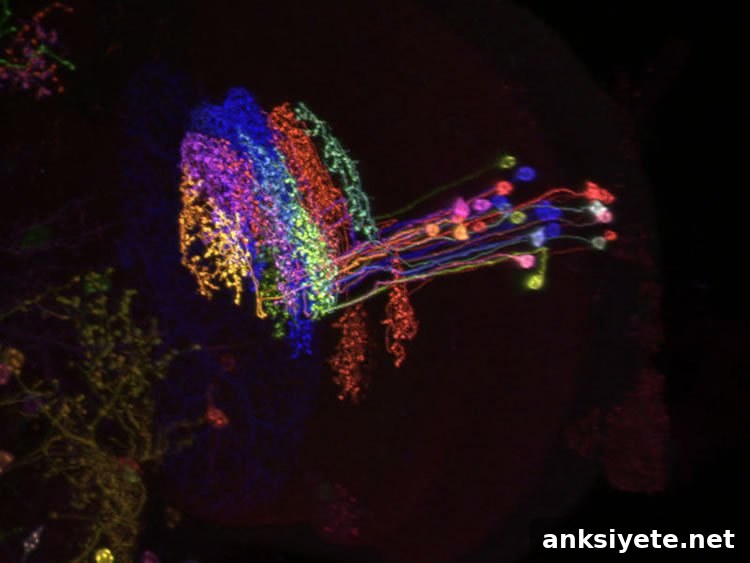
Motion despite immobility. The illusion of self-motion is created, for example, in an IMAX cinema with the help of large-format movies. This is possible because the brain computes self-motion from the visual surround moving past the eyes. Deciphering how the brain performs this computation is the aim of Alexander Borst and his team at the Max Planck Institute of Neurobiology in Martinsried. In collaboration with colleagues from the Janelia Research Campus in Virginia (USA), the researchers have now identified a previously unknown neuron type in the brain of fruit flies. Detailed analysis shows that these cells underlie a phenomenon called motion opponency, in which specific nerve cells are excited by motion in one direction and inhibited by motion in the opposite direction. Studying these newly discovered cells allowed the team to investigate motion opponency in detail and clarify its functional role for the first time.
Motion is a change in position over time. That definition is simple, but detecting motion is a challenging task for individual photoreceptors in the retina, since each one samples only a small portion of the visual scene. When the image on one photoreceptor changes, that cell alone cannot determine whether an object moved or simply disappeared, nor the direction of any movement. To extract motion and its direction, the brain must compare signals from multiple photoreceptors and combine them with precise timing differences between neighboring detectors.
Organized processing
Alexander Borst and his group at the Max Planck Institute of Neurobiology are dissecting this computation in detail. Working cell by cell, they map the structure, connections and functions of the circuits involved. Because this resolution is not currently achievable in human tissue, the team uses the fruit fly as a model system for motion vision. “Despite their obvious differences, flies and humans process visual information in similar ways,” Borst explains.
The researchers showed that visual processing in the fly brain, as in humans, initially separates into two parallel pathways: one that responds to bright edges and another that responds to dark edges. Within each pathway, the information is further sorted by motion direction so that different directions are processed in separate channels. The team not only demonstrated the existence of the two pathways in the fly brain but also identified the specific cell types involved and mapped their connections. Discovering these direction-selective pathways was a major advance. Yet an apparent paradox remained: if directional signals are processed in separate channels, why do so many animals — including flies and humans — exhibit motion opponency, where large wide-field neurons are excited by motion in their preferred direction and inhibited by motion in the opposite direction? If directional information is already segregated, additional inhibition from the opposite direction seems redundant. “This little inconsistency kept us awake at night,” Borst recalls.
Border crossers with a crucial function
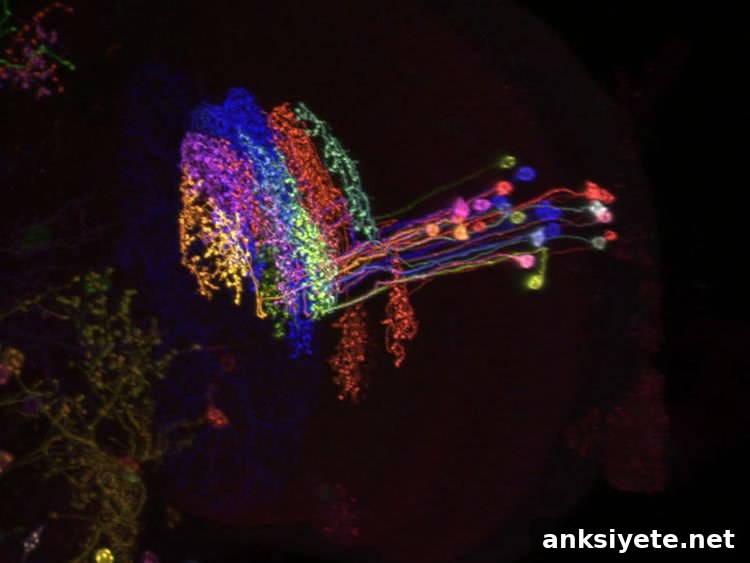
To resolve this puzzle, the team applied detailed anatomical, molecular and physiological methods. They discovered a key missing circuit element: a novel class of neurons they named LPi cells. These lobula plate–intrinsic interneurons had not been described before. Unlike the strictly segregated direction channels, LPi cells cross boundaries between neighboring pathways: each LPi cell receives input from one direction-selective pathway and sends inhibitory output to the adjacent pathway that encodes the opposite direction. In this way, LPi neurons implement direction-selective inhibition that suppresses responses to motion from the null (opposite) direction.
Functional experiments show that LPi cells are directly responsible for the inhibition of wide-field tangential cells by motion opposite to their preferred direction. In other words, LPi neurons form the cellular basis of motion opponency in the fly visual system. Importantly, the researchers could for the first time demonstrate the functional significance of this motif: LPi-mediated inhibition reduces inappropriate activation of downstream wide-field neurons by non-specific or conflicting motion cues.
When the team blocked LPi function, wide-field neurons lost their ability to discriminate relevant motion patterns. Signals that normally occur during forward flight began to stimulate these neurons as strongly as signals associated with rotational or vertical motion, producing erroneous responses. The LPi circuit therefore acts as a filter that improves flow-field selectivity by eliminating non-specific responses to complex visual scenes. As Alex Mauss, a lead author on the study, summarizes: “Flies are masters of motion vision. Without LPi cells, they would be unable to distinguish different motion patterns because of inappropriate activation.”
Source: Dr. Stefanie Merker – Max Planck Institute
Image Credit: A. Nern, Janelia Research Campus
Original Research: Abstract for “Neural Circuit to Integrate Opposing Motions in the Visual Field” by Alex S. Mauss, Katarina Pankova, Alexander Arenz, Aljoscha Nern, Gerald M. Rubin, and Alexander Borst in Cell. Published July 16, 2015, doi:10.1016/j.cell.2015.06.035
Abstract
Neural Circuit to Integrate Opposing Motions in the Visual Field
Highlights
• Discovery of bi-stratified glutamatergic lobula plate–intrinsic (LPi) interneurons
• LPi neurons provide direction-selective (null-direction) inhibition to wide-field tangential cells
• Blocking LPi activity causes target neurons to respond to inappropriate motion cues
• Motion opponency therefore enhances flow-field selectivity and filters out non-specific visual noise
Summary
Animals use visual motion cues that arise from their own movements as feedback for navigation. Wide-field neurons sample motion across many points in the visual field and respond selectively to specific optic flow fields that represent spatial distributions of motion vectors on the retina. This study describes a group of local inhibitory interneurons in Drosophila that are essential for refining those responses. Using anatomical mapping, molecular profiling, activity manipulation and physiological recordings, the authors demonstrate that LPi interneurons deliver direction-selective inhibition to wide-field neurons with opposite preferred directions. Their connectivity implements the computation needed to integrate opposing motions. Rather than merely sharpening directional tuning, these circuit elements reduce noise by suppressing non-specific responses to complex visual inputs.
“Neural Circuit to Integrate Opposing Motions in the Visual Field” by Alex S. Mauss, Katarina Pankova, Alexander Arenz, Aljoscha Nern, Gerald M. Rubin, and Alexander Borst in Cell. Published July 16, 2015. doi:10.1016/j.cell.2015.06.035