
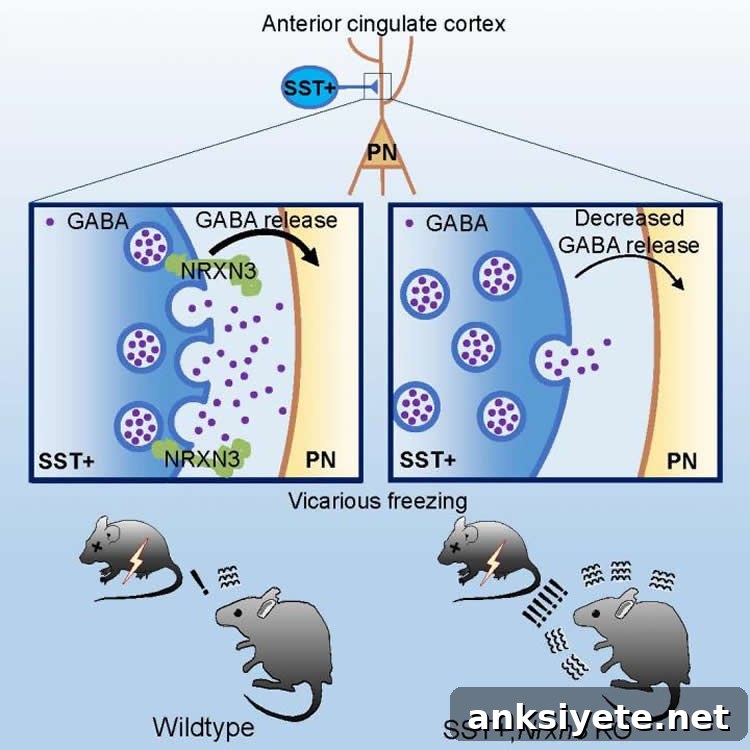
Summary: Researchers have identified a specific genetic variant that appears to increase empathy-driven fear in mice by altering inhibitory circuits in the brain.
Source: Institute for Basic Science.
Researchers at the Center for Cognition and Sociality, Institute for Basic Science (IBS), report in Neuron that a single genetic variant can amplify empathy-driven fear in mice. Because many elements of empathy are conserved across mammals, these findings may help explain individual differences in neuropsychiatric conditions marked by impaired empathy, such as autism, psychopathy and schizophrenia.
Empathy—the ability to understand and share another individual’s emotions—helps drive compassion, helping behavior, and social bonding. Although empathy is central to social life, its genetic and neural foundations are complex and not fully understood. Recent research shows that affective sensitivity, including responses to others’ pain and distress, is present in rodents as well as humans, making mice and rats useful models for studying empathy at a biological level.
For this study, the IBS team focused on observational fear, a form of affective empathy in which an animal develops fear in response to seeing another animal in distress. Fear is a fundamental survival mechanism: animals learn not only from direct experience of danger but also by observing threats to conspecifics. Using a standardized observational fear test, mice watched cage-mates receive a mild foot shock and responded as if they were experiencing the shock themselves—displaying freezing and other fear-related behaviors that reflect empathic fear.
The researchers compared observational fear responses across 18 common laboratory mouse strains and found considerable variability. One strain, 129S1, showed a notably stronger observational fear response than the others. Whole-genome sequencing and analysis identified a missense variant in the neurexin 3 gene (Nrxn3) that correlated with the heightened empathic fear. Neurexin 3 is a synaptic adhesion protein conserved across vertebrates and highly expressed in cerebral cortex regions involved in social and emotional processing.
To test causality, the team used genome-editing methods to introduce the Nrxn3 variant into mice with a typical empathic response. Mice engineered to carry the variant showed an increased observational fear response, demonstrating that this single genetic change can modify empathy-related behavior.
At the circuit level, the study highlights the anterior cingulate cortex (ACC) as a critical hub for observational fear. The ACC is implicated in affective processing, social cognition, and empathy in both rodents and humans. Within the ACC, the investigators found that the Nrxn3 variant specifically affected a subset of inhibitory interneurons that express somatostatin (SST+).
SST+ interneurons normally restrain the activity of nearby excitatory pyramidal neurons by releasing the inhibitory neurotransmitter GABA. The researchers showed that Nrxn3 is essential for SST+ neurons in the ACC to maintain normal GABA release. When Nrxn3 was selectively deleted from ACC SST+ neurons, these cells released less GABA onto pyramidal neurons, producing disinhibition and elevated observational fear—mirroring the high-empathy phenotype seen in the 129S1 strain.
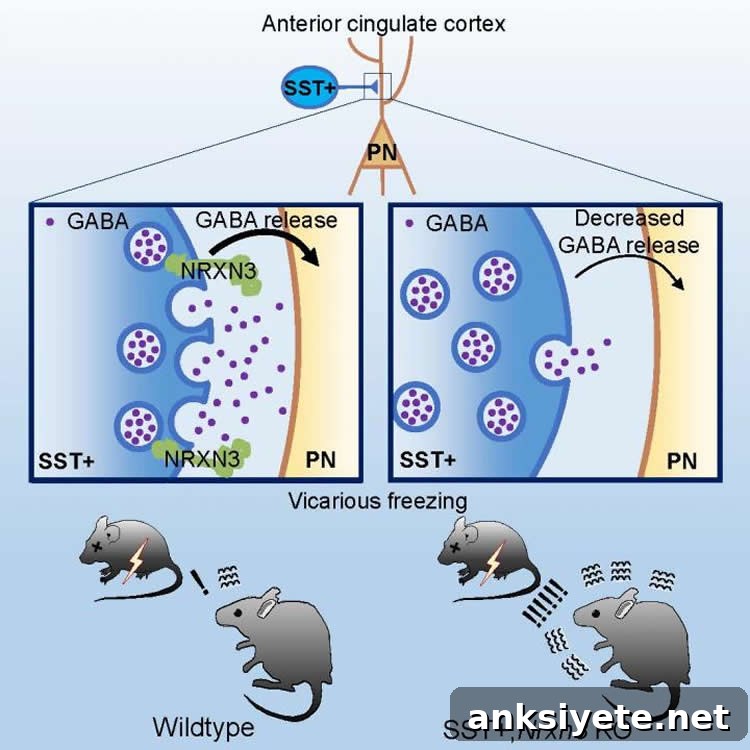
These results identify Nrxn3 as a gene that modulates empathy-related circuits at the molecular, cellular and behavioral levels. The study is the first to demonstrate a clear link between a specific neurexin variant, altered inhibitory synaptic function in SST+ ACC neurons, and changes in socially transmitted fear. By pinpointing how a single genetic change perturbs inhibitory control within a cortical microcircuit, the work provides a mechanistic explanation for individual differences in empathy-related behavior.
The authors note that SST+ neurons in the ACC can bidirectionally regulate observational fear: manipulating these cells increases or decreases empathic responses. Ongoing work will explore whether Nrxn3-dependent SST+ neurons also shape other empathy-related behaviors, including emotional contagion of pain, consolation, and prosocial helping. Understanding how genetic variation affects these circuits may offer new therapeutic targets for psychiatric disorders that involve social and emotional dysfunction.
Source: Dahee Carol Kim — Institute for Basic Science
Publisher: Organized by NeuroscienceNews.com
Image Source: Image credited to IBS
Original Research: Abstract for “A Missense Variant at the Nrxn3 Locus Enhances Empathy Fear in the Mouse” by Sehoon Keum, Arie Kim, Jae Jin Shin, Jong-Hyun Kim, Joomin Park, and Hee-Sup Shin in Neuron. Published April 19, 2018.
DOI: 10.1016/j.neuron.2018.03.041
Institute for Basic Science (2018, April 20). Gene Variant Increases Empathy Driven Fear: Mouse Study. NeuroscienceNews. Retrieved April 20, 2018.
Abstract
A Missense Variant at the Nrxn3 Locus Enhances Empathy Fear in the Mouse
Highlights
• The 129S1 mouse strain shows a pronounced increase in observational fear.
• A missense change (R498W) in Nrxn3 elevates observational fear.
• Selective loss of Nrxn3 in SST+ neurons reduces GABA release in the ACC.
• SST+ inhibitory neurons in the ACC control the degree of socially transmitted fear.
Summary
Empathy shapes emotional life and social interaction, and its disruption appears in multiple psychiatric conditions. Observational fear provides a measurable model of affective empathy in rodents, but the genes that regulate this behavior have been largely unknown. This study shows that 129S1/SvImJ mice carrying a unique missense variant in Nrxn3 display a marked and selective increase in observational fear. Using CRISPR/Cas9, the arginine-to-tryptophan substitution (R498W) was confirmed as the causative variant. Targeted deletion of Nrxn3 in somatostatin-expressing interneurons of the ACC increased observational fear and impaired inhibitory synaptic transmission from SST+ neurons. Optogenetic experiments further demonstrated that SST+ neurons in the ACC can bidirectionally modulate socially transmitted fear. Together, these findings reveal a genetic and neurophysiological mechanism that contributes to behavioral variability in empathy-related responses across mammalian brains.