
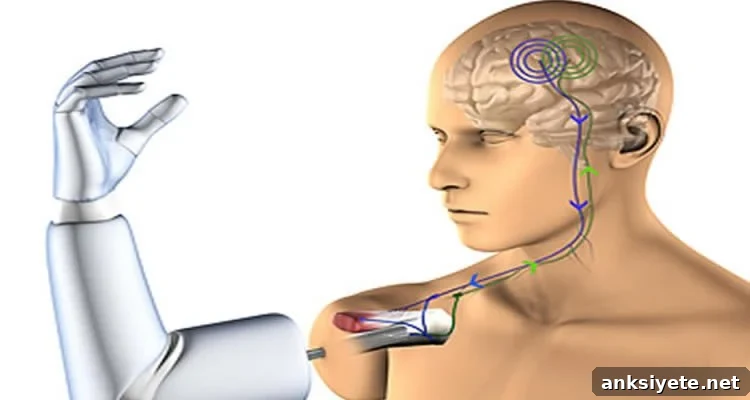
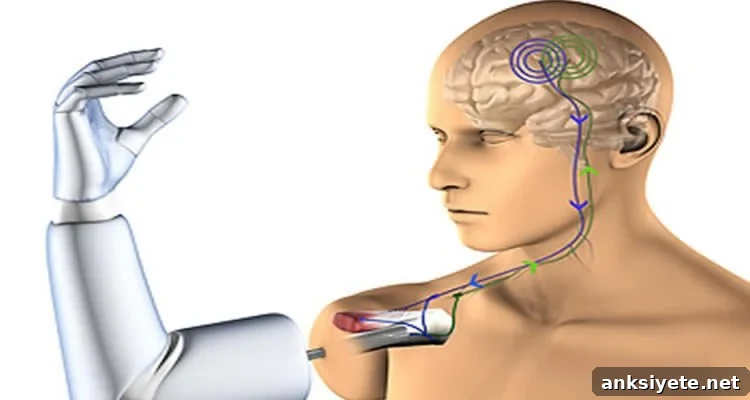
Providing simple neural signals to brain implants could substitute for the body’s natural feedback system.
New research from UC San Francisco brings naturally fluid movement of artificial limbs closer to reality. Scientists demonstrated that monkeys can learn to interpret simple, patterned electrical stimulation delivered to the brain as information about their hand and arm position, and then use that information to perform precise, goal-directed reaches.
Normal arm movements—like reaching to pick up a cup—are guided by both vision and proprioception, the internal sense that informs the brain about the position and movement of the body in three-dimensional space. When either visual or proprioceptive feedback is degraded, reaching becomes slower and less accurate. Current brain-machine interfaces (BMIs) that control robotic prosthetics typically rely almost entirely on visual guidance and lack direct proprioceptive feedback, which limits their performance and the naturalness of movement.
Philip Sabes, PhD, the senior author of the study, explains that state-of-the-art BMIs often produce slow, corrected movements. His team’s work explores whether adding a form of sensory feedback delivered directly to the brain can improve control and restore more natural dynamics to prosthetic movement. The study was supported in part by the REPAIR (Reorganization and Plasticity to Accelerate Injury Recovery) initiative of the Defense Advanced Research Projects Agency (DARPA).
Rather than attempting to exactly mimic the complex neural patterns used by the body’s natural proprioceptive pathways (a biomimetic approach), Sabes and colleagues tested a simpler alternative that exploits the brain’s ability to learn new associations. Their theoretical work suggested that the brain can identify signals that consistently change together and learn to interpret novel inputs if those inputs reliably correlate with sensory cues the brain already understands—such as vision.
In the laboratory experiments, monkeys were trained to reach toward a visible target while their reaching arm and the target were hidden beneath a tabletop. A sensor on the monkeys’ hand measured the direction and distance relative to the target. That sensor data drove two forms of feedback simultaneously: a visual “random-dot” display on a monitor and patterns of electrical stimulation delivered in real time through eight electrodes implanted in the monkeys’ brains.
Random-dot displays let researchers control how informative visual motion cues are. In a high-coherence condition, many dots move uniformly, accurately indicating reach direction and speed. In low-coherence conditions, only a fraction of dots carry reliable directional information, so the display is less useful. Initially, monkeys performed the task using the clear visual display. The researchers then introduced the brain stimulation and gradually reduced the visual coherence, forcing the animals to rely progressively more on the electrical stimulation to guide their reaches.
Throughout the experiment the monkeys still had their natural proprioceptive sense about the absolute position of the reaching arm, but the electrical stimulation conveyed novel information about the hand’s relationship to the target. Over time the animals learned to use those stimulation patterns. In fact, they eventually completed reaches in a dark room guided solely by the artificial stimulation, demonstrating that the brain can learn to interpret new, non-biomimetic signals if those signals are useful and temporally correlated with other sensory cues.
The best performance occurred when the brain-delivered signals were combined with visual information, suggesting that the brain’s native mechanisms for multisensory integration recognized the relevance of the novel stimulation and merged it with vision to guide more efficient, accurate movements. This result supports the idea that a learning-based approach—delivering simple, reliable neural signals rather than a perfect copy of natural proprioceptive patterns—can provide effective artificial sensory feedback for prosthetic control.
The researchers propose that for human neuroprosthetics, stimulation could encode the state of a device relative to the body—such as joint angles, endpoint position, or velocity—rather than target-relative information used in these experiments. Because these same variables are also observable through vision, similar learning mechanisms should allow users to integrate the new neural feedback with visual cues and regain more fluid, natural control of artificial limbs.
Funding for the study came in part from DARPA’s REPAIR program and from a grant by the National Institutes of Health. The work was carried out by Maria C. Dadarlat, PhD, Joseph E. O’Doherty, PhD, and Philip N. Sabes and was published in Nature Neuroscience in 2014 (Advance Online Publication).
Contact: Pete Farley – UCSF
Source: UCSF press release
Image Source: Image credited to Integrum and adapted from a prior NeuroscienceNews.com article
Original Research: A learning-based approach to artificial sensory feedback leads to optimal integration, Maria C. Dadarlat, Joseph E. O’Doherty and Philip N. Sabes. Nature Neuroscience. Published online 2014.