
Summary: Effective neurochemical changes in the brains of people with social anxiety take different forms after treatment with SSRIs combined with cognitive behavioral therapy compared with CBT alone.
Source: Uppsala University
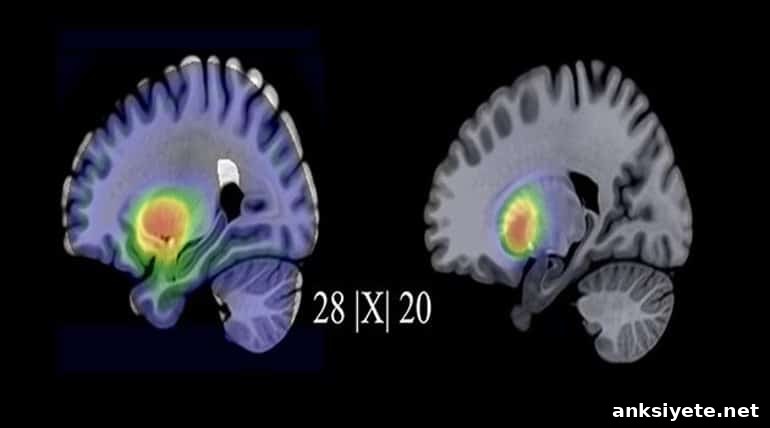
Neurochemical responses in the brain differ between patients with social anxiety who receive both selective serotonin reuptake inhibitors (SSRIs) and cognitive behavioral therapy (CBT) and those who receive only CBT. The medication combination strongly blocks serotonin transporters, while CBT alone is associated with increased serotonin transporter availability in some brain regions.
Selective serotonin reuptake inhibitors (SSRIs) are well-established treatments for depression and anxiety disorders, and their effectiveness can be enhanced when combined with psychological treatments such as cognitive behavioral therapy (CBT). Yet the precise neurochemical mechanisms that underlie symptom improvement remain incompletely understood. To clarify these mechanisms, researchers at Uppsala University conducted a randomized, double-blind positron emission tomography (PET) study examining how serotonin and dopamine transporter availability change in people with social anxiety disorder (SAD) following combined pharmacological and psychological treatments.
The study enrolled 24 participants diagnosed with social anxiety disorder. Half of the participants received the SSRI escitalopram together with internet-based CBT (ICBT). The control group received ICBT together with placebo pills. PET imaging using radioligands specific for the serotonin transporter (SERT) and the dopamine transporter (DAT) was performed both before and after nine weeks of treatment, allowing direct measurement of transporter availability and occupancy.
Distinct neurochemical changes with combined versus psychological treatment
Both treatment groups experienced clinically meaningful improvements in social anxiety symptoms, as measured by the Liebowitz Social Anxiety Scale (LSAS). However, the two treatment approaches produced markedly different changes in the brain’s monoaminergic systems. As expected, participants receiving escitalopram showed substantial SERT blockade, with average SERT occupancy greater than 80%—a level generally considered necessary for SSRI efficacy. In contrast, participants who received ICBT with placebo showed increases in SERT binding in regions such as the raphe nuclei in the brainstem, indicating greater transporter availability following psychological treatment alone.
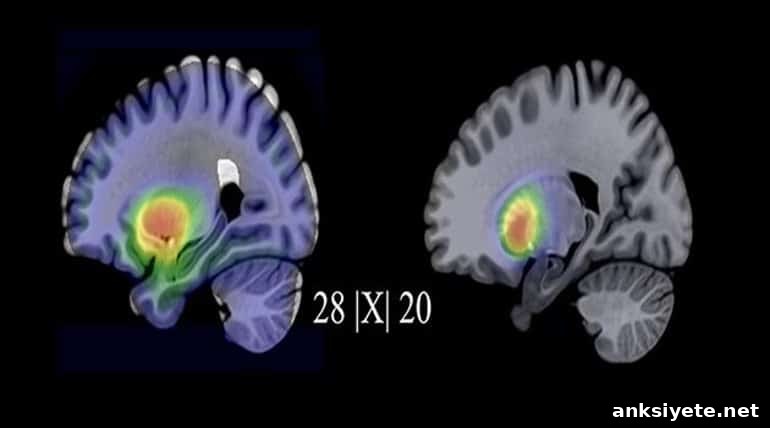
Beyond the serotonin system, dopamine transporter (DAT) changes also showed treatment-dependent relationships with clinical improvement. In the CBT-plus-placebo group, increased DAT availability was associated with greater symptom reduction. Conversely, in the escitalopram-plus-ICBT group, higher DAT availability was associated with less improvement. These opposing correlations suggest that the way dopamine signaling relates to recovery differs depending on whether pharmacological SERT blockade is present.
The investigators also evaluated SERT-DAT co-expression, a measure reflecting the balance between serotonergic and dopaminergic transporter availability across brain regions. At baseline, co-expression was high, and in areas such as the putamen and thalamus it correlated positively with symptom severity. Importantly, baseline SERT-DAT co-expression predicted treatment outcome, but the direction of the prediction differed between treatments: the same co-expression pattern could indicate better prognosis under one treatment and poorer prognosis under the other.
Overall, the findings demonstrate that successful treatment of social anxiety can be accompanied by very different neurochemical adaptations, depending on whether treatment includes SSRI medication. Pharmacological and psychological interventions both reduce symptoms but do so via distinct modulations of serotonin and dopamine transporter systems. This nuanced picture helps explain why combining treatments can be beneficial and highlights the potential for tailoring interventions based on individual neurochemical profiles.
“Both pharmacological and psychological treatments work against social anxiety, but they influence the brain’s serotonin and dopamine systems in different ways,” says Professor Tomas Furmark, who led the research. “Understanding these distinct neurochemical pathways may help guide more personalized treatment strategies for people with social anxiety disorder in the future.”
About this psychopharmacology research news
Author: Press Office
Source: Uppsala University
Contact: Press Office – Uppsala University
Image: The image is in the public domain
Original Research: Open access. “Serotonin and dopamine transporter availability in social anxiety disorder after combined treatment with escitalopram and cognitive-behavioral therapy” by Olof Hjorth et al., published in Translational Psychiatry.
Abstract
Serotonin and dopamine transporter availability in social anxiety disorder after combined treatment with escitalopram and cognitive-behavioral therapy
Selective serotonin reuptake inhibitors (SSRIs) and internet-based cognitive behavioral therapy (ICBT) are both recommended treatments for social anxiety disorder (SAD), and they are often combined. However, how these interventions affect monoaminergic signaling in the human brain has been unclear. In this multi-tracer PET study, 24 patients with SAD were randomized under double-blind conditions to receive either escitalopram+ICBT or placebo+ICBT. Patients underwent PET using [11C]DASB and [11C]PE2I to quantify serotonin (SERT) and dopamine (DAT) transporter proteins before and after nine weeks of treatment. Both treatment combinations produced significant clinical improvement on the LSAS.
At baseline, SERT-DAT co-expression was pronounced, and in regions including the putamen and thalamus co-expression correlated with symptom severity. Baseline co-expression also predicted treatment response, but the nature of this prediction differed between the two treatment arms. After treatment, average SERT occupancy in the SSRI+ICBT group exceeded 80%, with symptom improvement associated with occupancy in nucleus accumbens, putamen and anterior cingulate cortex. Following placebo+ICBT, SERT binding increased in the raphe nuclei. DAT binding increased in limbic and striatal areas in both groups, but its relationship to symptom change was positive for placebo+ICBT and negative for SSRI+ICBT. Thus, serotonin-dopamine transporter co-expression influences symptom severity and remission in SAD, and monoamine transporters are modulated differently when CBT is combined with either SSRI medication or placebo.