
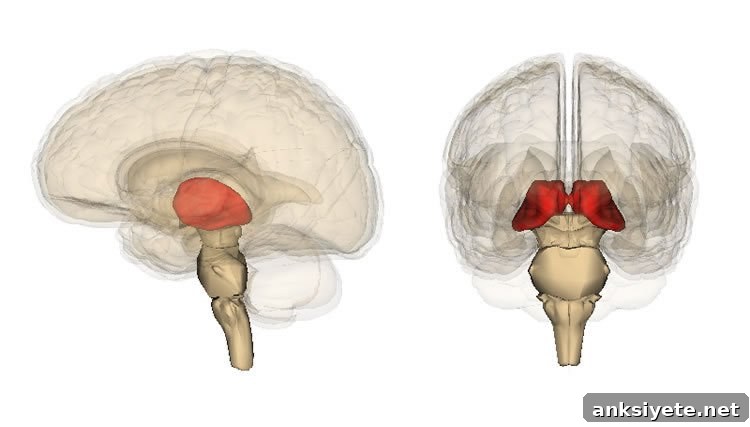
Summary: Researchers have identified the thalamus as a key regulator in the emergence of normal sleep and wake states during brain development.
Source: George Washington University.
Conscious awareness depends on continuous, internally generated brain activity. The way this activity is modulated underlies the electroencephalogram (EEG) and supports sleep, dreaming, perception, and attention. The appearance of continuous and state-dependent brain activity is a major milestone in early brain maturation and typically happens around the time of birth. This transition is an important prognostic sign for infants born prematurely or those who have suffered brain injury.
For the brain to function as a perceiving and thinking organ, it must reach two developmental benchmarks: continuity, meaning ongoing spontaneous activity, and state dependence, meaning that this activity changes with sleep, wakefulness, and arousal. Until now, researchers largely presumed that the cerebral cortex—the folded outer layer of the brain responsible for higher cognition and sensory processing—was the primary site controlling these shifts. The precise circuit mechanisms that produce continuity and state dependence during maturation, however, have remained unclear.
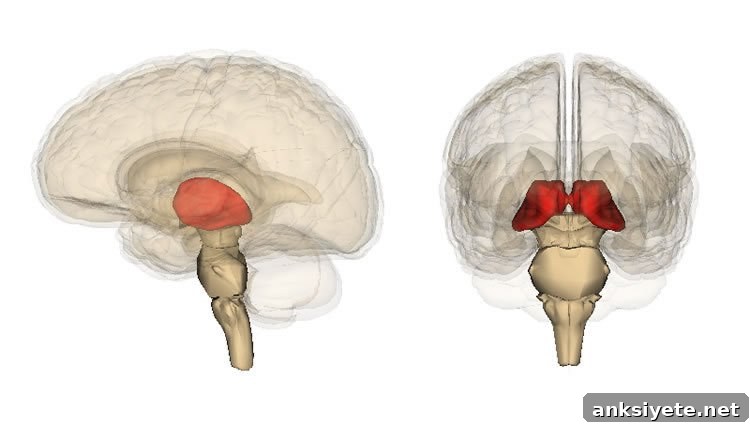
New work from a team at the George Washington University challenges that assumption. Published in the Journal of Neuroscience, the study shows that the relay thalamus, a small but pivotal nucleus deep within the brain, plays a decisive role in establishing the developmental transition to continuous and state-dependent cortical activity.
“Our results indicate that cellular changes in thalamic relay function may be critical drivers for the maturation of background activity,” said Matthew Colonnese, PhD, associate professor of pharmacology and physiology at the GW School of Medicine and Health Sciences. “Humans undergo developmental transitions in brain activity before and around the time of birth.”
Building on earlier studies, Colonnese and colleagues used advanced electrophysiological techniques to record simultaneously from multiple brain regions in awake, head-fixed rodent pups. This approach allowed them to compare activity in the relay thalamus with activity in primary visual cortex and to determine which structure initiates the developmental changes that produce continuous, state-modulated activity.
The team found that activity in the dorsal lateral geniculate nucleus (dLGN), the relay nucleus that supplies visual input to cortex, becomes continuous and begins to correlate positively with movement—a marker of arousal—on the same developmental day that primary visual cortex (VC) acquires these properties. Crucially, these thalamic changes occur independently of cortical activity. When the researchers silenced the dLGN after this developmental time point, cortical activity reverted to a discontinuous pattern and movement suppressed cortical firing rather than enhancing it, effectively reversing the mature state. The emergence of thalamic bursting patterns associated with non-aroused states occurred slightly later, indicating that different thalamic features mature on distinct timelines.
From a clinical perspective, these findings are significant because certain birth-related complications, such as hypoxic-ischemic encephalopathy (brain injury caused by oxygen deprivation), can disrupt or prevent the development of continuous, state-dependent EEG patterns. By clarifying the circuit basis for EEG maturation—specifically implicating relay thalamus—this work may improve the diagnostic interpretation of neonatal EEGs and help guide treatment strategies for vulnerable infants.
Colonnese and co-author Yasunobu Murata, PhD, a research scientist in the Colonnese laboratory, are extending this work by building a comprehensive atlas that links EEG patterns with specific brain lesions. Their goal is to provide clinicians with tools to localize and characterize developmental abnormalities from EEG recordings more accurately.
Source: Ashley Rizzardo – George Washington University
Publisher: Organized by NeuroscienceNews.com
Image Source: Image for illustrative purposes only.
Original Research: Murata, Y. and Colonnese, M. T., “Thalamus Controls Development and Expression of Arousal States in Visual Cortex,” Journal of Neuroscience. Published October 10, 2018. doi: 10.1523/JNEUROSCI.1519-18.2018
MLA: George Washington University. “Thalamus Wakes the Brain During Development.” NeuroscienceNews, 11 October 2018.
APA: George Washington University (2018, October 11). Thalamus Wakes the Brain During Development. NeuroscienceNews.
Chicago: George Washington University. “Thalamus Wakes the Brain During Development.” (Accessed October 11, 2018.)
Abstract
Thalamus Controls Development and Expression of Arousal States in Visual Cortex
Two fundamental developmental milestones for the cerebral cortex are the acquisition of continuous spontaneous activity and the modulation of that activity by behavioral state. Despite their importance, the circuit mechanisms underlying these transitions were not well understood. Using the rodent visual system as a model, the authors tested whether relay thalamus—rather than local cortical circuits or the connectivity between thalamus and cortex—drives the developmental onset of continuity and state dependence observed in sensory cortex. Simultaneous recordings from dorsal lateral geniculate nucleus (dLGN) and primary visual cortex (VC) in awake, head-fixed rat pups revealed that dLGN activity becomes continuous and positively correlated with movement on postnatal day 13 (P13), matching the day VC shows the same properties. These thalamic properties did not depend on cortical activity. Silencing the dLGN after P13 produced a reversal of development in VC, making cortical activity discontinuous and causing movement to suppress cortical firing. Thalamic bursting patterns characteristic of low-arousal states emerged later, on P16, indicating independent developmental trajectories for different thalamic mechanisms. Overall, the results support the conclusion that cellular or circuit changes in relay thalamus are critical drivers of background activity maturation around the term-equivalent period in humans.
SIGNIFICANCE STATEMENT The developing brain acquires continuous spontaneous activity and arousal-dependent modulation around term in humans and prior to sensory experience in rodents. This transition in cortical activity, evident in the EEG, is a key indicator of normal brain maturation and a favorable prognosis for preterm infants and those with neonatal brain injury. By identifying changes at the level of relay thalamus as the primary driver of EEG maturation in the visual system, this study provides a mechanistic framework that may improve interpretation of neonatal EEGs and support better diagnosis and treatment of infants at risk.