
Summary: Researchers have developed a method to monitor, in real time, when circadian “clock” genes switch on and off in multiple tissues of freely moving mice and how those gene rhythms relate to behaviour.
Source: Hokkaido University.
Scientists have developed a technique to simultaneously record circadian “clock” gene activity and its behavioral effects in freely moving mice, in real time.
Clock genes are expressed in rhythmic patterns throughout the body and help regulate physiological processes and daily behaviour. Although these genes oscillate in many tissues, how their rhythms are coordinated outside the brain in unrestrained animals has remained unclear. Until now, researchers lacked a method for long-term, simultaneous monitoring of gene rhythms in specific tissues of freely moving subjects.
Bioluminescence reporting is a common approach for tracking gene expression: when a target gene is active it drives expression of an inserted reporter that emits light, producing a measurable signal each time the gene turns on. This strategy has worked well in anesthetized animals, but anesthesia itself can alter clock gene expression. Alternative methods that avoid anesthesia have had practical limitations for reliable, multi-site, long-term recording in active animals.
A research team at Hokkaido University in Japan developed an advanced in vivo imaging system that overcomes these limitations, enabling continuous monitoring of clock gene expression—including the circadian gene Per1—in multiple tissues of fully conscious, freely moving transgenic mice. In these mice, activation of Per1 produces a bioluminescent signal that can be detected and quantified.
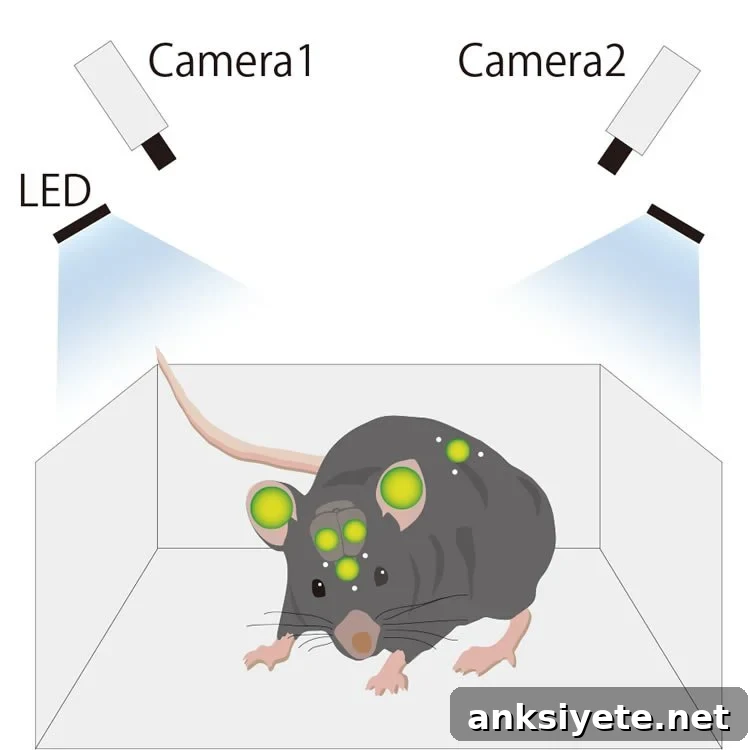
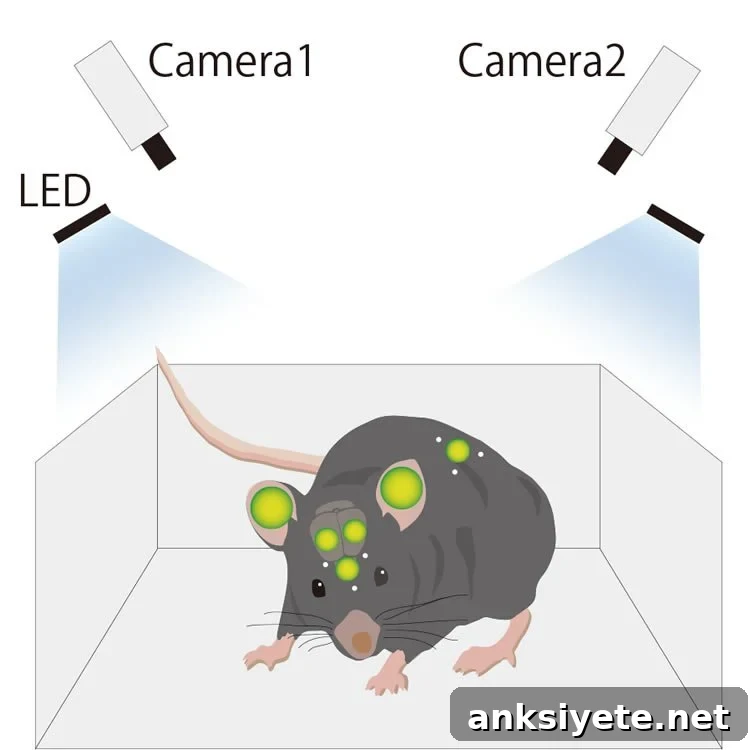
To track animals in three dimensions, the researchers affixed small fluorescent scintillators to the mice’s head and back. Two synchronized cameras captured images of the cage environment, and custom software reconstructed the 3D positions of the scintillators to follow movement continuously. A second set of algorithms corrected for motion and calibrated signal intensity so that bioluminescent output from specific tissues could be isolated and measured despite the animal’s movement. Target tissues included the olfactory bulb, left and right ears and cortical regions, and skin.
Using this system, the team observed robust circadian rhythms of Per1 expression across six body regions in freely moving mice. Per1 expression peaked in all monitored tissues at the start of the animals’ active period. When the researchers simulated an abrupt shift in the light–dark schedule—akin to jet lag—Per1 rhythms in the various tissues became temporarily desynchronized for about a day before re-synchronizing, demonstrating differential dynamics of clock resetting across tissues.
The system also allowed the investigators to track the temporal relationship between clock-gene expression and physiological or behavioural responses to experimental stimuli. Under stable light–dark conditions, Per1 oscillations were largely in phase across tissues. However, after prolonged light exposure, some tissues, such as the olfactory bulb, adjusted their phase faster than others. In genetically arrhythmic mice lacking Cry1 and Cry2, circadian oscillations were absent across all tissues, confirming the genetic basis of the observed rhythms.
The researchers report these findings in Nature Communications and note that while further refinements are still possible, this imaging platform opens many avenues for biomedical research. Potential applications include studies of how peripheral clocks interact with central pacemakers, how circadian disruption affects metabolism and behaviour, and how drug treatments influence tissue-specific clock dynamics. Beyond medicine, the method could be useful wherever long-term, multi-site gene expression tracking in moving animals is needed.
Funding: This work was supported by the Creation of Innovation Centers for Advanced Interdisciplinary Research Areas Program, Ministry of Education, Culture, Sports, Science and Technology, Japan.
Source: Hokkaido University.
Image credit: Image adapted from the Hokkaido University press release.
Original research: The study, titled “In vivo imaging of clock gene expression in multiple tissues of freely moving mice,” was published by Toshiyuki Hamada, Kenneth Sutherland, Masayori Ishikawa, Naoki Miyamoto, Sato Honma, Hiroki Shirato and Ken-ichi Honma in Nature Communications (published online June 10, 2016).
MLA: Hokkaido University. “Watching The Luminescent Gene Switch.” NeuroscienceNews. 20 June 2016.
APA: Hokkaido University. (2016, June 20). Watching The Luminescent Gene Switch. NeuroscienceNews.
Chicago: Hokkaido University. “Watching The Luminescent Gene Switch.” NeuroscienceNews. (accessed June 20, 2016).
Abstract
In vivo imaging of clock gene expression in multiple tissues of freely moving mice
Clock genes operate throughout the body, but their oscillatory behaviour in unrestrained animals has been difficult to observe. This study presents an in vivo imaging technique for long-term, simultaneous monitoring of multiple tissues. Combining dual-focal 3D tracking with signal-intensity calibration, the system follows gene expression in defined target areas and measures circadian rhythms in the olfactory bulb, left and right ears and cortices, and the skin. The approach also tracks how gene expression kinetics relate to physiological responses to experimental cues. Under stable conditions, gene expression is in phase across tissues; in response to a prolonged light pulse, the olfactory bulb shifts faster than other tissues. In Cry1−/− Cry2−/− arrhythmic mice, circadian oscillation is absent in all tissues. Overall, this system effectively tracks clock-gene rhythms in multiple tissues of freely moving mice.