
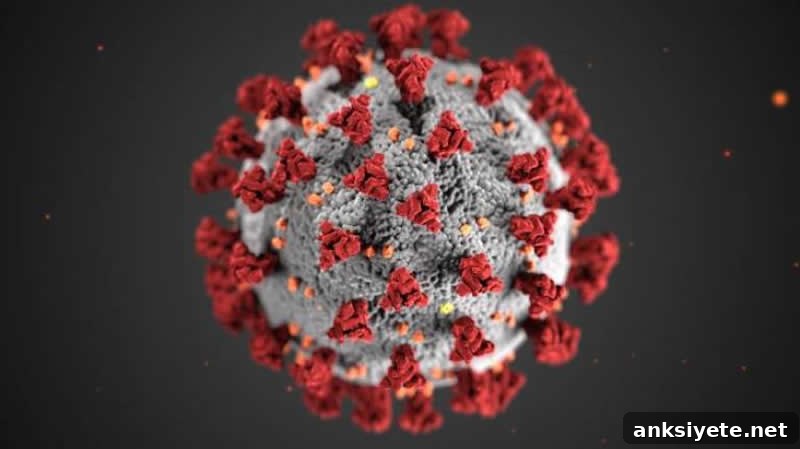
Summary: Analysis of Flu Watch data on common human coronaviruses shows a clear seasonal pattern in England: infections peak in winter and fall to very low levels in summer. These findings suggest that SARS-CoV-2 (the virus that causes COVID-19) may transmit less in summer but could rise again during winter if many people remain susceptible.
Source: UCL
UCL researchers, using historical community surveillance data, report that three commonly circulating coronaviruses showed strong winter seasonality in England and remained at low levels through the summer months.
The study, released as a preprint in Wellcome Open Research, draws on the Flu Watch cohort from 2006 to 2011. Researchers examined patterns of PCR-confirmed infections with HCoV-NL63, HCoV-OC43, and HCoV-229E—viruses that typically cause mild respiratory illness and share some clinical similarity with mild cases of SARS-CoV-2.
Dr Rob Aldridge (UCL Institute of Health Informatics), first author on the paper, explained that the team revisited previously collected Flu Watch data to determine whether infections with these seasonal coronaviruses were concentrated in winter or spread evenly through the year. They also looked for evidence of repeat infections to assess how often reinfection occurred and whether prior infection produced some immunity.
“Our results indicate that in the UK these coronaviruses circulate most intensely during winter, with only sporadic transmission during summer,” Dr Aldridge said. “This supports the idea that COVID-19 transmission might decline in warmer months, but could increase again in winter if a large proportion of the population remains susceptible.”
He cautioned that SARS-CoV-2 is a novel virus and population-level susceptibility is still high, so it is uncertain whether the same seasonal pattern will apply. For this reason, public health measures remain essential: hand hygiene, social distancing and following official guidance reduce transmission now and help protect others while scientists work on vaccines and treatments.
The Flu Watch study invited participants across England to report weekly on respiratory symptoms and to submit swabs when ill. For this analysis the team examined 1,104 swabs collected during respiratory illness across multiple seasons and identified 199 laboratory-confirmed coronavirus infections during the first four seasons analyzed (three winters and one summer). They also tracked cases across two subsequent winters to detect repeat infections and assess homologous reinfection (reinfection by the same coronavirus strain).
Across seasons, the overall rate of confirmed seasonal coronavirus infection was estimated at 390 cases per 100,000 person-weeks (95% CI 338–448), with the highest winter season rate observed in Nov–Mar 2008/9 and the single-month peak in February. During the May–September 2009 period—a summer that included the first wave of the 2009 H1N1 influenza pandemic—the team detected only four coronavirus cases, evidence of low but persistent summer transmission.
Professor Ellen Fragaszy (UCL Institute of Health Informatics and the London School of Hygiene & Tropical Medicine), a senior author, noted that many respiratory viruses in temperate regions show winter peaks. Seasonal drivers likely include environmental factors—temperature, humidity and sunlight—that influence viral survival and immune responses, as well as human behavior such as spending more time indoors and in close contact with others during colder months.
The study also found evidence suggesting some protection against reinfection by the same coronavirus strain. Among participants with two confirmed infections during the observation period, none were reinfected with the identical virus strain. Simulations by the authors indicate that, if no immunity followed infection, the chance of observing zero homologous reinfections in this sample would be only about 3.5%, which supports the presence of at least short-term immunity to these seasonal coronaviruses.
“We cautiously infer that infection with SARS-CoV-2 might also induce some immunity, but we do not yet know how strong or durable that immunity will be,” said Dr Aldridge.
The authors emphasize that while findings from seasonal coronaviruses can inform expectations about SARS-CoV-2, direct evidence for the novel virus is still limited. They recommend continued vigilance, public health action to reduce transmission, and rapid progress on vaccine trials to determine whether vaccination can induce protective immunity against SARS-CoV-2.
Source:
UCL
Media contacts:
Chris Lane – UCL
Image credit:
CDC Public Health Image Library
Original research:
“Seasonality and immunity to laboratory-confirmed seasonal coronaviruses (HCoV-NL63, HCoV-OC43, and HCoV-229E): results from the Flu Watch cohort study.” Rob Aldridge et al., Wellcome Open Research. DOI: 10.12688/wellcomeopenres.15812.1 (closed access).
Abstract (summary):
Background: Understanding whether SARS-CoV-2 will follow seasonal patterns and whether infection confers short-term immunity is critical for public health planning. Methods: The Flu Watch cohort supplied weekly symptom reports and swabs from 2006–2011. The analysis focused on PCR-confirmed HCoV infections across three winter seasons and one summer, then assessed reinfections over subsequent winters. Results: Out of 1,104 swabs, 199 HCoV infections were detected in the initial seasons. Infection rates peaked in winter—especially February—with very low summer detection (four cases in May–Sep 2009). Eight participants had two confirmed infections, and none experienced reinfection with the same strain. Conclusion: Seasonal coronaviruses in England show strong winter peaks with limited summer transmission, and the data provide some evidence of immunity against homologous reinfection. These findings offer context for expectations about SARS-CoV-2 seasonality and immunity but do not replace direct studies of the novel virus.