
Infant Brain Development Shows Early Differences Linked to APOE ε4, a Gene Associated with Alzheimer’s Risk
Researchers at Brown University and the Banner Alzheimer’s Institute used a specialized MRI method to examine how a common genetic variant associated with late‑onset Alzheimer’s disease relates to early brain development. Their study, published in JAMA Neurology, found measurable differences in brain growth patterns in healthy infants who carry the APOE ε4 variant compared with infants who do not carry this variant. These differences are not diagnostic or predictive of Alzheimer’s disease, but they provide important clues about how this gene may influence brain structure long before clinical symptoms appear.
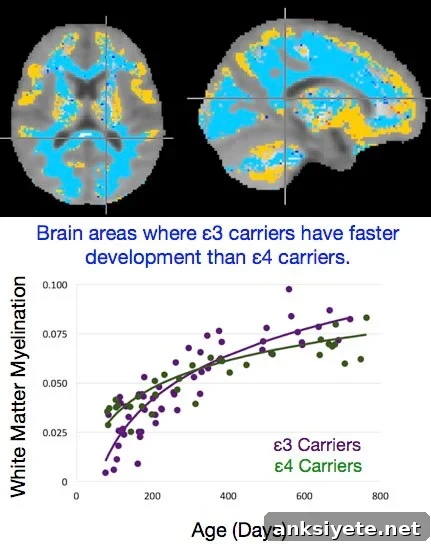
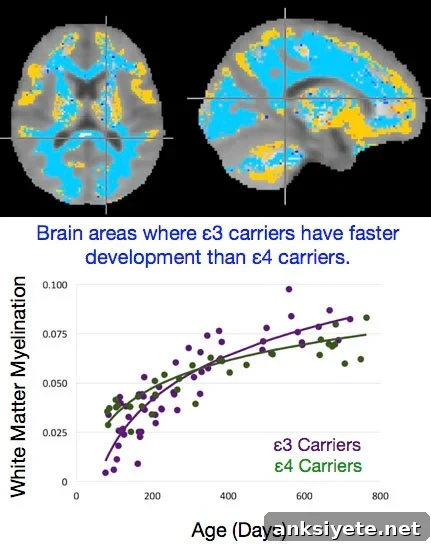
The graph plots the trajectory of brain development for children carrying the ε3 and ε4 variants of the APOE gene in areas of the brain where they diverge (blue). Credit: Deoni lab/Brown University.
The study examined 162 healthy infants aged between two months and 25 months. Each infant underwent genetic testing to determine which APOE variant they carried; 60 of the infants were found to carry the ε4 allele. Using a quiet, infant‑friendly MRI technique developed at Brown’s Advanced Baby Imaging Lab, the team measured both gray matter and white matter development while the babies slept naturally, without sedation.
Comparative analyses showed that infants with the APOE ε4 variant exhibited greater growth in some frontal lobe regions and reduced growth in several middle and posterior brain areas. Notably, the areas with decreased growth correspond to regions commonly affected in older adults with Alzheimer’s disease. The study does not claim that these infants will develop Alzheimer’s; rather, the findings suggest that the APOE ε4 genotype influences neural development from a very early age, creating subtle differences in brain structure that could relate to risk decades later.
Sean Deoni, director of Brown’s Advanced Baby Imaging Lab and a senior author on the paper, emphasized that the research aims to clarify how the APOE gene shapes development. “These results do not establish a direct link to the changes seen in Alzheimer’s patients,” Deoni said, “but with further research they may help explain mechanisms by which this gene contributes to Alzheimer’s risk later in life.”
APOE ε4 is relatively common, present in roughly one quarter of the U.S. population. While carrying ε4 increases the statistical likelihood of developing late‑onset Alzheimer’s, it is neither necessary nor sufficient to cause the disease—many ε4 carriers do not develop Alzheimer’s, and many people with Alzheimer’s do not carry ε4. The gene has multiple roles in the body and brain, including involvement in cholesterol regulation and in pathways related to amyloid protein processing—both processes long suspected to influence neuronal development, maintenance, and neurodegeneration.
The quiet MRI approach used in this study reduces acoustic noise so infants can be scanned during natural sleep without medication. This method captures high‑resolution images of gray matter (neuronal cell bodies and synapses) and white matter (myelinated axons), allowing researchers to track early growth patterns across brain regions. Because white matter development accelerates shortly after birth and plays a central role in neural connectivity, measuring its trajectory offers key insight into early brain maturation.
Importantly, investigators stressed there is no evidence from this cross‑sectional study that APOE ε4 carriers experience cognitive delays or developmental problems in infancy. On the contrary, some regions with increased growth raise the possibility that the gene may confer early developmental advantages in certain contexts. Longitudinal follow‑up will be necessary to determine how these early differences evolve and whether they interact with aging and other risk factors to influence later cognitive health.
Eric Reiman, executive director of the Banner Alzheimer’s Institute and a senior author on the paper, framed the findings in the context of prevention: “It may sound alarming that we can detect brain differences in infants, but our hope is that understanding the earliest brain changes associated with genetic risk will help researchers develop interventions that prevent the clinical onset of Alzheimer’s disease long before these children reach old age.”
Study collaborators, funding, and publication details
The study involved investigators from Brown University, the Banner Alzheimer’s Institute, the Translational Genomics Research Institute, and the University of Southern California. Co‑first authors on the paper included Douglas C. Dean III (Brown), Beth A. Jerskey (Brown), and Kewei Chen (Banner Alzheimer’s Institute). Additional contributors were Hillary Protas, Pradeep Thiyyagura, Auttawat Roontiva, Jonathan O’Muircheartaigh, Holly Dirks, Nicole Waskiewicz, Katie Lehman, Ashley L. Siniard, Mari N. Turk, Xue Hua, Sarah K. Madsen, Paul M. Thompson, Adam S. Fleisher, Matthew J. Huentelman, Sean C. L. Deoni, and Eric M. Reiman.
The research was supported by grants from the National Institute of Mental Health (R01 MH087510) and the National Institute on Aging (R01 AG031581 and P30 AG19610), parts of the U.S. National Institutes of Health, as well as support from the State of Arizona. The paper was published online in JAMA Neurology as “Brain Differences in Infants at Differential Genetic Risk for Late‑Onset Alzheimer Disease: A Cross‑sectional Imaging Study.” The DOI for the original article is 10.1001/jamaneurol.2013.4544.
Contact: Kevin Stacey, Brown University
Source: Brown University press release
Image credit: Deoni lab/Brown University