
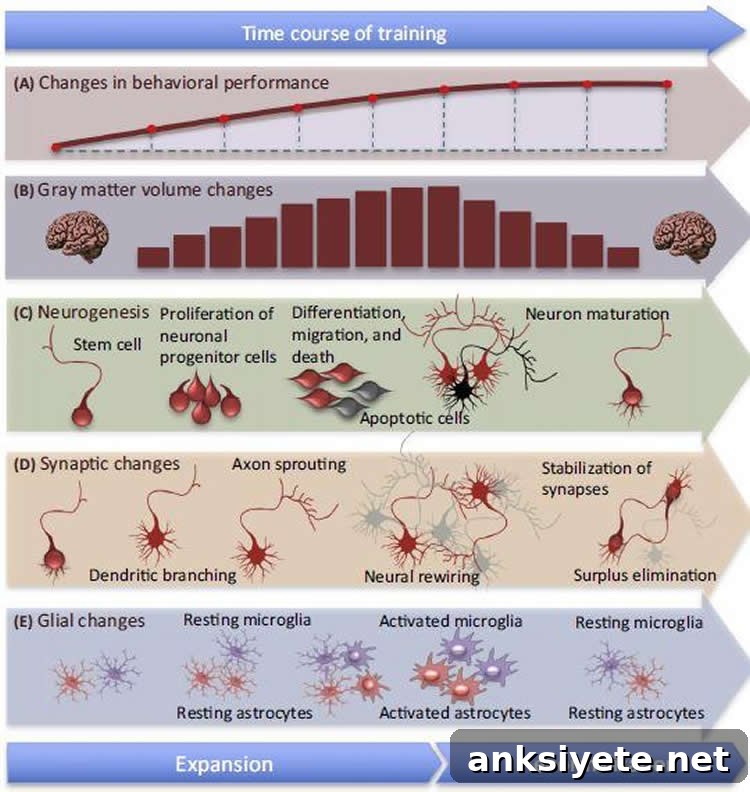
Summary: New review describes how brain tissue expands during early learning and later renormalizes as cells are pruned or reassigned, offering an efficient mechanism for acquiring many skills without net brain growth.
Expansion and Renormalization: How the Brain Reorganizes Cells During Learning
Source: Cell Press
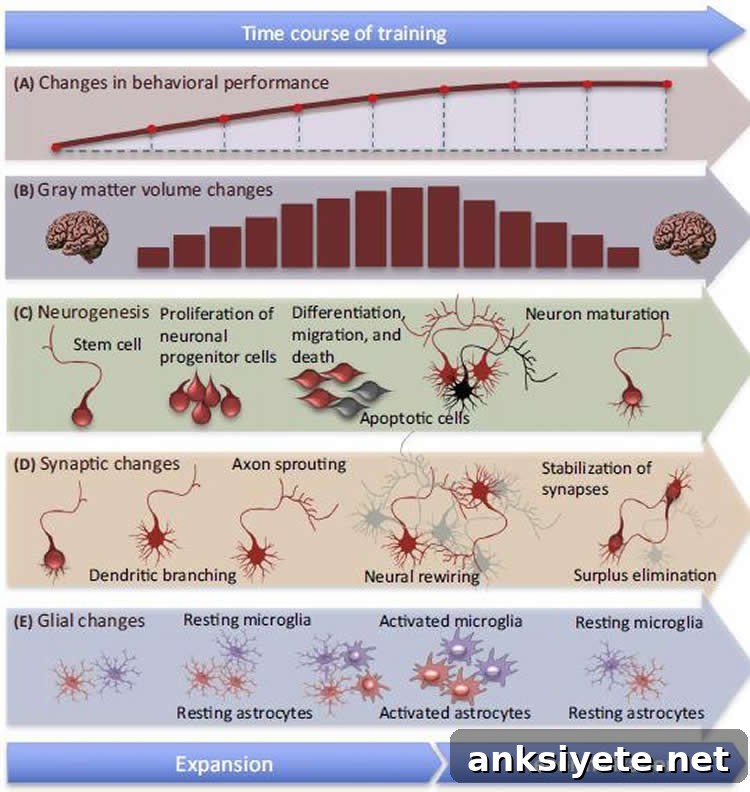
For decades, neuroscientists have asked how the human brain continues to acquire and refine new skills throughout life without steadily increasing in size. A review published in Trends in Cognitive Sciences proposes a simple, data-supported explanation: during the early phase of learning the brain increases tissue in task-relevant regions, recruiting neurons and support cells to “audition” for the new role. After evaluation and selection, much of that extra tissue either returns toward baseline or is reassigned to other functions. This expansion–renormalization model reconciles short-term growth observed with magnetic resonance imaging (MRI) and the long-term stability of brain volume across the lifespan.
The audition metaphor: recruitment, trial, and selection
Elisabeth Wenger and colleagues describe the learning process as similar to casting actors for a film. When the brain faces a novel challenge, it initially enlarges relevant regions by growing or recruiting cellular resources—neurons, synapses, and glial cells—so many candidate elements become available. These candidates are then tested: which neurons or circuits best encode, store, or transmit the new skill? Those that perform well are retained and refined; the rest are either pruned away or repurposed for other tasks. This sequence—expansion, selection, and renormalization—allows the brain to explore many possible solutions quickly while avoiding indefinite net growth.
Empirical evidence from humans and animals
Several experiments demonstrate the pattern the model predicts. In one human study, right-handed participants trained to write and draw with their non-dominant left hand. Brain volume in motor areas increased during the first month of training, and then declined toward baseline within a few weeks of continued practice. Comparable patterns have been observed in animal models: monkeys that learned to use a rake and rats trained to discriminate sounds showed transient increases in task-related brain tissue followed by partial renormalization. These converging results suggest the expansion–renormalization sequence is a general feature of learning across species.
Why expansion followed by renormalization is efficient
The proposed mechanism is efficient because it balances the need for exploration with long-term resource management. If the brain instead continuously expanded to accommodate every new skill, overall tissue and energy demands would grow unsustainably. By temporarily increasing resources during the trial phase and then selecting the most effective configurations, the brain can refine neural circuits while maintaining overall volume and metabolic economy.
Implications for research and study design
Wenger and co-authors emphasize that common study designs may miss this dynamic pattern. Studies with only a few measurement points may observe expansion or a later renormalized state but not the full trajectory. To capture the complete expansion–selection–renormalization process, researchers should include more frequent MRI or other measurements across the learning period and consolidation phases. This will improve interpretation of neuroimaging results and guide mechanistic investigations into which cellular processes—neurogenesis, synaptogenesis, dendritic remodeling, or glial changes—underlie observed volume shifts.
Funding and acknowledgments
This review and related research were supported by the Max Planck Society, the European Research Council, the Swedish Research Council, the European University Institute, and the Agence Nationale de la Recherche.
Publication and credits
This summary draws on the review “Expansion and Renormalization of Human Brain Structure During Skill Acquisition” by Elisabeth Wenger, Claudio Brozzoli, Ulman Lindenberger, and Martin Lövdén, published in Trends in Cognitive Sciences (online November 2017). Organized and summarized by NeuroscienceNews.com. Image credit: Wenger et al., Trends in Cognitive Sciences (2017). Source reporting by Cell Press.
Abstract (concise)
Learning-related brain plasticity often shows an early increase in gray matter volume in task-relevant areas. The expansion–renormalization model proposes that this initial growth reflects temporary recruitment of neural resources, followed by a selection process that returns overall volume to baseline, either partially or completely, once the most efficient circuits are established. This model integrates human imaging findings with animal studies and theoretical accounts of plasticity and highlights the need for richer longitudinal measurements to reveal underlying mechanisms.