
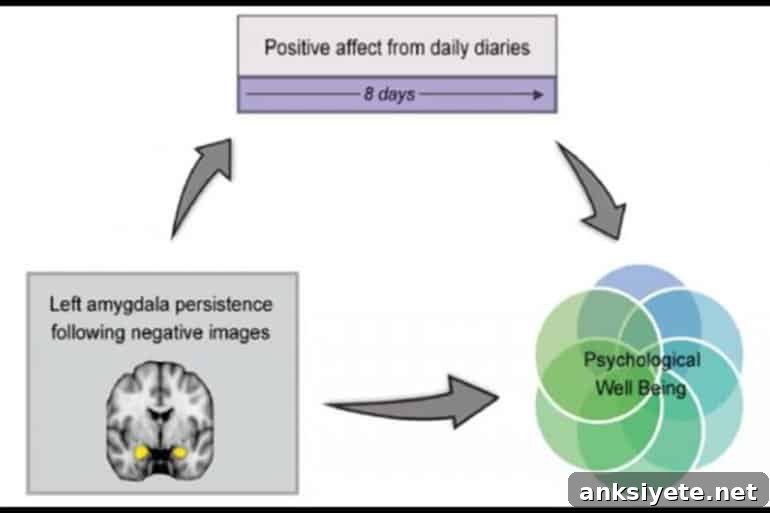
Summary: New research shows that when the amygdala remains active after viewing negative images, it continues to respond to subsequent neutral stimuli. This persistent activity is associated with higher day-to-day negative mood and lower positive mood, which in turn relates to psychological well-being.
Source: SfN
How the amygdala responds to negative images and to neutral stimuli that follow may shape everyday mood and long-term well-being, according to new findings published in Journal of Neuroscience.
The amygdala is a brain region that monitors the environment for potential threats and assigns emotional value to what we see. When it detects danger, amygdala activity can remain elevated and cause subsequent, unrelated stimuli to be processed as if they were also threatening. In real life this can be adaptive in a dangerous situation, but it can be maladaptive if a minor stressor—like spilling your coffee—keeps you on edge for the rest of the day.
In the study, Puccetti and colleagues analyzed data from the Midlife in the United States (MIDUS) longitudinal project. Participants completed measures of psychological well-being and took part in eight daily telephone interviews assessing their mood. They also underwent an fMRI session in which they viewed a series of negative, positive, and neutral images; between each image they were shown a photograph of a neutral facial expression. This design allowed researchers to test how amygdala responses to emotional images compared with responses to the neutral faces that followed.
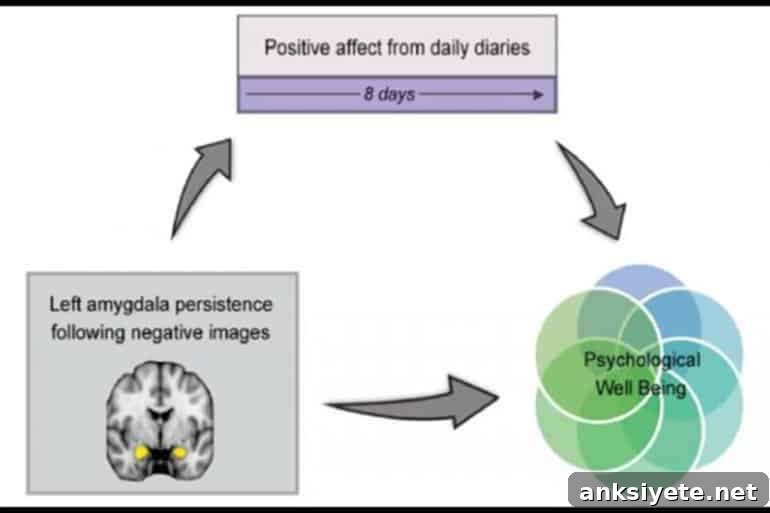
Researchers measured how similar the patterns of amygdala activation were when participants viewed negative images and when they viewed the neutral faces that immediately followed. This approach—representational similarity analysis (RSA)—captures whether the brain preserves an affective representation from one stimulus to the next. When participants’ left amygdala showed a similar activation pattern for negative images and the subsequent neutral faces, that persistence of activation predicted more frequent negative mood and less frequent positive mood in daily life.
The study also linked these daily mood patterns to psychological well-being. Individuals who experienced more positive affect day to day tended to report greater psychological well-being years later. Importantly, the data indicated that lower left amygdala persistence after negative images was associated with higher daily positive affect, and that positive affect in daily life served as an indirect pathway connecting amygdala dynamics to long-term well-being.
About this neuroscience research on mood
Source: SfN
Contact: Calli McMurray – SfN
Image: The image is credited to Puccetti et al., JNeurosci 2021
Original Research: Closed access. “Linking Amygdala Persistence To Real-World Emotional Experience and Psychological Well-Being” by Nikki A. Puccetti, Stacey M. Schaefer, Carien M. van Reekum, Anthony D. Ong, David M. Almeida, Carol D. Ryff, Richard J. Davidson and Aaron S. Heller. Journal of Neuroscience
Abstract
Linking Amygdala Persistence To Real-World Emotional Experience and Psychological Well-Being
Neural responses to emotional stimuli are closely tied to momentary feelings. The amygdala contributes to subjective emotional experience and can attribute affective meaning to neutral stimuli. Because the persistence of amygdala activation after aversive events varies across people, some individuals are more likely than others to interpret subsequent neutral information through the lens of prior negative experience. Those individual differences may produce more frequent or longer-lasting emotional responses in daily life and relate to broader measures of psychological well-being (PWB). Although prior work links daily affect to PWB, few studies have directly examined how amygdala persistence, daily affective experience, and PWB relate to one another.
To address this gap, the authors analyzed data from 52 adults (67% female) in the MIDUS study who completed measures of psychological well-being, daily affect assessments, and functional MRI. During scanning, participants viewed affective images followed immediately by neutral faces, enabling quantification of the similarity between amygdala responses to emotional images and the neutral expressions shown afterward.
Using representational similarity analysis, researchers operationalized neural persistence as the similarity between amygdala activation patterns during negative images and during the neutral faces that followed. Individuals with lower persistence in the left amygdala reported more frequent positive affect and less frequent negative affect in everyday life. Moreover, daily positive affect served as an indirect link between left amygdala persistence and psychological well-being measured years later.
These findings clarify connections between individual differences in brain function, everyday emotional experience, and long-term well-being. They suggest that the degree to which the amygdala maintains an affective representation after negative events helps shape day-to-day mood, and through those daily experiences, may influence broader evaluations of psychological health.
SIGNIFICANCE STATEMENT
Bringing together affective neuroscience and psychology, this study provides evidence that individual differences in neural processing of emotional events map onto real-world emotional life and later judgments of well-being. By demonstrating that less amygdala persistence after negative images predicts greater daily positive affect—and that daily positive affect in turn predicts higher psychological well-being—this research highlights daily positive emotions as a meaningful bridge between neural dynamics and long-term mental health.