
Summary: A new, non-invasive wearable device measures cervical nerve activity to support more personalized care for conditions such as PTSD and sepsis.
Source: UCSD
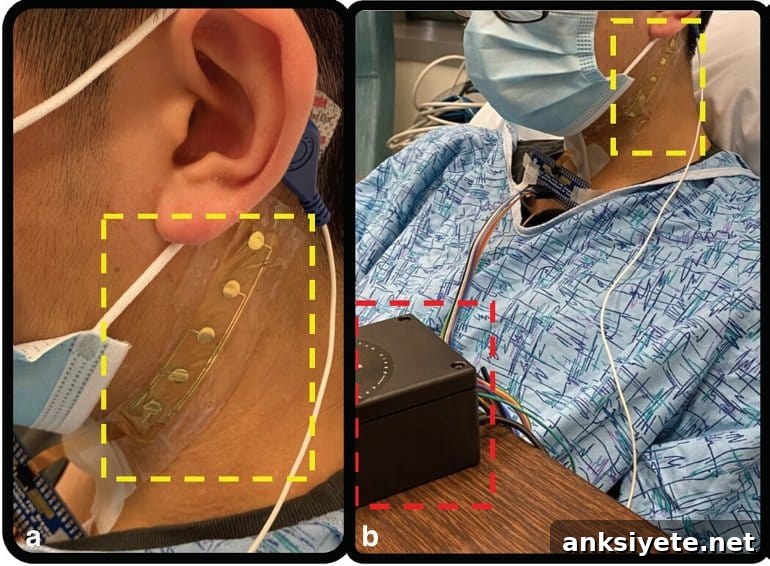
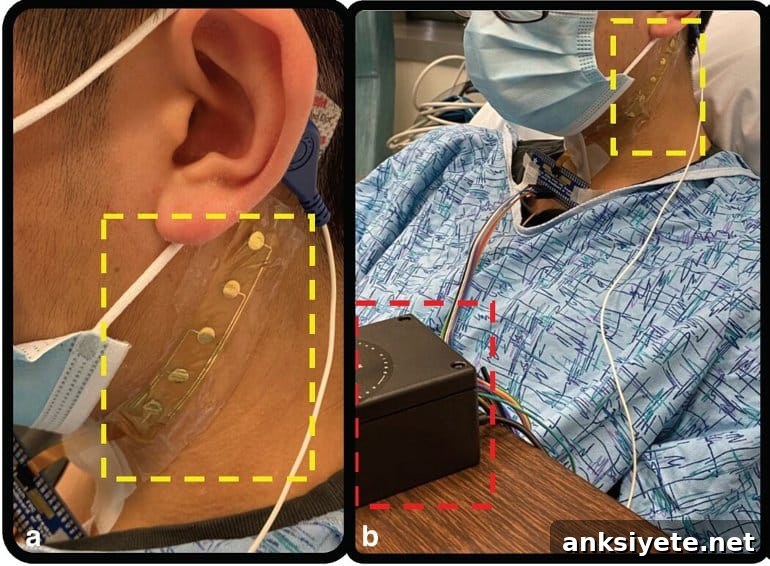
A multi-campus research team has introduced a flexible, adhesive electrode array that non-invasively records cervical nerve activity in humans. Reported in Scientific Reports, the device—designed for cervical electroneurography—could enable more tailored monitoring and treatment for disorders linked to autonomic nervous system dysregulation, including post-traumatic stress disorder (PTSD) and sepsis.
“Using this new device, we identified clear electrophysiological evidence of autonomic biotypes—distinct patterns of ‘fight-or-flight’ versus ‘rest-and-digest’ nervous system responses—that remained consistent across different autonomic challenges,” said Imanuel Lerman, the study’s senior author from UC San Diego’s Qualcomm Institute, School of Medicine, and Jacobs School of Engineering, and the VA Center of Excellence for Stress and Mental Health.
The system uses a flexible electrode array that contours from the front base of the neck to the upper back, capturing electrical signals from multiple cervical nerves. It includes a biopotential data acquisition module with a graphical interface for real-time visualization and a custom algorithm that groups individuals by how their autonomic nervous system responds to stressors.
A safer, less invasive way to study autonomic nerve activity
Historically, high-fidelity recordings of cervical nerve activity required surgically implanted microelectrodes. To reduce risk and broaden applicability, the researchers adapted existing flexible-sensor technology to create a wearable alternative that can remain on a person for extended monitoring without restricting head and neck movement.
The adhesive array is comfortable enough for prolonged wear, allowing researchers to capture neural activity over longer periods without the pain or complications associated with implanted devices. This makes it feasible to study naturalistic autonomic responses and to monitor patients during everyday tasks or clinical assessments.
To probe autonomic biotypes—groups of people whose involuntary nervous systems respond similarly—the team conducted two standardized stress challenges: a cold-pressor test in which participants held their hand in ice water, and a timed paced-breathing exercise. The electrode array recorded cervical electroneurography (CEN) signals alongside heart rate before, during, and after each challenge.
Across participants, recordings consistently separated subjects into two distinct response groups: one group showed increases in neural firing and heart rate in response to both challenges, while the other group showed decreases or the opposite patterns. These repeatable biotypes suggest the device can reveal meaningful individual differences in autonomic regulation.
The device’s spike-sorting algorithm also distinguishes responses from different electrode channels, pointing to localized changes in activity across rostral-to-caudal channel positions. This feature helps identify how specific cervical nerve clusters react to pain, deep breathing, and related autonomic symptoms such as sweating and heart rate changes.
“The sensor array reliably recorded autonomic nervous system activity during both the cold pressor and deep-breathing challenges,” said Todd Coleman. “We were encouraged by the consistent responses across tests, though larger studies are needed to validate these findings in broader populations.”
Applications for personalized medicine and clinical care
While the surface array does not yet pinpoint the exact individual nerve fibers responsible for each recorded signal, the team envisions several clinical uses. For people with PTSD, measuring vagus nerve activity might help clinicians assess responses to interventions such as paced breathing or vagus nerve stimulation aimed at reducing inflammation and stress-related symptoms.
In hospital settings, continuous monitoring of cervical nerve activity could flag patients who show exaggerated autonomic responses to stress—an early indicator of vulnerability to conditions like sepsis, where a dysregulated immune response to infection rapidly increases mortality risk. Early detection would give clinicians more time to intervene, administer antibiotics, and improve outcomes.
The array may also have niche safety applications, for example monitoring pilots or other operators for sudden autonomic changes that precede dizziness or nausea, improving operational safety in high-risk environments.
Next steps include miniaturizing the hardware into a wireless, ambulatory wearable capable of real-world deployment. The team is advancing toward a clinical trial that will test the technology for in-hospital sepsis detection and further evaluate its utility across clinical populations.
Lerman and several collaborators are already exploring electrical vagus nerve stimulation as a complementary approach to reduce inflammation and pain in PTSD. The non-invasive electrode array could provide an objective way to monitor neural responses during such treatments and guide personalized therapy adjustments.
As the research progresses, the combination of wearable cervical electroneurography, targeted stimulation, and algorithmic classification of autonomic biotypes may help clinicians tailor interventions for mental health disorders, critical care conditions, and safety-critical occupations.
About this neurotech and PTSD research news
Author: Press Office
Source: UCSD
Contact: Press Office – UCSD
Image: The image is credited to UCSD
Original Research: Open access.
“A flexible adhesive surface electrode array capable of cervical electroneurography during a sequential autonomic stress challenge” by Yifeng Bu et al. Scientific Reports
Abstract
A flexible adhesive surface electrode array capable of cervical electroneurography during a sequential autonomic stress challenge
This study presents a flexible, adhesive electrode array designed for non-invasive monitoring of cervical nerve activity. The system uses silver-silver chloride electrodes paired with a custom biopotential data acquisition unit and an integrated graphical user interface for real-time visualization.
Preliminary evaluation showed the design achieves a favorable signal-to-noise ratio for cervical neural recordings. To demonstrate the array’s ability to detect autonomic changes, researchers applied two standardized stressors: a cold-pressor test and a paced-respiration challenge. The resulting recordings constitute a novel technique the team calls Cervical Electroneurography (CEN).
Applying a custom spike-sorting algorithm to the CEN data, the team classified neural activity by changes before versus after the cold-pressor test and during the timed respiratory challenge. Notably, the study observed position-specific firing patterns along rostral-to-caudal channels and consistent cross-challenge changes in average CEN firing that differentiated biotype groups.
Future work aims to develop an ambulatory, wireless CEN device capable of continuous monitoring and immediate notification of autonomic activity changes that could signal autonomic dysregulation in healthy individuals and patients with clinical disease states.