
Summary: Reduced blood flow to specific brain regions parallels accumulation of tau protein in people with Alzheimer’s disease. This link grows stronger as cognitive function declines, suggesting vascular dysfunction and tau pathology interact during disease progression.
Source: SfN
New research published in Journal of Neuroscience finds that impaired blood flow in targeted brain regions coincides with tau protein buildup in Alzheimer’s disease, and that this relationship intensifies as cognition worsens.
Alzheimer’s disease is characterized by progressive declines in vascular function alongside accumulation of hallmark proteins—amyloid-β and tau—which contribute to neuronal injury and cell loss. Determining how vascular changes and abnormal protein deposition influence one another is a critical challenge: it remains uncertain whether reduced blood flow promotes protein aggregation, whether protein pathology undermines vascular health, or whether both arise from shared upstream processes.
To address this, Albrecht and colleagues compared measures of cerebral blood flow (CBF) obtained with MRI to tau deposition measured by PET imaging in older adults spanning a range of cognitive status, from cognitively normal to mild cognitive impairment (MCI). By using multimodal neuroimaging across independent cohorts, the investigators probed where and how tightly vascular dysfunction and tau pathology were associated.
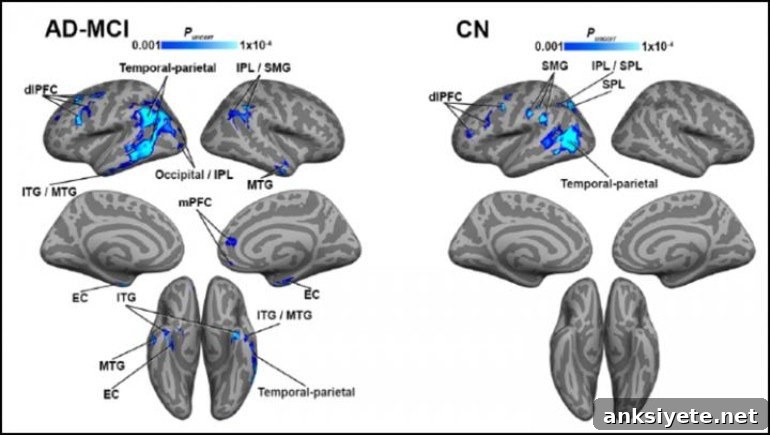
Their analyses revealed that brain regions with elevated tau PET signal tended to show reduced blood flow. These negative correlations were most prominent in temporal and parietal areas, and notably in the inferior temporal gyrus—an area known to accumulate tau early in the course of Alzheimer’s disease, even before clinical symptoms emerge. In other words, localized decreases in perfusion tended to map onto sites of tau accumulation.
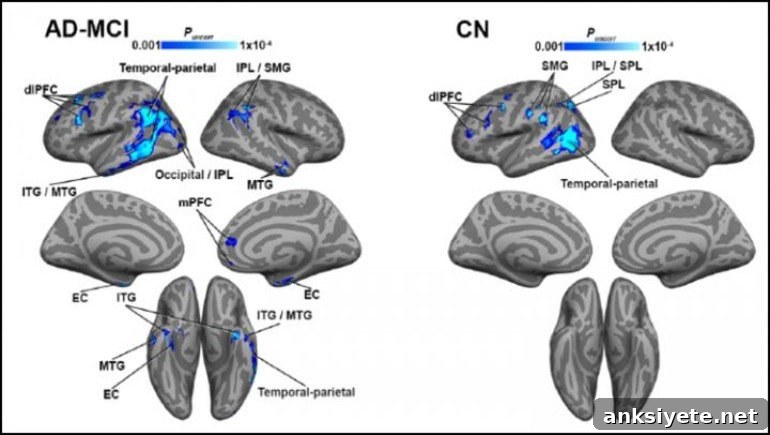
The observed pattern was replicated using data from the Alzheimer’s Disease Neuroimaging Initiative (ADNI). In that independent sample, negative CBF–tau correlations appeared in similar regions and expanded in both spatial extent and strength as clinical severity increased. Participants with greater cognitive impairment and higher amyloid-β burden displayed stronger associations between reduced perfusion and tau accumulation, and the spatial distribution of these correlations broadened with advancing disease.
A subgroup analysis incorporated a cerebrospinal fluid (CSF) vascular biomarker, soluble platelet-derived growth factor receptor beta (sPDGFRβ), which indexes pericyte injury and microvascular dysfunction. Stronger relationships between this vascular marker and tau PET were observed in participants with higher amyloid levels and lower global cognition scores, supporting the link between vascular injury and tau pathology from an independent biological measure.
Mediation analyses further indicated that tau burden significantly mediated the association between vascular measures (CBF and sPDGFRβ) and global cognitive performance. This suggests that vascular dysfunction may contribute to cognitive decline in part through effects on tau accumulation, consistent with models in which vascular and proteinopathies interact to drive neurodegeneration.
Taken together, these findings provide in vivo evidence across the Alzheimer’s disease spectrum that vascular abnormalities and tau pathology are interconnected, and that this relationship is modulated by amyloid burden and clinical status. Early vascular–tau associations appear to be exacerbated in the presence of amyloid, supporting a multi-hit model in which vascular dysfunction and amyloid together accelerate tau-related neurodegeneration and cognitive decline.
Clinically, the results imply that therapeutic strategies addressing vascular health—alongside approaches that reduce amyloid-β and tau—may offer greater potential to preserve cognitive function than treatments that target a single pathological process. Improving cerebral perfusion or protecting microvascular integrity could therefore represent an important complement to anti-amyloid and anti-tau interventions.
About this neurology research news
Source: SfN
Contact: Calli McMurray – SfN
Image: Image credited to Albrecht et al., JNeurosci 2020.
Original Research: Closed access. “Associations Between Vascular Function and Tau PET are Associated with Global Cognition and Amyloid” by Daniel Albrecht, A. Lisette Isenberg, Joy Stradford, Teresa Monreal, Abhay Sagare, Maricarmen Pachicano, Melanie Sweeney, Arthur Toga, Berislav Zlokovic, Helena Chui, Elizabeth Joe, Lon Schneider, Peter Conti, Kay Jann, Judy Pa and for the Alzheimer Disease Neuroimaging Initiative. Journal of Neuroscience.
Abstract (summary)
Associations Between Vascular Function and Tau PET are Associated with Global Cognition and Amyloid
Tau pathology and vascular dysfunction both contribute to Alzheimer’s disease, yet their interrelationships and impact on cognition remain incompletely understood. The study conducted voxelwise comparisons between cerebral blood flow (CBF) maps from MRI and tau PET images in independent discovery and replication cohorts that included cognitively normal individuals, people at risk for MCI, those with MCI, and participants with Alzheimer’s disease. Cohort sizes included small discovery samples and larger replication samples across the clinical spectrum. In a subgroup, the authors assessed CSF levels of sPDGFRβ to index pericyte-related vascular injury. They evaluated whether CBF and sPDGFRβ relationships to tau varied with global cognitive scores (Montreal Cognitive Assessment, MoCA) and with amyloid burden, and they performed mediation analyses to test whether tau mediated the relationships between vascular measures and cognition.
Negative correlations between CBF and tau were concentrated in temporal-parietal regions. In the replication cohort, these negative correlations became more widespread and stronger with increasing disease severity. Participants with greater amyloid burden and lower MoCA scores showed stronger vascular–tau associations, and amyloid-positive individuals appeared to drive the stronger CBF–tau relationships observed in those with worse cognition. Tau PET acted as a significant mediator in multiple regions linking vascular measures to cognitive performance.
Overall, the results demonstrate vascular–tau associations across the Alzheimer’s spectrum and indicate that early vascular changes may be amplified by amyloid pathology. These findings support combined therapeutic approaches that target vascular health together with amyloid-β and tau to better preserve cognitive function.
SIGNIFICANCE
This multimodal neuroimaging study provides in vivo evidence that cerebral blood flow, a clinical MRI measure of vascular health, is associated with regional tau pathology measured by PET, and that these associations relate to global cognition and are influenced by amyloid burden. An independent CSF vascular marker (sPDGFRβ) corroborated the imaging findings in a subgroup. Together, the data suggest that combination treatments addressing vascular dysfunction, amyloid-β, and tau may be more effective at preserving cognition than approaches targeting any single pathology.