
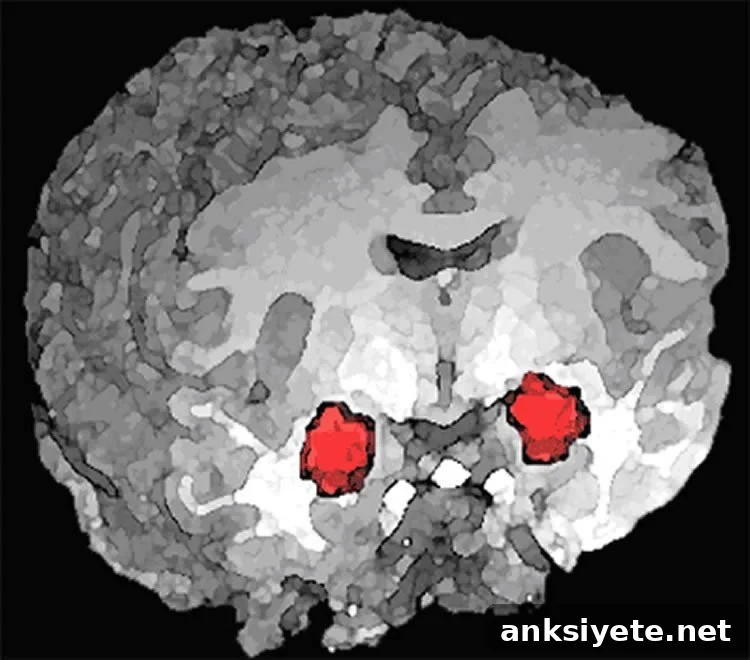
Summary: Neurons in the amygdala derive object values from observation and use those values to simulate a social partner’s decision-making process.
Source: University of Cambridge
Scientists report discovering a distinct class of brain cells that appear to reconstruct others’ decision processes, enabling prediction of intentions and potentially explaining social-cognitive difficulties seen in conditions such as autism and social anxiety.
Researchers at the University of Cambridge have identified a previously unrecognized type of neuron in the amygdala that appears to actively and spontaneously simulate another individual’s decision process during social learning. The findings, published in Cell, indicate these so-called “simulation neurons” allow an observer to build a representation of a partner’s mental state and foresee their likely choices.
The team proposes that impaired simulation neurons could restrict social cognition, a feature common in autism, while hyperactive simulation neurons might exaggerate imagined thoughts of others and contribute to social anxiety.
Lead author Dr. Fabian Grabenhorst, from the Department of Physiology, Development and Neuroscience, explained: “We originally set out to find neurons involved in social learning. We were surprised to discover that amygdala neurons not only learn object values through social observation but also use those values to simulate a partner’s decisions.”
Simulating another’s decision is a sophisticated cognitive operation at the heart of social learning. By watching a partner’s choices—for example, which food sources they select—an observer learns which options are rewarding. This observational knowledge informs the observer’s own choices and helps predict future choices of the partner.
Although psychologists and philosophers have long proposed simulation as a mechanism for understanding other minds, the neural substrates of this process remained unclear. The amygdala is known for its broad role in social behaviour and has been implicated in autism, but until now it was unknown whether amygdala neurons take part in higher-level social cognition such as simulating another’s decisions.
To investigate, the researchers recorded the activity of single amygdala neurons in rhesus macaque monkeys engaged in an observational learning task. Two animals sat facing one another with a touchscreen between them and alternated making choices to gain a fruit-juice reward. Each picture on the screen was associated with a particular reward probability, which the animals needed to learn and track to maximize reward.
During the task, one animal could observe its partner’s choices and, by doing so, learn the reward values associated with the pictures. When the roles switched, the observing animal could then apply that learned information to its own decisions.
Remarkably, when an animal watched its partner act, the observer’s amygdala neurons displayed activity resembling an internal decision computation. These neurons first compared the observed reward values of the choice options and then signalled which option the partner was likely to select, mirroring a decision process. Crucially, these activity patterns appeared spontaneously—well before the partner’s choice—and occurred even when the observer was not required to make a decision.
Building on the neural recordings, the researchers developed a computational model of amygdala circuits underlying social cognition. The model indicates the amygdala contains both a “decision circuit” that computes the animal’s own choices and a separate “simulation circuit” that predicts a social partner’s choice. According to the model, simulation neurons arise naturally when object-value signals converge with self-other encoding, allowing observers to convert learned values into predictions of another’s behaviour.
“Simulation and decision neurons are closely intermingled within the amygdala,” Grabenhorst added. “By recording one neuron at a time we could separate their roles—an approach not feasible with human neuroimaging methods that average activity across large neural populations.”
“We think simulation neurons are essential building blocks of social cognition — they enable animals to reconstruct a partner’s internal decision process and could represent a simple precursor to human capabilities like Theory of Mind.”
The authors suggest that loss or dysfunction of simulation neurons could impoverish social behaviour and the ability to infer others’ mental states. Grabenhorst noted: “If simulation neurons are impaired, an individual may struggle to relate to or infer the minds of others. Identifying specific neuron types and circuit mechanisms for mental simulation offers a path to better understanding social difficulties in disorders such as autism.”
Ethical context and model relevance
The researchers emphasize that advanced social behaviours require a brain comparable to humans, so non-human primates such as marmosets and rhesus macaques are used to study these processes. The use of these species is closely reviewed by institutional ethical boards and regulatory bodies. The study aims to advance understanding of healthy brain function and how neural dysfunction can lead to significant health problems, including implications for obesity, addiction, schizophrenia and Parkinson’s disease, by revealing how reward information drives crucial decisions.
Source:
University of Cambridge
Media Contacts:
Fabian Grabenhorst – University of Cambridge
Image Source:
The image is in the public domain.
Original Research: Open access.
“Primate Amygdala Neurons Simulate Decision Processes of Social Partners” — Fabian Grabenhorst, Raymundo Báez-Mendoza, Wilfried Genest, Gustavo Deco, Wolfram Schultz. Cell doi: 10.1016/j.cell.2019.02.042
Abstract
Primate Amygdala Neurons Simulate Decision Processes of Social Partners
Highlights
• Amygdala neurons derive object values through both personal experience and social observation
• Simulation neurons transform object-value information into predictions of a partner’s choices
• During social observation, simulation neurons display hallmark signatures of decision computation
• Simulation signals can emerge where value signals converge with self–other representations
Summary
Observing conspecifics allows primates to learn reward values of objects. This study shows that monkeys’ amygdala neurons not only encode object values learned by observation but also use those values to simulate a partner’s decision-making. While monkeys alternated making reward-based choices, amygdala neurons encoded object-specific values learned from watching others. Dynamic neural activity converted these values into representations of the subject’s own choices, and similar patterns spontaneously unfolded before a partner’s choices in separate neurons, as if simulating the partner. These “simulation neurons” encoded mutual-inhibitory decision computations—value comparisons and value-to-choice conversions—accurately predicting partner choices. Population decoding revealed contributions from different amygdala subnuclei. Biophysical circuit models indicate simulation neurons naturally arise from the convergence of object-value signals and self–other encoding, suggesting a neural basis by which primates reconstruct the mental states of social partners.