
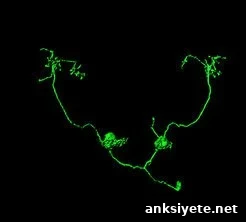
Different neural circuits process environmental signals depending on the state of satiation.
Hunger changes more than appetite. It alters mood, attention and even willingness to accept risk. This effect appears across many species, including humans. Researchers at the Max Planck Institute of Neurobiology in Martinsried used the fruit fly Drosophila as a genetic model to show that hunger not only shifts behavior but also switches which neural pathways process the same environmental cues.
Food availability profoundly shapes animal behavior. Many species become more willing to take risks when food is scarce and more cautious when well fed. Predators, for instance, will target more dangerous prey when close to starvation. Human studies echo this pattern: in controlled experiments, hungry participants have been shown to take significantly more financial risks than their sated peers. The new Drosophila research demonstrates a neural basis for this flexible decision-making, revealing how internal state changes the brain’s routing of sensory information.
The researchers focused on how flies respond to carbon dioxide, a cue that typically signals danger and triggers avoidance. Yet many of the flies’ natural food sources, such as rotting fruit, also emit carbon dioxide, creating a natural conflict: flee from a potential threat or approach a prospective meal. Using carefully controlled behavioral assays, the scientists presented flies with air containing carbon dioxide alone or carbon dioxide mixed with food odor. They found that hungry flies overcame their innate aversion to carbon dioxide much more quickly than fed flies when food odor was present. In other words, hunger tilted the balance in favor of risk-taking when a potential reward—food—was detected.
To identify the neural circuits involved, the team manipulated different brain regions genetically and observed resulting behavior. Avoidance of carbon dioxide is typically considered an innate response and was assumed to be generated by neural pathways outside the mushroom body, a central brain structure long associated with learning and memory. Surprisingly, when the researchers temporarily silenced neurons in the mushroom body, hungry flies no longer responded to carbon dioxide at all, whereas fed flies continued to avoid it. This indicates that the mushroom body becomes essential for the avoidance response when the animal is hungry.
Further experiments pinpointed a specific projection neuron that conveys carbon dioxide information into the mushroom body. This projection neuron is necessary for triggering flight in hungry flies but not in their well-fed counterparts. As Ilona Grunwald-Kadow, who led the study, explains: in sated flies, circuits outside the mushroom body suffice to drive escape from carbon dioxide. In hungry flies, the decision depends on integration within the mushroom body and on the projection neuron that routes CO2 information there. Disrupting either the mushroom body or that projection neuron selectively abolishes the avoidance response in hungry animals.
These findings demonstrate that Drosophila uses two parallel neural circuits to control a single innate behavior, with the active pathway determined by the fly’s nutritional state. When hungry, the fly shifts from a direct, reflexive circuit to a circuit that involves higher processing centers capable of weighing internal needs against external risks. This adaptive routing enables a balanced decision: accept a potential hazard for the chance of food, or avoid danger when safety is prioritized.
The study highlights how metabolic signals and hunger dynamically reconfigure sensory processing and decision-making in the brain. Understanding these mechanisms in a simple model organism provides insight into general principles of how internal states modulate perception and behavior, and it may inform future studies on how hunger influences human choices and risk assessment.
Notes about this hunger and risk perception research
Contact: Dr. Stefanie Merker – Max-Planck-Gesellschaft
Source: Max-Planck-Gesellschaft press release
Image Source: The fruit fly neuron projections are credited to Purayil and Kadow and were adapted from the Max-Planck-Gesellschaft press release.
Original Research: Abstract for “Essential Role of the Mushroom Body in Context-Dependent CO2 Avoidance in Drosophila” by Lasse B. Bräcker, K.P. Siju, Nélia Varela, Yoshinori Aso, Mo Zhang, Irina Hein, Maria Luísa Vasconcelos and Ilona C. Grunwald Kadow in Current Biology. Published online June 13 2013.