
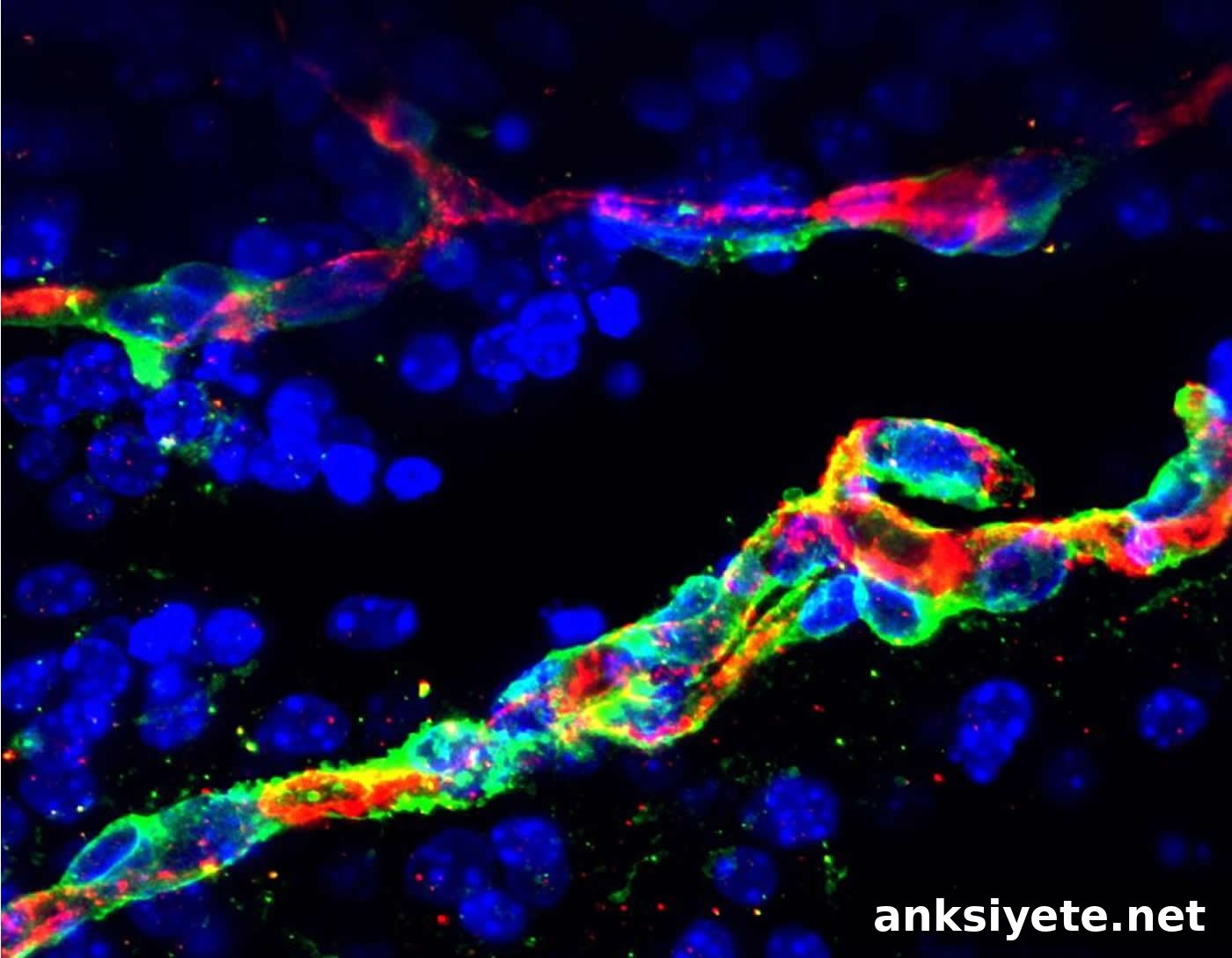
Summary: Blood vessels in the brain can detect the metabolic state of nearby neurons. An imbalance in fatty acid processing is sensed by these neural blood vessels, prompting a stress response that loosens the blood-brain barrier. If the imbalance persists, the resulting barrier leakiness can contribute to disease.
Source: Max Planck Institute
The brain is our most energy-demanding organ. It powers thought, movement, memory and learning, yet relies on a finely tuned supply of nutrients and removal of waste. This supply is delivered by roughly 600 km of blood vessels that support neural tissue. Because the brain is vulnerable to toxins and infection, these vessels form a highly selective blood-brain barrier that tightly regulates which molecules can enter or exit the brain. This barrier protects neuronal function while allowing essential nutrients and signaling molecules to pass under controlled conditions.
Epigenetics turns on the nutrition program
Close communication between neurons and the surrounding vasculature is essential for brain health. Recent research from Asifa Akhtar’s laboratory at the Max Planck Institute in Freiburg demonstrates that blood vessels actively sense the metabolic condition of adjacent neurons and respond accordingly.
The team identified the epigenetic regulator MOF as a key factor that enables neurons to express the metabolic enzymes required to process fatty acids. As Bilal Sheikh, the study’s lead author, explains, MOF binds to DNA and activates the gene programs neurons need to metabolize fatty acids. These fatty acids, obtained from diet and cellular breakdown, serve both as an energy source and as building blocks for complex lipids in membranes.
When MOF function is impaired—such as in certain neurodevelopmental disorders—neurons fail to express the proper enzymes for fatty acid processing. This defect causes long-chain fatty acids to accumulate in the interstitial spaces between cells. The researchers found that this metabolic imbalance is detected by the neighboring neural blood vessels, which respond by activating a stress program that increases the permeability of the blood-brain barrier. If the metabolic disturbance continues, the sustained barrier leakiness can drive vascular inflammation and contribute to a disease state.
Neural blood vessel breakdown
These findings illuminate how metabolic changes in one cell type of a complex organ can directly affect the behavior and health of surrounding cells, ultimately influencing the function of the entire organ. Proper neuronal metabolism is therefore critical not only for neuronal survival and signaling but also for maintaining vascular integrity. According to Asifa Akhtar, a defective neural metabolic environment can trigger vascular inflammation, impair the cells that form the blood-brain barrier, and increase barrier permeability. Over time, these changes can lead to breakdown of neural blood vessels.
Vascular breakdown within the brain is a hallmark of several age-related neurodegenerative conditions, including Alzheimer’s disease and vascular dementia. By characterizing the molecular and cellular events that lead from neuronal metabolic disturbance to vascular dysfunction, this work provides a framework for developing targeted interventions that protect vascular health and slow or prevent disease progression.
About this neuroscience research article
Source:
Max Planck Institute
Media Contacts:
Marcus Rockoff – Max Planck Institute
Image Source:
The image is credited to MPI of Immunobiology and Epigenetics, B. Sheikh.
Original Research: Closed access
“Neural metabolic imbalance induced by MOF dysfunction triggers pericyte activation and breakdown of vasculature” by Bilal N. Sheikh, Sukanya Guhathakurta, Tsz Hong Tsang, Marius Schwabenland, Gina Renschler, Benjamin Herquel, Vivek Bhardwaj, Herbert Holz, Thomas Stehle, Olga Bondareva, Nadim Aizarani, Omar Mossad, Oliver Kretz, Wilfried Reichardt, Aindrila Chatterjee, Laura J. Braun, Julien Thevenon, Herve Sartelet, Thomas Blank, Dominic Grün, Dominik von Elverfeldt, Tobias B. Huber, Dietmar Vestweber, Sergiy Avilov, Marco Prinz, Joerg M. Buescher & Asifa Akhtar.
Nature Cell Biology. DOI: 10.1038/s41556-020-0526-8
Abstract
Neural metabolic imbalance induced by MOF dysfunction triggers pericyte activation and breakdown of vasculature
Mutations that affect chromatin-modifying complexes and metabolic enzymes commonly underlie complex human developmental syndromes. Understanding how such genetic lesions disturb cellular homeostasis in specific cell types remains a major challenge. This study shows that neural-specific loss of members of the non-specific lethal (NSL) chromatin complex—Mof, Kansl2, or Kansl3—causes pronounced vascular defects and brain hemorrhaging. Epigenetic deregulation in neural cells disrupts metabolic programs and leads to accumulation of free long-chain fatty acids (LCFAs). These LCFAs activate a pro-inflammatory Toll-like receptor 4 (TLR4)–NFκB signaling cascade in neighboring vascular pericytes; blocking TLR4 rescues this response. Activated pericytes undergo functional changes that compromise vascular integrity and lead to vascular breakdown. The work demonstrates that neurovascular function depends on the metabolic state of neural cells and highlights metabolic cross-talk as a determinant of brain vascular health.