
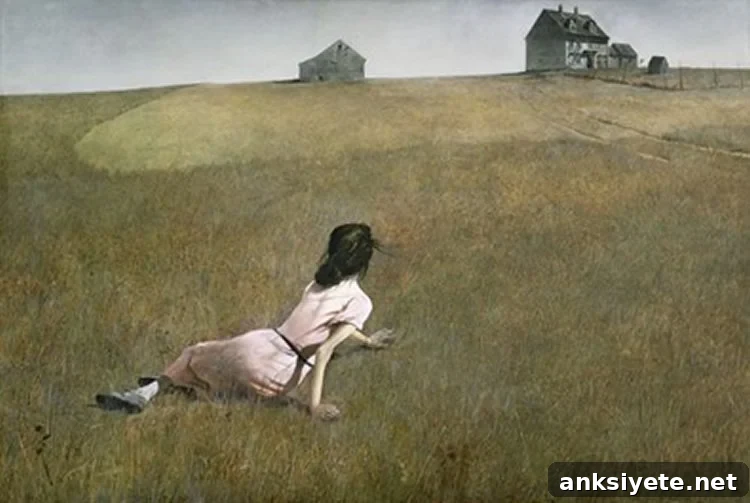
Findings suggest the subject of Christina’s World suffered from a neurological disorder.
Andrew Wyeth’s Christina’s World is among the most iconic images in American art: a luminous painting of a young woman sprawled in a field, her gaze fixed on a distant farmhouse beneath a wide sky. The work, widely reproduced and held in the Museum of Modern Art in New York, captures a quietly haunting scene that has intrigued viewers for decades.
But behind the beauty lies a long, difficult story.
The woman depicted is Christina Olson, Wyeth’s neighbor and close friend. Throughout most of her life, Olson lived with a progressive physical disability that gradually limited her ability to walk and, over time, to use her hands. She lived to age 74, and for many years the exact nature of her illness remained uncertain.
New medical analysis offers a plausible explanation.
Marc Patterson, a child neurologist at the Mayo Clinic who also serves as a professor of neurology, pediatrics and medical genetics, has re-examined the available evidence surrounding Olson’s condition. Based on medical records, historical accounts and the physical portrayals in Wyeth’s paintings, Dr. Patterson proposes that Olson most likely had an early-onset form of Charcot-Marie-Tooth disease (CMT). CMT refers to a group of inherited peripheral neuropathies that progressively impair peripheral nerves, often leading to muscle weakness, sensory changes and difficulties with walking and manual tasks.
“This was a fascinating case,” Dr. Patterson said, describing the intersection of art and medicine that led to his conclusion. “Wyeth’s portrayals of Christina offer visual clues about her gait, posture and hand use that complement the documentary medical evidence. Taken together, they support a diagnosis consistent with Charcot-Marie-Tooth disease.”
Dr. Patterson planned to present his findings at the 23rd annual Historical Clinicopathological Conference held on May 6 at the University of Maryland School of Medicine. That conference series examines medical puzzles surrounding notable historical figures, offering clinicians and historians an opportunity to apply modern diagnostics to long-standing mysteries. Past discussions have re-evaluated the probable illnesses of figures such as Lenin, Charles Darwin and Abraham Lincoln.
Thomas B. Cole, associate editor for the Journal of the American Medical Association and an authority on medical themes in art, was also scheduled to speak at the conference. The event’s organizers include Philip A. Mackowiak, MD, who founded the conference in 1995 and has emphasized its value in demonstrating how much medical understanding has advanced over recent decades.
Charcot-Marie-Tooth disease is an inherited disorder of the peripheral nerves, characterized by progressive muscle weakness and sensory loss, typically beginning in the feet and lower legs and sometimes affecting the hands and forearms as it advances. Presentation and severity vary by subtype and age of onset. Early-onset forms can produce significant mobility challenges and visible changes in posture and limb use—features that, according to Dr. Patterson, align with historical descriptions of Christina Olson and Wyeth’s paintings.
Re-examining medical histories through the combined lenses of neurology, genetics and visual evidence highlights how contemporary clinical knowledge can illuminate the lived experience of historical patients. In Olson’s case, the proposed diagnosis of early-onset Charcot-Marie-Tooth disease offers a medically coherent explanation for the progressive disability she endured and helps viewers understand the context behind a beloved work of art.
Source: David Kohn – University of Maryland School of Medicine
Image Credit: The image is credited to Andrew Wyeth, 1948, and is licensed Fair Use.
Original Research: The study was presented at the Historical Clinicopathological Conference in Baltimore, MD on May 6, 2016.