
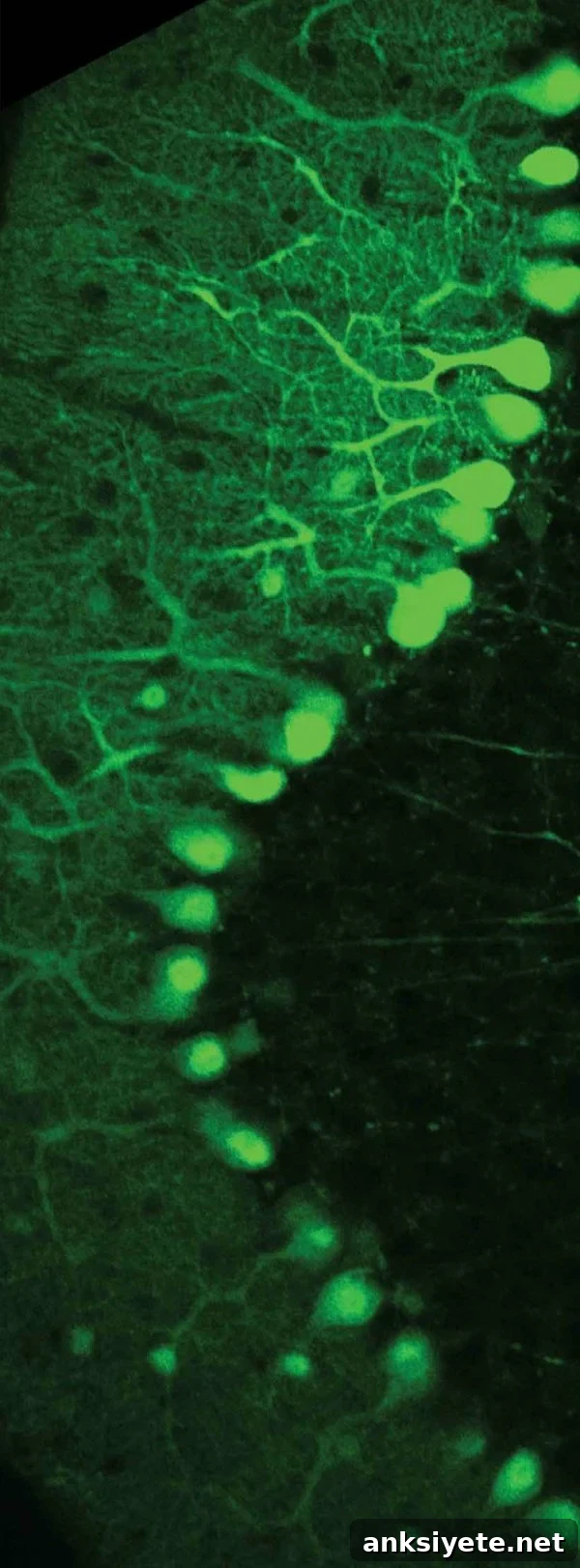
Whether performing a piano sonata or serving an ace in tennis, the brain must precisely coordinate many muscles while continuously monitoring feedback from the senses. Two key players in that process are Purkinje cells, which direct motor output, and climbing fibers, which report errors or unexpected sensations. A team from the University of Pennsylvania and Princeton University has clarified a long-standing paradox about how this feedback system reliably signals true errors amid pervasive spontaneous activity.
Climbing fibers send error-related messages to Purkinje cells, but they also fire spontaneously at about one impulse per second. That random activity raised a major question: how can an individual Purkinje cell tell a meaningful error signal from the constant background of spontaneous firing?
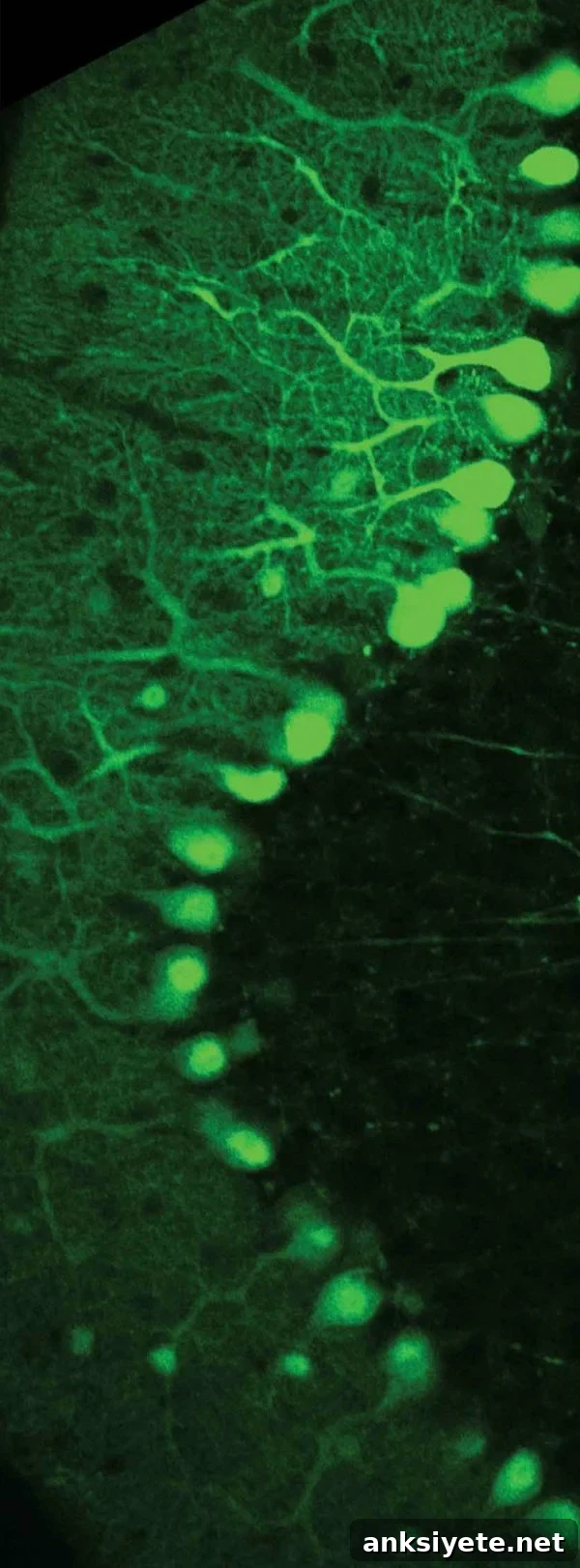
Using two-photon microscopy to observe chemical signaling between climbing fibers and Purkinje cells in awake, behaving mice, the researchers found for the first time a measurable difference between “true” sensory-driven signals and spontaneous action. This discovery has direct implications for our understanding of motor control, learning, and neuroplasticity.
The study was led by Javier Medina, assistant professor in the Department of Psychology at Penn, with graduate student Farzaneh Najafi and collaborators Andrea Giovannucci and Samuel S. H. Wang at Princeton. Their work appeared in the journal Cell Reports.
The cerebellum, a central hub for fine motor control, contains many Purkinje cells that integrate inputs from across the brain and shape motor commands sent to muscles. Each Purkinje cell receives input from a single climbing fiber, a nerve projection from the brainstem that signals when sensory feedback differs from the brain’s prediction.
“Climbing fibers do more than report raw sensations,” Medina explained. “They signal when a sensation was unexpected. That distinction is critical — it’s why you can’t tickle yourself. The brain predicts sensations produced by your own movement, but an externally generated touch is unexpected and thus registers differently.”
Beyond preventing surprise, that unexpectedness — or error information — is crucial for motor learning. When a movement deviates from its intended outcome, climbing fibers inform Purkinje cells that a correction is needed. In response, Purkinje cells alter the strength of incoming synapses, adjusting future motor commands. This adaptive process, neuroplasticity, underlies skill improvement through practice.
The apparent paradox was that climbing fibers also fire spontaneously. If each firing looked the same to a Purkinje cell, the cell could not distinguish noise from meaningful error signals. To test whether there is an identifiable difference, Medina and colleagues measured calcium signals in Purkinje cell dendrites while mice walked on a treadmill and received unexpected air puffs to the face that triggered blinks.
Two-photon microscopy, combined with calcium-sensitive dyes, allowed the team to monitor intracellular calcium — a proxy for neural signaling — in real time in awake animals. The air puffs provided controlled, unexpected sensory events so the researchers could compare how Purkinje cells responded to sensory-driven inputs versus spontaneous climbing fiber firings.
They found that Purkinje cell dendrites exhibited larger calcium transients when a climbing fiber firing was linked to an unexpected sensory event than when the same climbing fiber fired spontaneously. In other words, sensory-driven climbing fiber signals produced stronger calcium responses in individual Purkinje cell branches than did background activity.
This finding challenged the long-standing view that climbing fiber inputs are strictly “all-or-nothing.” Instead, Purkinje cells appear capable of grading their response, allowing them to separate true error-related messages from routine spontaneous firing.
The exact mechanism that enables this discrimination remains under investigation. The researchers propose two non-exclusive possibilities: first, the pattern of electrical impulses (burst size and timing) from climbing fibers may carry distinguishing information; second, a climbing fiber input may be interpreted differently when it arrives in synchrony with other cerebellar or cortical signals. Either mechanism would allow Purkinje cells to extract more nuanced, graded information about the presence and magnitude of errors.
Recognizing that individual Purkinje cells can tell when their associated muscle output deviates from expectation has important consequences for future research on motor control and learning. If climbing fiber signals convey graded information about error size as well as its occurrence, the cerebellum could fine-tune motor commands more precisely, enabling higher levels of skill and accuracy in tasks that demand delicate control.
Notes about this neuroscience research
The research received support from the National Institutes of Health, the New Jersey Commission on Brain Injury Research, and the Searle Scholars Program.
Contact: Evan Lerner – University of Pennsylvania
Source: University of Pennsylvania press release
Image Source: Andrea Giovannucci; image adapted from the University of Pennsylvania press release.
Original Research: “Sensory-Driven Enhancement of Calcium Signals in Individual Purkinje Cell Dendrites of Awake Mice” by Farzaneh Najafi, Andrea Giovannucci, Samuel S.-H. Wang, and Javier F. Medina, published in Cell Reports. DOI: 10.1016/j.celrep.2014.02.001.