
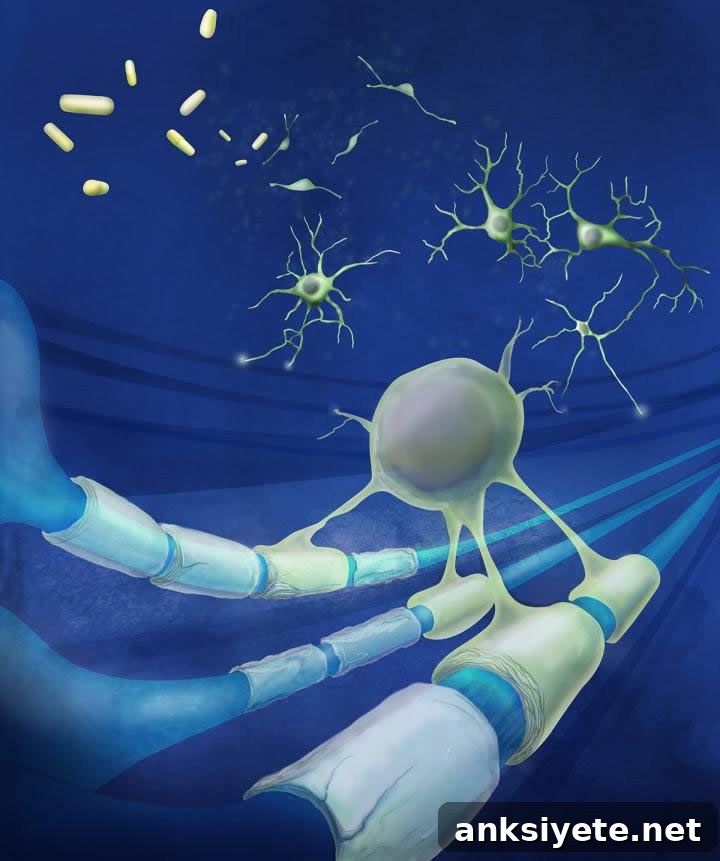
NIH-funded study identifies over-the-counter compounds that may replace damaged cells
Researchers have identified two widely available drugs that could help the brain repair the myelin damage that occurs in multiple sclerosis (MS). A study published in Nature and partially funded by the National Institute of Neurological Disorders and Stroke (NINDS) found that the antifungal miconazole and the steroid clobetasol can stimulate endogenous stem cells in the central nervous system to produce new myelin-forming cells, promoting remyelination and restoring function in preclinical models.
Myelin is a fatty insulating layer wrapped around axons—the long projections that connect neurons—and it is essential for fast electrical signaling in the nervous system. In MS, myelin breaks down, interrupting communication between nerve cells and causing symptoms such as weakness, numbness, vision problems, and balance and coordination difficulties. Current MS therapies largely focus on suppressing the immune system to reduce relapses, but they do not directly repair lost myelin. Therapies that encourage remyelination could potentially reduce long-term disability.
Oligodendrocytes are the cells that produce myelin, and they arise from oligodendrocyte progenitor cells (OPCs), a type of resident stem cell in the adult brain. Although OPCs are present in demyelinated regions of MS patients and proliferate in response to damage, they often fail to differentiate into mature oligodendrocytes capable of restoring myelin. The research team, led by Paul J. Tesar, Ph.D., at Case Western Reserve School of Medicine, set out to discover whether approved drugs might be repurposed to activate OPCs and drive remyelination.
To perform a rapid and systematic search, the investigators adapted a method to generate OPCs in culture from pluripotent stem-cell sources and screened a library of bioactive compounds provided by the National Center for Advancing Translational Sciences (NCATS). The screen tested hundreds of approved drugs for their ability to promote OPC differentiation into myelin-producing oligodendrocytes.
Two compounds emerged as particularly promising: miconazole and clobetasol. Both drugs stimulated mouse and human OPCs in vitro to form mature oligodendrocytes. When tested in mouse models of demyelination, systemic administration of each drug increased the generation of new oligodendrocytes and enhanced remyelination. In an experimental autoimmune encephalomyelitis (EAE) model, which mimics aspects of MS, treatment at disease peak produced dramatic improvement in motor function, with many animals regaining use of affected limbs.
Mechanistic studies showed the drugs operate through distinct pathways. Miconazole promoted remyelination primarily through activation of mitogen-activated protein kinase (MAPK) signaling within OPCs, acting directly on the cells responsible for building myelin and without detectable effects on immune responses. Clobetasol, by contrast, combined remyelinating activity with potent immunosuppressive effects mediated by glucocorticoid receptor signaling.
Importantly, both drugs also enhanced the production of human oligodendrocytes from human OPCs in laboratory assays, supporting the translational potential of these findings. However, the investigators emphasize caution: miconazole and clobetasol are currently approved only as topical formulations for use on the skin or mucous membranes. Their effects, safety, and appropriate dosing by systemic routes—such as oral or injectable administration—have not been established in humans for the purpose of remyelination.
“Rather than transplanting cells, we asked whether existing drugs could harness the brain’s own repair cells to restore myelin,” said Paul J. Tesar, Ph.D. The team is pursuing further preclinical work to optimize delivery, improve safety, and identify derivative molecules that retain remyelinating activity with favorable pharmacological profiles.
Research support: This work received funding from NINDS (NS085246, NS030800, NS026543), the New York Stem Cell Foundation and the Myelin Repair Foundation.
Summary of the study: The study demonstrates that drug-based activation of endogenous OPCs can promote functional remyelination in vivo. Screening identified compounds that drive OPC differentiation at low (nanomolar) concentrations, and two lead drugs—miconazole and clobetasol—enhanced remyelination and improved function in mouse models. Miconazole acted directly on OPCs via MAPK signaling, while clobetasol combined remyelinating effects with immunosuppression through glucocorticoid receptor pathways. Both drugs increased human oligodendrocyte generation in vitro, supporting further exploration of remyelination-focused therapies.
Caveat: Clinical testing in people with multiple sclerosis will require additional preclinical safety studies and formulation development. Off-label use of current topical forms is unlikely to be safe or effective for remyelination and may pose risks.
Image credit: Case Western Reserve University; Illustrator: Megan Kern.
Abstract (condensed)
Multiple sclerosis involves autoimmune-mediated injury and a progressive failure of remyelination. Oligodendrocyte progenitor cells are abundant in demyelinated lesions but often fail to differentiate into myelinating oligodendrocytes. A targeted screen of bioactive, clinically approved small molecules identified several compounds that promote OPC maturation. Two leads, miconazole and clobetasol, increased oligodendrocyte production and enhanced remyelination in organotypic cultures and in vivo models, and substantially reversed disease severity in an autoimmune model of MS. The drugs act through MAPK and glucocorticoid receptor signaling, respectively, and also improve human OPC differentiation in vitro. These results support further development of remyelination-promoting therapies based on these or related compounds.