
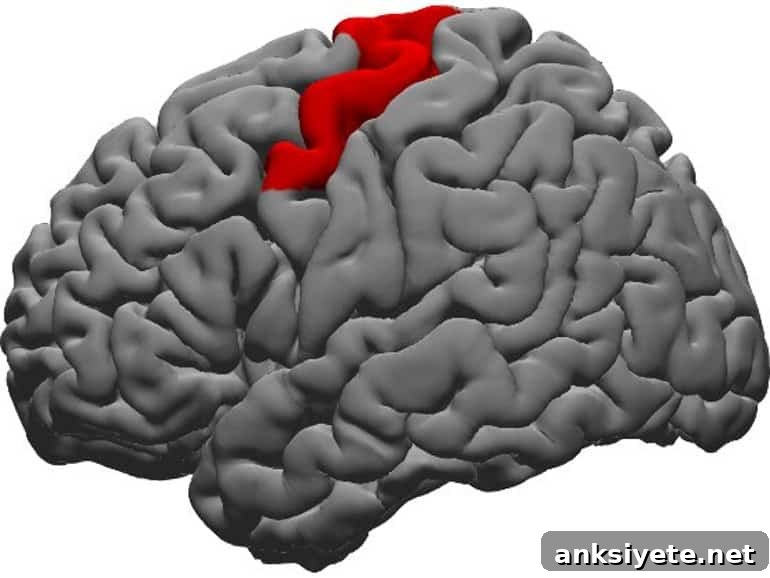
Summary: Researchers identified a key role for the dorsal precentral gyrus in using voice feedback to shape how spoken words sound in real time.
Source: NYU Langone
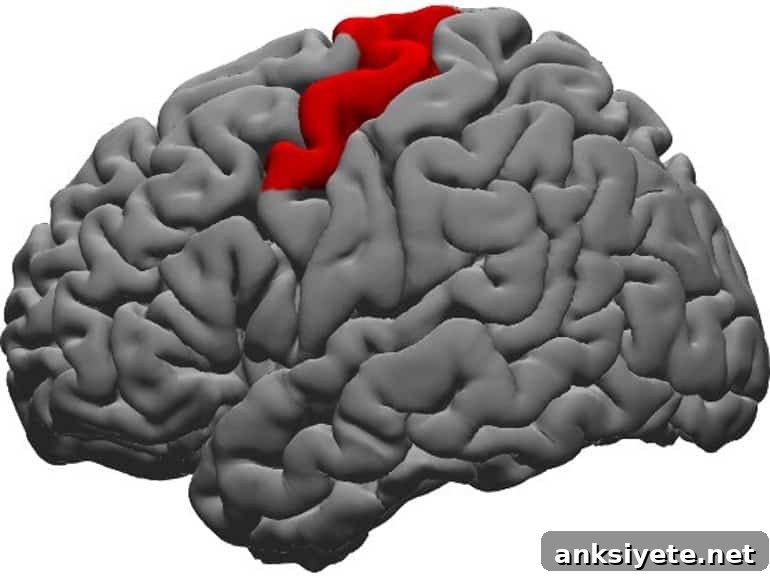
The dorsal precentral gyrus, a region that spans the folded surface at the top of the brain, is essential for using auditory feedback to control spoken language, according to a new study.
Hearing oneself while speaking is widely recognized as crucial to fluent speech. People constantly use auditory cues from their own voice to make almost instantaneous adjustments—slowing down to articulate a multisyllable word, speaking louder to overcome noise, or subtly changing pitch and timing to improve clarity.
Researchers at NYU Grossman School of Medicine examined several subregions of the cerebral cortex that govern the mouth, lips, and tongue and that process auditory feedback from speech. Although prior work implicated multiple cortical areas in speech production and perception, the precise, real-time contribution of each subregion to feedback-based control of speech remained unclear. Directly measuring brain activity while people speak has been a major technical challenge.
Published in PLOS Biology, the new study mapped electrical responses across cortical regions while participants experienced delayed auditory feedback (DAF). Short delays, from 0 to more than 200 milliseconds, were introduced to mimic everyday disruptions such as slurring or echoes. The researchers found that three regions, including the superior temporal gyrus and the supramarginal gyrus, were involved in correcting speech errors. However, only the dorsal precentral gyrus showed dominant responses when feedback delays were greatest, indicating a primary role in compensating for pronounced mismatches between intended and heard speech.
“This study confirms the critical role of the dorsal precentral gyrus in maintaining control over speech as we are talking, ensuring we pronounce words the way we intend,” said senior investigator Adeen Flinker, Ph.D., a neuroscientist and assistant professor in the Department of Neurology at NYU Langone Health.
The team plans follow-up studies to clarify whether the dorsal precentral gyrus generates the brain’s internal memory of how words are supposed to sound and how it detects deviations from that template after motor commands turn plans into articulatory movements.
Understanding this region’s precise function could guide targeted treatments for conditions in which auditory feedback control is disrupted, such as stuttering and Parkinson’s disease—disorders that involve delayed or faulty processing of speech feedback in the brain.
The study analyzed thousands of recordings taken from about 200 electrodes implanted in each of 15 people with epilepsy who were scheduled for clinical monitoring to locate seizure foci. Recordings were collected in 2020 at NYU Langone. During planned breaks in their clinical care, participants read standardized words and phrases aloud while wearing headphones. Their speech was recorded and played back to them with varying delays.
Using electrocorticography to measure electrical activity across cortical subregions, investigators compared neural signals as feedback delay increased. Delayed auditory feedback is a well-established paradigm for probing how the brain detects and corrects speech errors: it reliably disrupts fluency and can produce slowed or stutter-like speech. By introducing controlled errors, researchers were able to localize neural signatures of auditory error detection and subsequent motor adjustments.
The study observed a strong, delay-dependent enhancement of activity in auditory cortex, consistent with an auditory error signal that grows as feedback mismatch increases. Immediately after auditory cortex, the dorsal precentral gyrus exhibited a similar enhancement, suggesting tight functional coupling between auditory processing and motor control regions. Notably, the dorsal precentral gyrus response was most prominent during extended utterances, when a continuous mismatch accumulates between produced speech and delayed feedback.
These findings indicate that the dorsal precentral gyrus plays a central role in processing auditory error signals during speech production to help maintain fluency. By pinpointing this region’s contribution to real-time speech monitoring and correction, the research opens paths for targeted interventions and deeper investigation into neural mechanisms underlying speech disorders.
About this neuroscience research news
Author: Press Office
Source: NYU Langone
Contact: Press Office – NYU Langone
Image: The image is in the public domain
Original Research: Open access. “A cortical network processes auditory error signals during human speech production to maintain fluency” by Özker M, Doyle W, Devinsky O, Flinker A. PLOS Biology
Abstract
A cortical network processes auditory error signals during human speech production to maintain fluency
Hearing one’s own voice is essential for fluent speech because it enables detection and correction of vocalization errors in real time. This auditory feedback control is impaired in conditions ranging from stuttering to aphasia, yet the underlying neural mechanisms are not fully understood.
Computational models propose that during speech the brain uses an efference copy of motor commands to predict the expected auditory outcome. When actual feedback deviates from that prediction, an error signal is generated to update internal estimates and modify motor commands to achieve intended speech.
Using electrocorticographic recordings during a delayed auditory feedback paradigm, the investigators localized an auditory speech error signal in auditory cortex and identified a closely coupled response in dorsal precentral gyrus. Critically, the dorsal precentral response emerged primarily during long utterances when a sustained mismatch between produced speech and delayed feedback exists. These results implicate dorsal precentral gyrus as essential for processing auditory error signals and maintaining speech fluency.