
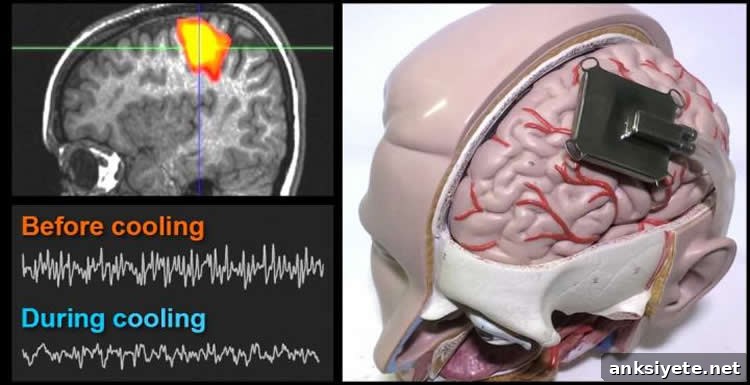
Summary: Researchers developed a computer model that sheds light on how cooling specific brain regions could help reduce or stop epileptic seizures.
Source: PLOS.
Computer Simulations Reveal How Focal Brain Cooling May Treat Epilepsy
Using detailed computer simulation methods, researchers have clarified mechanisms by which lowering the temperature of targeted brain areas—focal brain cooling—might suppress epileptic discharges. The findings were reported in PLOS Computational Biology and offer new insight into a potential alternative treatment for patients whose seizures do not respond to medication or surgery.
Epilepsy affects roughly 50 million people worldwide and is marked by sudden, recurrent seizures caused by abnormal electrical activity in the brain. When conventional treatments such as drugs or surgical resection fail, clinicians and scientists have explored neuromodulation strategies. One promising approach, focal cooling, involves an implanted device that locally reduces brain temperature to dampen the abnormal electrical discharges that produce seizures.
Jaymar Soriano and colleagues at Nara Institute of Science and Technology (NAIST), Japan, used a computational neural mass model to investigate how focal cooling changes neural dynamics. Although short-term cooling has been applied experimentally in operating-room studies in humans and shows consistent seizure suppression in animal models, some experiments in rats showed an unexpected effect: while cooling reduced the strength or amplitude of epileptic discharges, it sometimes produced a slight increase in discharge frequency. The researchers set out to reproduce and explain these heterogeneous outcomes using a model informed by laboratory and animal data.
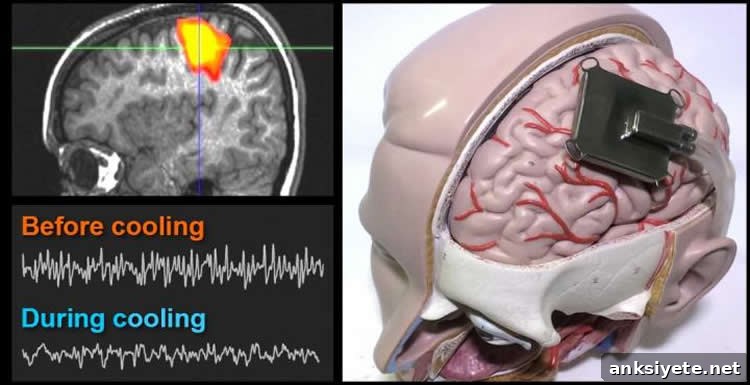
First, the team simulated a synaptic mechanism suggested by laboratory studies: cooling reduces neurotransmitter release and weakens synaptic transmission, which should lower the likelihood of synchronized discharges and thus decrease seizure frequency. However, this synaptic attenuation alone did not replicate the electrical patterns recorded in live rat experiments where cooling produced persistent but smaller discharges.
To resolve this discrepancy, the modelers added a second mechanism. They incorporated temperature-dependent changes in intrinsic excitability—how readily neurons fire—so that cooling not only weakened synaptic responses but also altered the firing threshold distribution across neuronal populations. In the model this compensatory change allowed discharges to persist (maintaining or slightly increasing frequency) even while their magnitude was reduced. When combined, the two temperature-sensitive effects reproduced the mixed experimental outcomes: cooling could either terminate discharges or produce persistent but attenuated activity depending on the parameter values and relative sensitivities.
These results suggest that focal cooling operates through at least two interacting processes: reduced synaptic efficacy that lowers post-synaptic potentials, and altered intrinsic excitability that can partly offset the diminished synaptic drive. The balance between these processes determines whether cooling will fully stop epileptic discharges or only diminish their amplitude. Bifurcation analysis of the model showed how small differences in temperature sensitivity of synaptic versus firing processes can produce qualitatively different responses to cooling.
“Focal brain cooling could be an alternative treatment for epileptic seizures with lower risk of irreversible functional loss compared to surgery,” says co-author Takatomi Kubo. The computational approach provides a framework to interpret animal and intraoperative human data, and can guide further experiments and device development for thermal neuromodulation.
About this research
Funding: This study was supported in part by grant 15H05719 from The Japan Society for the Promotion of Science. The funders had no role in study design, data collection and analysis, decision to publish, or preparation of the manuscript.
Source: PLOS. Image credit: Soriano et al.
Original research: The study is titled “Differential temperature sensitivity of synaptic and firing processes in a neural mass model of epileptic discharges explains heterogeneous response of experimental epilepsy to focal brain cooling,” authored by Jaymar Soriano, Takatomi Kubo, Takao Inoue, Hiroyuki Kida, Toshitaka Yamakawa, Michiyasu Suzuki, and Kazushi Ikeda, published in PLOS Computational Biology on October 5, 2017 (doi:10.1371/journal.pcbi.1005736).
Abstract (rephrased)
Experiments in drug-induced epilepsy models in rats and observations from human epileptic brain tissue indicate that narrowly targeted cooling can suppress epileptic discharges without impairing normal brain function. This supports the concept of an implantable focal cooling device as a potential therapy for refractory epilepsy. The precise biophysical mechanisms behind cooling-induced suppression, however, remain unclear. In vitro experiments point to reduced neurotransmitter release and structural changes at synapses as possible synaptic mechanisms. Using a neural mass model, the authors show that introducing a homogeneous temperature factor that reduces post-synaptic impulse responses can terminate epileptic discharges by lowering post-synaptic potentials and decreasing pyramidal cell firing when inhibitory interneurons are less affected. But in vivo cooling sometimes produces persistent, lower-amplitude discharges rather than full termination. To account for this, the model incorporates a compensatory, reciprocal temperature factor in the firing response that captures redistribution of firing thresholds across the neuronal population. The combined model reproduces both suppression and termination outcomes observed experimentally and suggests that cooling reduces both the mean and variance of firing thresholds. Bifurcation analysis demonstrates how differential temperature sensitivities across synaptic and firing processes lead to heterogeneous outcomes of focal cooling in experimental epilepsy.