
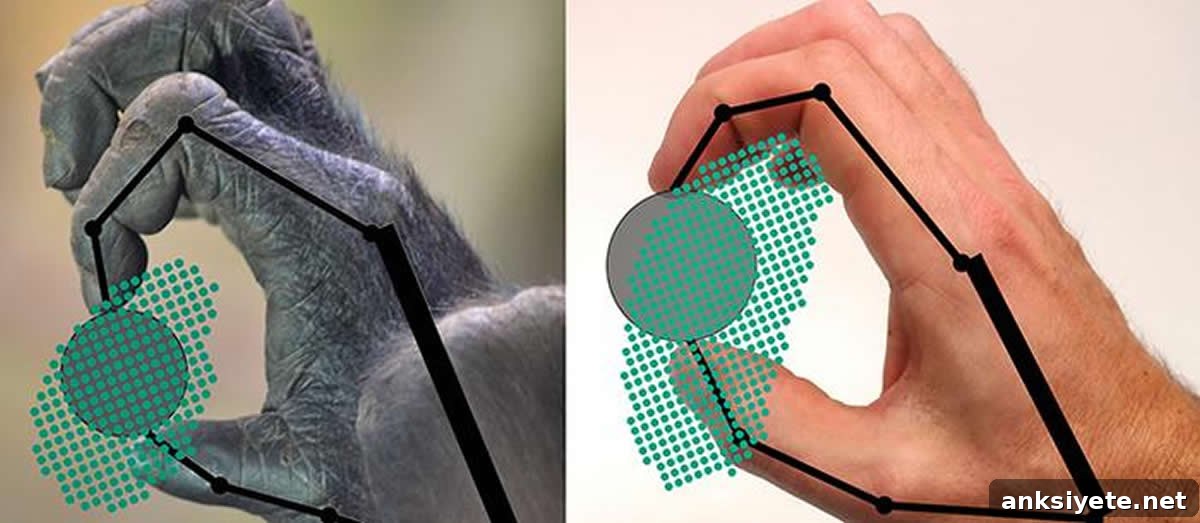
Scientists are refining their understanding of the exceptional grasping abilities of humans and other primates across evolutionary history.
A new study led by researchers at Yale University indicates that even some of the earliest known human ancestors may have possessed precision-grip abilities comparable to those of modern humans. Notably, the research suggests that Australopithecus afarensis—an early hominin that appears in the fossil record around one million years before the first clear archaeological evidence for stone tools—may already have had a capacity for fine thumb–index finger manipulation.
The interdisciplinary team brought together Yale robotics engineers Thomas Feix and Aaron Dollar, anthropologist Tracy Kivell of the University of Kent and the Max Planck Institute for Evolutionary Anthropology, and primatologist Emmanuelle Pouydebat of the French National Centre for Scientific Research. Their results were published in the Journal of the Royal Society: Interface.
To estimate precision-grip potential, the researchers developed a kinematic model based on measurements of the digit segments. This model reconstructs the movement possibilities of the thumb and index finger from bony landmarks in both living primates and fossil hand remains. It is the first comprehensive, movement-focused model to compare thumb–index interactions across a broad sample of extant primates and fossil hominins.
“A long thumb or high joint mobility on its own does not guarantee superior precision manipulation,” said Feix, the study’s corresponding author. The model shows that modern humans retain the greatest overall manipulation potential, particularly for handling very small objects, because precision grip ability depends on the combination of scaled digit proportions and joint mobility rather than a single anatomical feature.
Previous studies of primate precision grips tended to emphasize static digit posture—how fingers contact an object—or simple ratios such as thumb length relative to finger length. The novel approach in this study models the dynamic interaction between thumb and index finger, the core mechanism for stable manipulation of small objects, and evaluates performance potential across species and fossil specimens.
Manual dexterity is widely considered a defining trait of primates. It likely emerged as hands were freed from locomotor duties and as selective pressures favored more skilled manipulation for tasks such as foraging and tool-related behavior. However, debates persist about when anthropoid precision grips first evolved and which fossil hominins could perform complex manipulative tasks.
The new kinematic model contributes important evidence to that discussion. By integrating joint range of motion and digit proportions scaled to hand size, the analysis indicates that some early hominins—most notably Australopithecus afarensis—may have possessed manipulation potential similar to modern humans. If accurate, this implies that behaviors requiring fine thumb–index coordination could have been possible long before the earliest unambiguous stone tools appear in the archaeological record.
Such a conclusion does not assert that all tool-related behaviors left behind durable traces, only that the anatomical potential for more refined manipulation existed. The study therefore supports the possibility that certain manipulative or pre-tool activities took place but were either not preserved or not recognized in the archaeological record.
Funding: Open Access funded by Economic and Social Research Council.
Source: Jim Shelton – Yale
Image Source: The image is credited to Yale University
Original Research: Abstract for “Estimating thumb–index finger precision grip and manipulation potential in extant and fossil primates” by Thomas Feix, Tracy L. Kivell, Emmanuelle Pouydebat, and Aaron M. Dollar in Journal of the Royal Society: Interface. Published online April 15 2015 doi:10.1098/rsif.2015.0176
Abstract
Estimating thumb–index finger precision grip and manipulation potential in extant and fossil primates
Primates, and particularly humans, exhibit exceptional manual dexterity relative to other mammals. Establishing a biomechanical link between hand morphology, movement capability, and functional behavior in living primates and fossil taxa has been difficult. The authors present a kinematic model of thumb–index precision grip and manipulative movements derived from bony hand morphology across a wide sample of extant primates and fossil hominins. Their findings indicate that both scaled digit proportions and joint mobility are essential determinants of precision grip and manipulation potential. Neither a long thumb nor enhanced joint mobility alone is sufficient to produce high precision manipulation. The results imply that some of the oldest available fossil hominins may have shared precision grip capacities comparable to modern humans. In particular, the model predicts human-like precision manipulation in Australopithecus afarensis, roughly one million years before the earliest clear stone-tool evidence, which adds weight to contested interpretations of early tool-use in this species.
“Estimating thumb–index finger precision grip and manipulation potential in extant and fossil primates” by Thomas Feix, Tracy L. Kivell, Emmanuelle Pouydebat, and Aaron M. Dollar in Journal of the Royal Society: Interface. Published online April 15 2015 doi:10.1098/rsif.2015.0176