
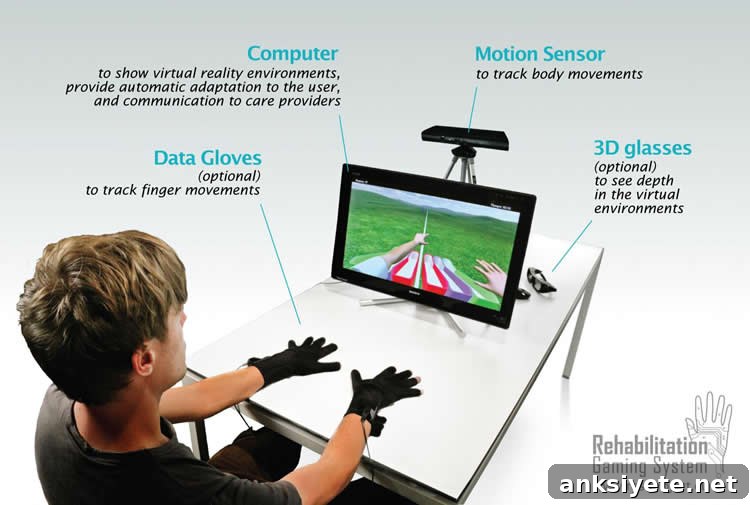
Using virtual reality to boost a stroke patient’s confidence in using a paralyzed arm may be a crucial step in recovery, according to research published in the open-access Journal of NeuroEngineering and Rehabilitation.
Virtual reality (VR) shows promise as a tool for arm rehabilitation in some stroke survivors. A clinical pilot study investigated whether visually enhancing the movement of a patient’s affected arm in a VR environment can increase spontaneous use of that limb and counteract the common problem known as learned non-use.
After a stroke, many patients develop hemiparesis — reduced strength and control on one side of the body. Even when some motor function remains, patients often rely on their healthy arm for daily tasks. This compensatory behavior can quickly become habitual: prolonged non-use of the paretic limb may lead to further loss of function and a diminished quality of life. Therapies that encourage repeated use of the affected limb are therefore central to promoting motor recovery and improving independence.
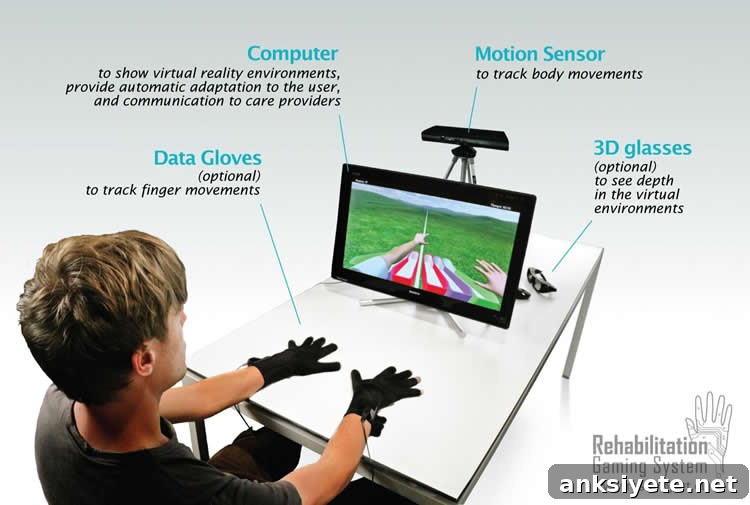
The pilot study enrolled 20 hemiparetic stroke patients who trained with the Rehabilitation Gaming System (RGS), a VR platform that uses a motion sensor to map the user’s movements onto a virtual body seen from a first-person perspective. Participants reached for targets that appeared in the virtual environment while the system recorded their choices and performance. During a brief intervention phase, the researchers subtly amplified the apparent speed, accuracy and reach of the virtual representation of the paretic arm. These visual amplifications were introduced and withdrawn gradually so that participants remained unaware of the manipulation.
The core idea was to test whether a short period of positive visual feedback could change patients’ beliefs about what their affected arm was capable of, and whether that change in belief would produce measurable increases in the spontaneous selection and use of the paretic limb.
Results showed that even a brief enhancement — as little as ten minutes — significantly increased the likelihood that patients would choose their paretic arm to reach for targets after the manipulation had ended. Crucially, this change in behavior occurred despite the fact that the later test sessions contained no movement amplification and that patients did not report noticing any manipulation. The study also observed transfer of effects to real-world measures: patients demonstrated a larger working area for the affected arm in physical reaching tasks following the VR intervention.
Lead author Belén Rubio, from the Laboratory of Synthetic, Perceptive, Emotive and Cognitive Systems at Universitat Pompeu Fabra in Spain, emphasized the importance of addressing the emotional and cognitive aspects of rehabilitation. She noted that increasing patients’ confidence in the paretic limb can create a virtuous circle: improved belief in ability leads to more spontaneous use, which provides more practice and feedback, which in turn supports motor recovery. This reinforcement-based strategy contrasts with some current approaches that focus on physically constraining the healthy limb to force use of the affected limb, such as Constraint-Induced Movement Therapy.
The RGS platform has been validated in a variety of studies over the last decade. According to the authors, evidence supports RGS’s positive impact on functional recovery for both acute and chronic stroke patients, and the system is already in clinical use in several hospitals and treatment centers.
While findings from this small pilot are encouraging, the authors stress the need for larger trials to confirm effectiveness, define optimal dosing, and determine which patients are most likely to benefit from VR-based visual amplification. If replicated, this approach could become an accessible, non-invasive complement to existing stroke rehabilitation strategies, particularly for patients who are reluctant or anxious about using their affected arm.
RGS is being commercialized via a spin-off company, Eodyne.
Source: Joel Winston – Biomed Central
Image Credit: Rehabilitation Gaming System
Original Research: “The visual amplification of goal-oriented movements counteracts acquired non-use in hemiparetic stroke patients” by Belén Rubio Ballester, Jens Nirme, Esther Duarte, Ampar Cuxart, Susana Rodriguez, Paul Verschure and Armin Duff in Journal of Neuroengineering and Rehabilitation. Published online June 9, 2015. doi:10.1186/s12984-015-0039-z
Abstract
The visual amplification of goal-oriented movements counteracts acquired non-use in hemiparetic stroke patients
Background
Stroke-related impairments arise from both direct brain damage and secondary effects such as acquired non-use of an impaired limb. Many stroke survivors under-utilize their paretic arm despite retaining some residual motor function. The authors hypothesized that reinforcement-based training strategies could overcome learned non-use.
Methods
Twenty hemiparetic stroke patients (11 males, 9 with right-sided hemiparesis) completed reaching tasks presented either in the real world or within a virtual environment. Sessions included baseline, intervention and washout phases. During intervention, the virtual representation of the paretic limb was visually amplified toward the target.
Results
After the intervention, the probability of selecting the paretic limb during washout was significantly higher than at baseline. Patients also showed a larger reachable workspace in real-world tasks, and these gains were associated with changes in effector selection patterns.
Conclusions
Visual amplification of the paretic limb within a virtual environment promotes increased use of that limb in stroke patients. These results suggest reinforcement-based VR therapies may effectively counteract learned non-use and positively influence motor performance in everyday settings.
“The visual amplification of goal-oriented movements counteracts acquired non-use in hemiparetic stroke patients” by Belén Rubio Ballester et al., Journal of Neuroengineering and Rehabilitation. Published online June 9, 2015. doi:10.1186/s12984-015-0039-z