
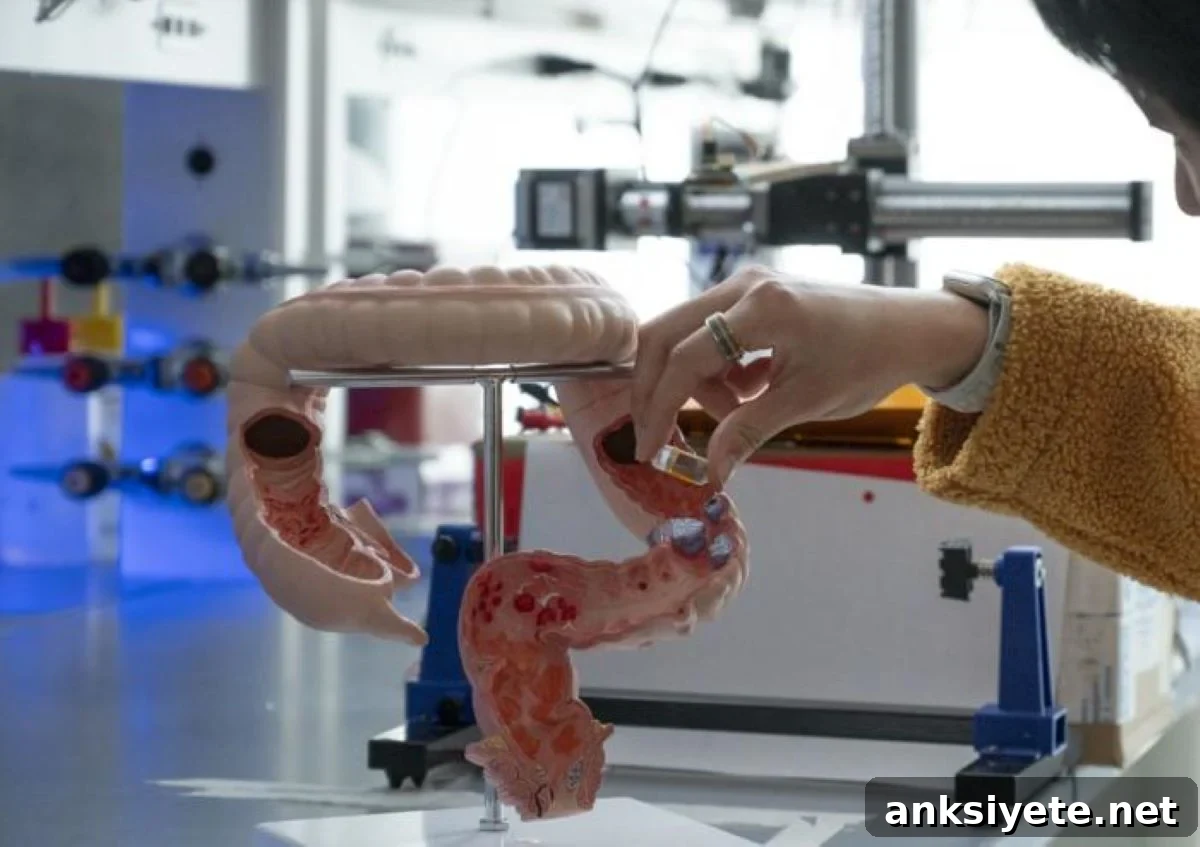
Summary: Researchers at the University of Southern California have developed an AI-driven system that tracks tiny ingestible devices designed to monitor disease markers inside the gut. This non-invasive approach could enable people to evaluate and monitor gastrointestinal (GI) health at home, reducing the need for invasive hospital procedures.
The system combines a discreet wearable coil with artificial intelligence to locate an ingestible pill to within a few millimeters and to measure concentrations of gases inside the GI tract in real time. The team plans additional refinements and preclinical testing before moving toward human trials.
Key Facts:
- AI-enabled platform localizes millimeter-scale ingestible devices in three dimensions.
- A wearable coil interacts with the capsule’s sensors, enabling real-time position tracking and gas sensing.
- Demonstrated measurements include oxygen and ammonia, with plans for further miniaturization and animal testing before human trials.
Source: Cell Press
Researchers at the University of Southern California have created an AI-powered system to track millimeter-scale ingestible devices that measure gas markers associated with gut health.
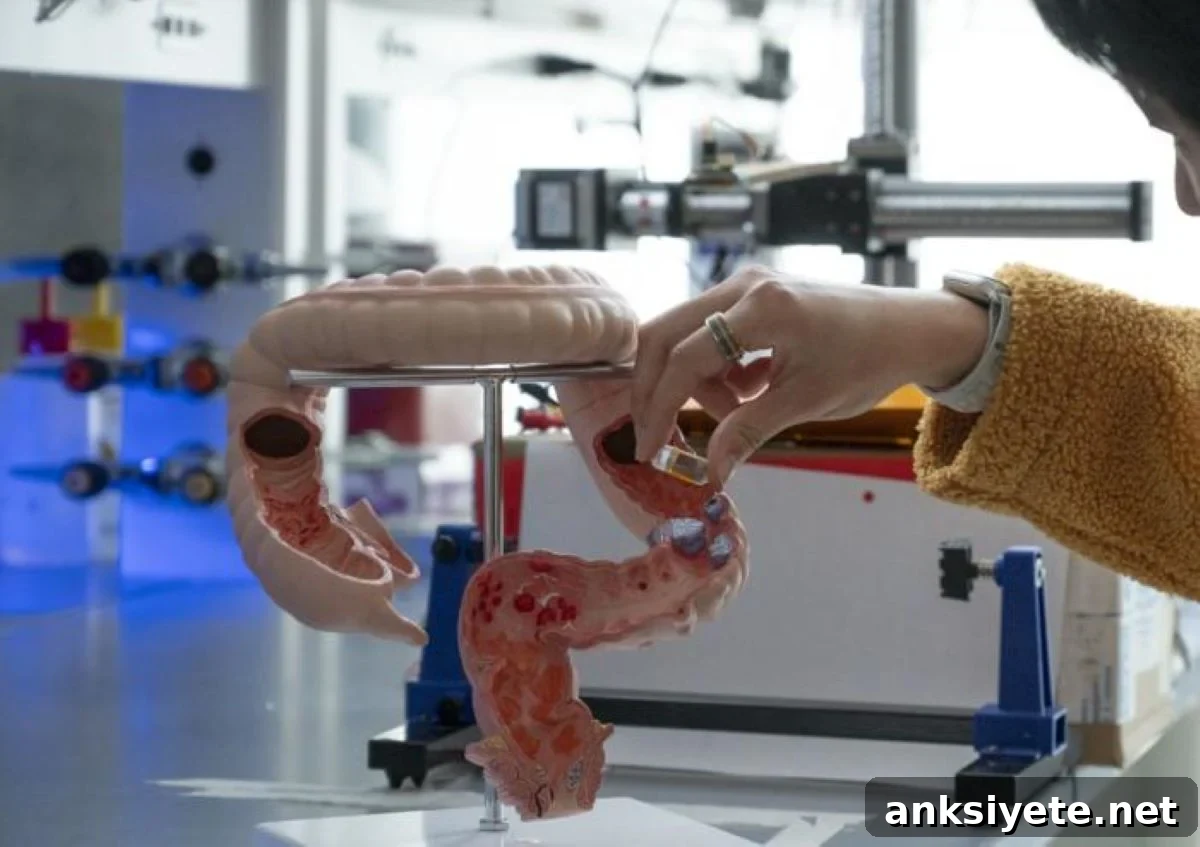
“Ingestibles are like Fitbits for the gut,” says Yasser Khan, assistant professor of electrical and computer engineering at USC. The major obstacle addressed by the team is precisely locating such devices once swallowed while also collecting meaningful gas-profile data from within the GI tract.
Gases produced by intestinal bacteria as they metabolize food can reveal important information about digestive health. Traditional gas assessment methods—such as fluid sampling, breath testing, and stool analysis—are either invasive or indirect and typically require clinic visits. Ingestible electronic capsules promise a more convenient, direct approach, but until now accurate, portable localization and reliable gas sensing remained challenging.
The USC system pairs a compact, wearable coil—thin and concealable beneath clothing—with an ingestible capsule that contains sensors and optoelectronic membranes. The coil generates a magnetic field that couples with the capsule’s internal sensors. Signals returned from this interaction are analyzed by AI algorithms that determine the capsule’s three-dimensional position to within a few millimeters.
Alongside localization, the capsule measures concentrations of oxygen and ammonia inside the GI tract. Ammonia readings can serve as a proxy for the presence of Helicobacter pylori, a bacterium associated with peptic ulcers and certain gastric cancers. The system records these measurements in real time, producing a 3D gas map of the digestive tract as the capsule moves.
Unlike earlier approaches that relied on large, stationary coils in laboratory settings, the wearable coil enables tracking in everyday environments. The researchers note potential additional uses beyond gas profiling: the same platform could help pinpoint inflamed tissue—useful in conditions such as Crohn’s disease—or act as a delivery system to release drugs at targeted locations within the gut.
Validation experiments were carried out using materials and setups that simulate human GI conditions, including a surrogate cow intestine model and fluids that mimic stomach and intestinal environments. During those tests, the ingestible demonstrated reliable localization and accurate measurement of oxygen and ammonia levels, confirming the feasibility of the approach.
Khan and colleagues acknowledge remaining engineering challenges: the capsule needs to become smaller, consume less power, and maintain robust sensing performance across variable physiological conditions. The next step is preclinical testing in pigs to evaluate safety and effectiveness in an organism with GI physiology similar to humans. Positive outcomes from those trials would support advancement to human clinical studies.
“We are optimistic about the practicality of the system and believe it will soon be applicable for use in humans,” Khan said, noting the potential for at-home GI monitoring that could transform how clinicians and patients manage digestive health.
About this Artificial Intelligence research news
Author: Kristopher Benke
Source: Cell Press
Contact: Kristopher Benke – Cell Press
Image credit: Khan Lab at USC
Original Research (open access): “3D gas mapping in the gut with AI-enabled ingestible and wearable electronics” by Yasser Khan et al., published in Cell Reports Physical Science.
Abstract
3D gas mapping in the gut with AI-enabled ingestible and wearable electronics
Highlights
- Wearable, AI-enabled millimeter-scale localization platform for ingestible devices.
- Development of an ingestible electronic pill equipped with optoelectronic gas sensors.
- Demonstrated measurements of oxygen and ammonia within physiologically relevant ranges.
- Provides a practical, non-invasive approach to assess gastrointestinal gas profiles outside clinical settings.
Summary
Accurate measurements of gastrointestinal gases support diagnosis and ongoing management of disorders such as irritable bowel syndrome, inflammatory bowel disease, and food intolerances. Existing clinical methods are often invasive or indirect. This work introduces a wearable magnetic-field-based platform that achieves 3D localization of ingestible devices with millimeter-scale accuracy—using a lookup-table approach and neural-network algorithms—and pairs that localization with optoelectronic sensing of oxygen (0%–20%) and ammonia (0–100 ppm). By enabling convenient at-home monitoring, the technology aims to empower patients and clinicians with richer, localized gas-profile data to guide diagnosis and treatment of digestive conditions.