
Summary: A fully implanted wireless neural device enabled a locked-in ALS patient to control a speech computer using only her brain activity, allowing independent communication at home.
Source: UMC Utrecht.
Researchers at UMC Utrecht have implanted a wireless brain–computer interface in a patient with advanced amyotrophic lateral sclerosis (ALS), enabling her to operate a speech computer with mental commands. After intensive calibration between the clinical team and the patient, she can now communicate from home with family and caregivers using the implant. This achievement—use of a fully implanted system in a patient’s home environment—is unique worldwide and was reported in the New England Journal of Medicine.
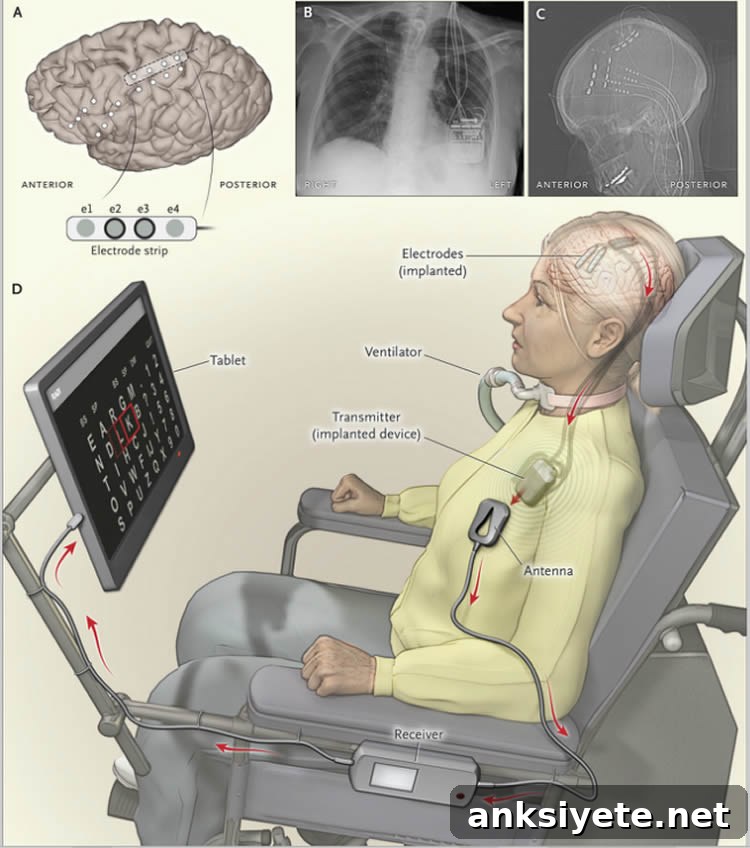
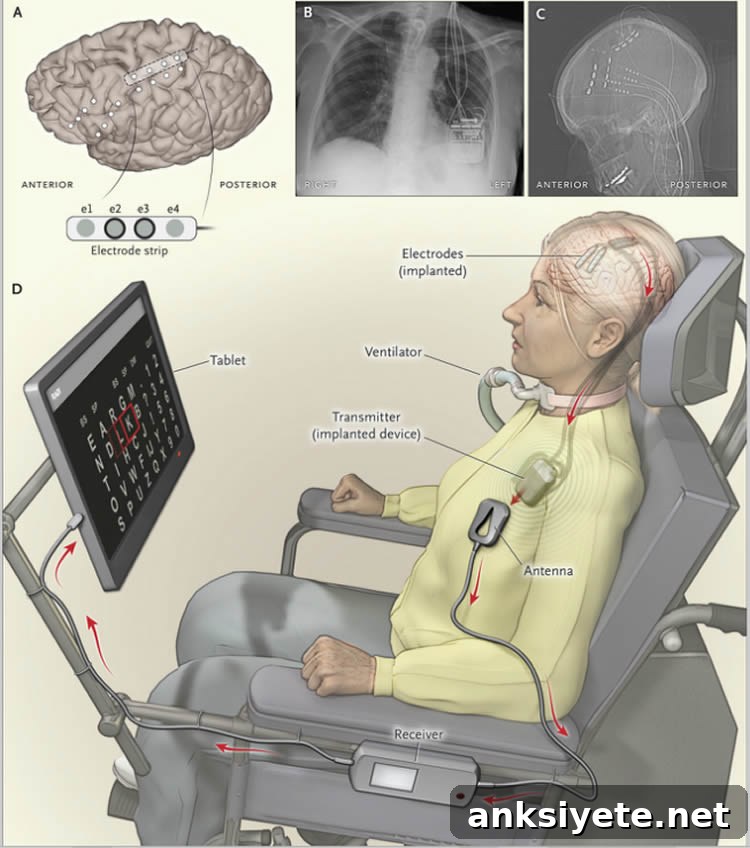
The patient, who is paralyzed by ALS and can no longer speak or move reliably, received subdural electrode strips placed over areas of her motor cortex. These electrodes detect localized brain activity linked to her intention to move. Signals from the electrodes are transmitted to a small subcutaneous transmitter implanted beneath the collarbone, which amplifies and wirelessly relays the signals to the external components that translate brain patterns into a precise “mouse click.” That click lets the patient select letters and words on a speech computer, permitting text-to-speech communication without any muscle-based input.
How the system works
The patient generates the control signal by imagining or attempting a specific movement—typically moving a hand or fingers. This intentional activity produces a measurable change in the brain signals beneath the electrodes. Algorithms convert the detected neural modulation into a discrete click event. On the tablet interface, letters and command options are highlighted sequentially; the patient triggers the click at the correct moment to choose a letter, delete characters, or select suggested words. By selecting characters one by one, she composes messages that the device vocalizes. Functionally, the implanted brain signal replaces a physical switch or button press and provides a direct communication pathway when peripheral muscles are no longer available.
Wireless and fully implanted components
During a minimally invasive procedure, thin electrode strips were positioned on the cortical surface through small openings in the skull. A compact transmitter unit was implanted subcutaneously in the chest and connected to the electrodes by short leads. The implanted transmitter receives and conditions the neural signals, then transmits them wirelessly to external receiving hardware and a tablet that runs the communication software. After surgery, the clinical team worked closely with the patient to tune device settings and train reliable neural control. Training began with simple tasks designed to teach the patient how to produce repeatable clicks, then progressed to operating the speech computer. Over time she has achieved independent use of the system at home without routine assistance from the research team.
UMC Utrecht’s Brain Center has long pursued methods to control computers via cortical signals. Earlier experiments used noninvasive caps with surface electrodes to demonstrate proof of concept. The major step reported here is the translation of that concept into a fully implanted, wireless device that a patient can use in daily life, unobtrusively and without external electrode arrays.
If the implanted system demonstrates consistent safety and efficacy in additional patients, the research team plans to expand to a larger international trial. Professor Nick Ramsey, a lead investigator, notes that these results could accelerate development of more advanced implants to restore communication for people with severe paralysis and potentially assist people with other motor disabilities such as spinal cord injury.
Funding: This work is part of the Utrecht NeuroProsthesis project carried out by the UMC Utrecht Brain Center Rudolf Magnus and was supported by the technology foundation STW. The implanted device was provided by a medical technology research and development department.
Source: UMC Utrecht.
Original research: The clinical report, “Fully Implanted Brain–Computer Interface in a Locked-In Patient with ALS,” documents the implantation, training, and performance outcomes in a patient who achieved autonomous communication using the fully implanted system. The study describes independent control of a typing program 28 weeks after electrode placement, achieving about two letters per minute and providing communication that supplemented the patient’s eye-tracking device.
Fully Implanted Brain–Computer Interface in a Locked-In Patient with ALS
Communication options for people with severe paralysis who have lost oral speech are limited. This report describes a fully implanted brain–computer interface comprising subdural electrodes over the motor cortex and a subcutaneous transmitter in the thorax. By attempting to move the hand opposite the implanted electrodes, the patient learned to control a typing program independently and accurately. Twenty-eight weeks after electrode placement she achieved communication at the rate of approximately two letters per minute. The implanted system provided autonomous communication that at times supplemented and at times replaced an eye-tracking device. (Clinical trial supported by national and European funding.)
The clinical team emphasizes the need for careful patient selection, rigorous calibration and support during the training phase. Continued research is required to refine decoding algorithms, improve communication speed, and evaluate long-term reliability and safety across more patients. This case represents an important step toward practical, implanted neural interfaces for restoring communication in patients with locked-in syndrome due to ALS or other severe neurological injuries.