
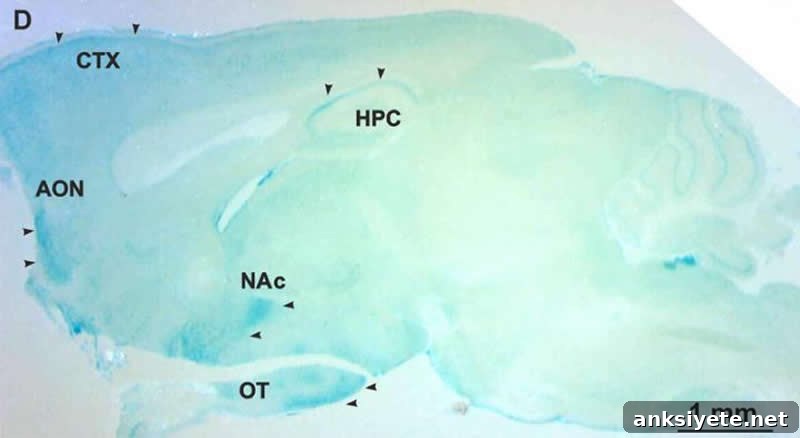
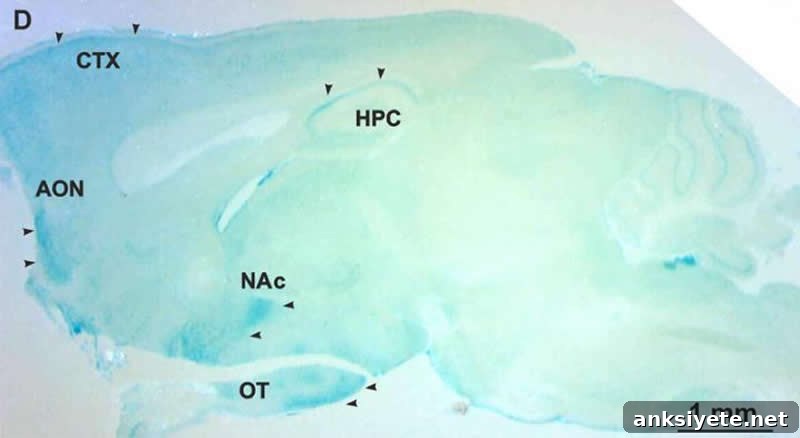
Summary: Researchers have discovered a previously unrecognized neurotransmitter pathway in the brain. Signals carrying innate olfactory information reach emotion-related regions through the trace amine-associated receptor TAAR5. These findings point to new directions for treating mood disorders and psychosis by targeting TAAR5 and related receptors.
Source: St. Petersburg State University
Neurotransmitters are chemical messengers that relay signals between neurons and from neurons to other cells. They act through specific receptors in the brain and control a wide range of biological functions, including fear, anger, pleasure, memory, energy, appetite, and sleep. Well-known neurotransmitter systems include dopamine, norepinephrine, serotonin, histamine, and glutamate, and many clinically used psychiatric medications act on these systems.
Scientists from St. Petersburg State University, collaborating with colleagues at the Istituto Italiano di Tecnologia (Genova, Italy) and the Pavlov First St Petersburg State Medical University (St. Petersburg, Russia), used genetically modified mice to investigate trace amine-associated receptors (TAARs). Their experiments reveal that TAAR5 mediates transmission of innate olfactory signals into limbic brain areas involved in emotion, identifying a novel neurotransmitter pathway centered on TAAR5.
“Trace amines are chemical relatives of classical neurotransmitters like dopamine and serotonin,” explains Professor Raul Gainetdinov. “Humans express several TAAR subtypes that detect trace amines. TAAR1 is the most studied and has generated clinical interest: drugs acting on TAAR1 are under advanced development for schizophrenia and represent a potential new class of antipsychotic agents that do not block dopamine receptors. Our group is also working on TAAR1-targeted compounds.”
Historically, receptors other than TAAR1 were thought to be limited to the olfactory system, detecting innate social odors such as those associated with decay, predators, or pheromones. Because of this, they were not generally considered promising drug targets for psychiatric disorders. To challenge that view, the researchers focused on TAAR5. They created TAAR5 knockout (TAAR5-KO) mice in which the TAAR5 gene was inactivated and replaced by a reporter. This allowed precise mapping of TAAR5 expression throughout the brain.
Mapping revealed that TAAR5 is present not only in the olfactory epithelium and the olfactory bulb but also in deeper olfactory layers and multiple limbic structures that process emotional and social information. High levels of TAAR5 expression were found in regions such as the anterior olfactory nucleus, olfactory tubercle, orbitofrontal cortex, amygdala, hippocampus, piriform and entorhinal cortices, nucleus accumbens, and several thalamic and hypothalamic nuclei.
Behaviorally, TAAR5-KO mice displayed reduced anxiety- and depression-like behaviors across several tests. These animals tolerated bright light more readily and showed reduced stress-related responses compared with control mice, resembling the effects of some antidepressant or anxiolytic treatments. Neurochemically, TAAR5 deficiency led to altered serotonin levels and changes in serotonin metabolite concentrations in multiple brain regions, suggesting that TAAR5 influences emotional state at least in part by modulating the serotonin system. TAAR5-KO mice were also more sensitive to the hypothermic effects of a serotonin 5-HT1A receptor agonist, further linking TAAR5 function to serotonergic signaling.
These results indicate that TAAR5 is not merely an “olfactory-only” receptor but provides olfactory input to limbic circuitry and helps regulate emotional behaviors. The broader implication is that other so-called “olfactory” TAARs could similarly contribute to psycho-emotional regulation, expanding the functional repertoire of the TAAR family beyond odor detection into neuromodulation of mood and affect.
Professor Gainetdinov notes the translational potential of the discovery: identifying TAAR5 antagonists that block receptor activity might produce antidepressant or anxiolytic effects. The St. Petersburg laboratory has developed screening systems for TAAR-targeted compounds and maintains a unique collection of knockout models for TAAR family members, positioning the team to pursue drug discovery for TAAR5 and related receptors. Ongoing studies of additional TAAR subtypes may reveal further therapeutic targets for schizophrenia, depression, anxiety disorders, addiction, and possibly neurodegenerative conditions where emotional regulation is affected.
Source:
St. Petersburg State University
Media Contacts:
Poina Ogorodnikova – St. Petersburg State University
Image Source:
The image is credited to SPbU.
Original Research: Open access
“Trace Amine-Associated Receptor 5 Provides Olfactory Input Into Limbic Brain Areas and Modulates Emotional Behaviors and Serotonin Transmission”. Stefano Espinoza et al. Frontiers in Molecular Neuroscience, doi: 10.3389/fnmol.2020.00018.
Abstract (summary)
Trace amine-associated receptors (TAARs) form a class of G-protein-coupled receptors. While TAAR1 is expressed broadly in the brain, other TAARs have been primarily associated with the olfactory epithelium and olfactory bulb, where they detect innate odors. This study characterizes mice lacking TAAR5 and maps TAAR5 expression using a beta-galactosidase reporter. TAAR5 is expressed in olfactory areas and in several limbic brain regions that receive olfactory input. TAAR5-deficient mice show reduced anxiety- and depression-like behaviors and altered serotonin levels and responses, indicating that TAAR5 supplies olfactory input to limbic circuitry and modulates emotional behavior, likely via serotonergic mechanisms. The findings predict that TAAR5 antagonists could have anxiolytic or antidepressant effects and suggest that TAAR-mediated olfactory circuits represent a previously underappreciated neurotransmitter system linking innate odors to emotional responses.